


Clifton Taulbert on Habits of the Heart
Key Points
-
Microdosages of unselfishness is a process, not a project. It never ever stops.
-
As adults we have longstanding opportunities and obligations to create the best world we can for the students and young people who cross our paths. These habits are not definitions to learn, they are people to become.
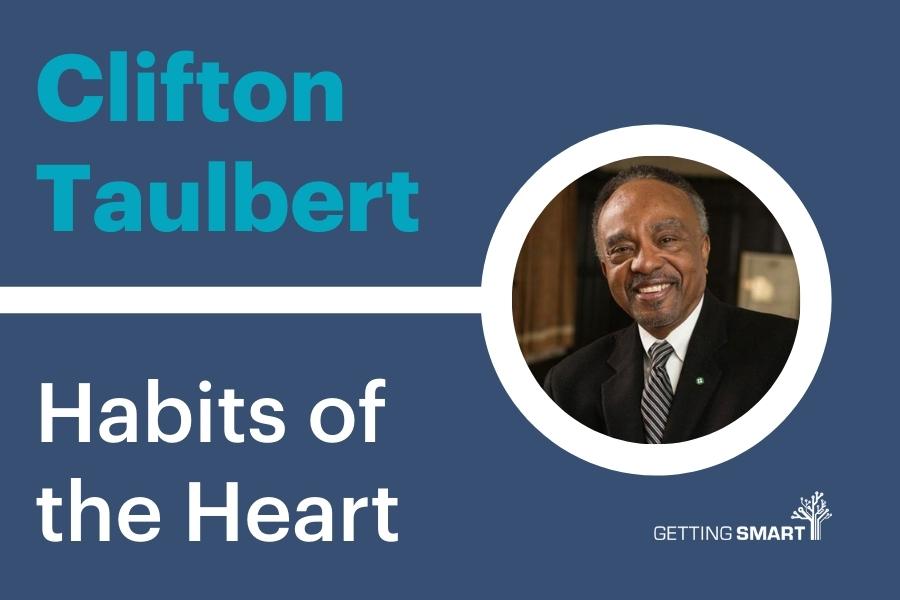
On this episode of the Getting Smart Podcast, Tom Vander Ark is joined by Clifton Taulbert, an acclaimed author, speaker and entrepreneur. His life story, Once Upon a Time When We Were Colored became a critically acclaimed 1996 movie and one of his books was sent to Nelson Mandela as a gift for his release from prison in 1990.
His most recent book, The Invitation, was chosen by the Architect of the United States Capitol as part of the 50 th anniversary celebration of the signing of the 1964 Civil Rights Legislation. Taulbert has written fourteen books in total, produced a major motion picture, and served as a consultant on several documentaries, including the Emmy-award winning Boomtown: An American Journey, which details the birth of Tulsa, Oklahoma.
If you want the bell of joy to ring, then ring the frippin’ bell!
Clifton Taulbert
Transcript
This transcript has not been edited for spelling accuracy.
Hey listeners, before we jump in today, we wanted to thank you for choosing to spend your time with us on the Getting Smart podcast. If you’re interested in more conversations and thoughts on the future of learning, be sure to check out GettingSmart.com, our regularly updated blog that highlights the most innovative schools, leaders, and practices in education.
We post every weekday and hope that you find the stories and voices inspirational. Alright, let’s get into the episode. You’re listening to the GettingSmart podcast. I’m Tom Vander Erk, and I’m joined today by Clifton Talbert. Clifton is an acclaimed author, speaker, entrepreneur.
Clifton’s life story was first told to America and the world in a book called Once Upon a Time When We Were Colored. Many of you may remember the 1996 movie made from that book, and it’s really served as the foundation of Clifton’s 13 other books. Clifton, welcome to the podcast.
Thank you. It’s my pleasure being with you. You’re joining us today from Tulsa, Oklahoma. I couldn’t figure out from your bio, Clifton, when and how you made it to Oklahoma. Oklahoma has always been that place that beckoned the young men and young women to come west,
and I think I fell into that category myself. I came to Tulsa from Washington, D.C. I had served in the United States Air Force for four years. My last two years were in the 89th presidential wing in Washington, and upon completing that, I had about two years of college left, and I got the call from Tulsa, Oklahoma.
I came here, was captivated by what I saw and have never left. Then I got a mortgage with Derek, me to leave. Clifton, folks that don’t know Tulsa well may be surprised to learn that it has a thriving black population that long ago even developed what they called a black wall street in Tulsa, a really thriving business community that made people maybe surprised to know that about an Oklahoma city.
Tulsa’s had twists and turns in terms of its race relations, right? I would say so. The territories presented an opportunity that did not exist in the states at the time. Those states that were considered, you know, firmly entrenched in the United States of America. The territory, even though it had a symbionic relationship with the rest of America,
but yet it could do things a little differently. And of course you had the land to deal with. There were many people getting free land. Things like that caused it to become a place that welcomed people who were looking to better themselves, change their lives and create a future for themselves.
And the territories seemed to be a much better place to accomplish that. Before we start out, I’ll give a shout out to Dr. Deborah Gist, Tulsa superintendent. Your neighborhood is many great school districts there. Jynx and Union are districts that we deeply appreciate. I’d love to talk about Ice House and sort of your backstory on entrepreneurship.
One of your early books was called Who Owns the Ice House? Tell us that story and why it shaped your view on entrepreneurship. No, I’m delighted to do so. Here’s one thing that’s quite interesting. The term entrepreneurship when I was growing up was not used in the Mississippi Delta,
as well I would say specifically in the Black neighborhoods. That was another word that was used that meant the same thing and carried the same amount of weight and was highly praised, really, and thought of. It was called gumption. Have you ever heard that word before? That was the word. That was our entrepreneurial portion, was called gumption.
My great uncle, Cleave, owned the Ice House. What makes that significant? It was the only Ice House in a very segregated world. If you know anything about heat, humidity, and hot sun, the Mississippi Delta is the place where all three were born and then dispensed throughout the rest of the world. It didn’t matter your ethnicity, your race, your gender, where you live, what you had, or didn’t have.
You couldn’t survive the summers in the Delta without ice. Ice was only sold at one place owned by a black man who happened to have been my great uncle. As a 13-year-old boy, I became his wingman. I learned the business and there were certain things within that that you don’t necessarily find happening in the fields of the Delta because it was a land of work that was primarily African-American and you didn’t have earning money, making money, making more.
You had a very specific assignment. Whereas at the Ice House, you had to think. You had to use your head, you had to use your brains, and you find out, I can do this. And to find my great uncle being able to maneuver, when I look back at the world in which we grew up in and recognize his great ability to be strategic, he probably never knew the word, but he was strategic in all of his action as to how to be that business that served the whole community. And upon my leaving Glen Island, Mississippi, I think everything I learned at the Ice House was packed in my little suitcase and traveled with me.
Clifton, we both appreciate the work of the Kauffman Foundation and the way they’ve worked to advance entrepreneurship across America for the last 30 years. How did the Kauffman Foundation discover you and your story of entrepreneurship and how have they supported sharing that story with people across the world? Well, it’s really interesting because prior to that part of my life, I had not heard the Kauffman Foundation, but come to find out, one of their clients, a company called the Eli company out of Ohio, had come to Tulsa to interview a number of people around entrepreneurship. And according to Gary Schoeninger, who’s found and president of that company, everyone he talked to in Tulsa said, don’t leave Tulsa without talking to Clifton Talbot.
Now, I’m not sure that’s exactly what they told him, but it sounds good to say that now. Don’t leave Tulsa without talking to Clifton. Well, we made a last minute appointment and he asked me a very poignant question. He said, you know, what sparked this idea of independence in you, this idea that you could own your own business coming from the world in which you did? I said, yes, my world was two-part. There was Uncle Cleveland Ice House and there were the cotton fields of the Delta, which my family, myself, we were basically domestic migrant field workers. And that had become the life of so many people who look like me, but that was my great uncle who was really kicking it in the field of entrepreneurship without even knowing such a word existed. He simply said, I got gumption, gumption has me, and together we’re going to make it happen. In spite of racism, in spite of legal segregation, he created a pathway for himself.
And the Carpenter Foundation heard about me through Gary Shanaga. And as a result of that, that became that introduction that continued to grow over years. And as I indicated earlier, the Carpenter Foundation sponsored was part of the group that sponsored me right in the book, Who Owns the Ice House? Clifton, we love that book. And some of the chapters in that book are ones that people that have studied entrepreneurship would expect persistence and choice and opportunity and action. But I love the fact that you called out wealth and access to capital and also community that entrepreneurship isn’t an individual act. I’d love to have you talk about the importance of access to capital and community as it relates to entrepreneurship.
You know, one of the things that’s very important and the reason community is so important is because people matter. And not only do they matter, but they matter even more when they are connected to others who matter. And that’s the one thing that entrepreneurship has the opportunity to do and maybe should really embrace that is connecting the great variety of people together in order to come up with robust solutions that might not be forthcoming otherwise, because I’m thoroughly convinced that no one set of people will have all the answers to the questions that are being asked. And so entrepreneurship gives you that opportunity to do that. And I think for me being able to look at the acquisition of wealth and being able to acquire that.
Looking at my life and from where I’ve come wealth acquisition was not something that was part of our lives. We made just enough money to live and work the next day. But then you have this one bright light in that community at least that I knew personally was my great uncle. He went to the bank. I would say 75% of the people that were my kin probably had no idea where the bank even existed because banks were not necessarily looking for people of color as depositors to make loans to them. But yet he did he knew where the bank was and that was and he took me with him. So I actually found myself going through this place that other people would pass by.
So the thing about community and wealth sort of intermingling is that if you grew up in a world where wealth was relatively easy to acquire, or there was institutions in place that looked out for you. Those partnerships are just as viable today as they could have been historically. So that’s one of the reasons why I talk about community is that never assume. In fact, I think I can say this without question. Nothing that has ever been invented, innovated abroad to life has happened because of one person. Multiple people are involved in that chain of success. We just need to make sure that that chain is more diverse than it has ever been. Yeah, amen to that.
Clifton, if you were writing a 2021 epilogue to Ice House, is there anything that you would add to that? Do you see the opportunity set better or declined in some respect? What’s your 2021 take on the state of entrepreneurship? I would say the state of entrepreneurship is very broad based, very much becoming a household word, but there are still what I call a cadre of underserved, whose mental attitudes have not been shaped by what happened in 2008 at the World Economic Forum that made a statement that I think may have really pushed entrepreneurship to the mainstream. Everyone should have an entrepreneurial experience is one of the statements that came out of the 2008 World Economic Forum. And that fell on good ears for the most part. But there were ears and there are still ears that have not heard that that conversation was for them. So that to me, how do I create an avenue of not just acceptance, but an avenue of involvement so that there will become multiple uncle Cleaves throughout our country of all genders, all ethnicities, etc.
Realize that even though the dye has been set, the dye can be changed. I love that Clifton and as I mentioned before we started recording, we’re working with Kauffman Foundation and 75 high schools in Metro Kansas City to help them implement entrepreneurial experiences for all learners. So it’s so exciting for a region to step up and make sure that every student has a work experience, every student has an opportunity to impact their community through entrepreneurship and I think it’s in part because of your work Clifton. Well, I would hope so but but who knows but one thing I will say is that entrepreneurship and the academic journey should not be separate trips. I think there’s room in the car for both. And I think that the entrepreneurial mindset is absolutely critical to help a young person understand that yes, I can.
And because that is what the entrepreneurial mindset does it allows you to go into your own imagination and embrace it and accept the possibilities that can exist. As I told the group I was speaking with in Birmingham, Alabama, several weeks ago, I said nothing that we enjoy today has come out of nothing. It is always started with the mind and imagination of someone. And then we bring that imagination to life. And we need to keep doing that, giving everybody a chance to recognize. It doesn’t matter if I’m picking cotton in the Mississippi Delta as I was, or I’m at the Hamptons having tea. It doesn’t matter what does matter is that we all have a brain. We all have a mind and when those brains and minds are not equally and wonderfully used, we’re never will know all the things we missed. Clifton were both big fans of the CAPS network. For folks that that don’t know CAPS it started as the Center for Advanced Professional Studies in the Blue Valley School District just southwest of downtown Kansas City.
It’s a great option for juniors and seniors in the Blue Valley School District to really step into professions based learning, both at the center and out in the community. The CAPS network is they open their doors to affiliates around the country and there’s now about 75 school districts that participate to try to expand access to real world learning across the country and Clifton they really they love you at CAPS and they consider you as their roving ambassador. Why do you think the program is important and what have you been doing to help more people have access to experiences like that? You know, to be quite honest with you, I never thought of this until right now. That’s why it’s so important to talk to people like you, because you lighten my thought process. You know, I was running the ice house when I was 14. Uncle Cleen had no idea that he was breaking every record of child labor law. He never got the email, never got the text. I literally was running the ice house. I was running a business five days a week, a 14 year old boy serving Washington County, Issa Queener County and part of Sharky County with ice that they needed for the fields of the Mississippi Delta.
Now, what does that have to do with CAPS? CAPS realize that you can do more when you think you can. And that’s the word that Steve Jobs said often, oftentimes, you can always do more than you think you can. And you can almost do it better than you think you can. And I think this is what CAPS realizes just because you’re not 35 years old. It doesn’t mean your brain has already atrophied or something. At 14 at 13 at 15 at 16, given the opportunity, you can make great discoveries, great innovation and think and talk about things that have world consequences. And that is what drove me to CAPS. I was absolutely amazed. It’s not the right word. I was totally knocked off of my feet when I saw some of the things that these young people were involved in, the creations that they were bringing to life. And the conversations about world issues. I’m talking about major world issues like hunger, like water. How do you solve that? And this was not like a one page paper, because she had nothing to do in 30 minutes.
And this was like research, real research, and they were doing it. And it was good stuff that could go into the mainstream to perk and peak what I would say the interest and the imagination of others. And that to me is what CAPS has done, has given us the idea that Uncle Cleave was onto something when he was back in Glen Island, Mississippi by hiring me at 14 to run the ice house. I could be a foreshadowing of CAPS. Who knows? Well, I appreciate your support for CAPS. You were a big hit offering the keynote there recently. And we appreciate your support for all those affiliates across the country. We’ll include a link to the CAPS network in our show notes. Clifton, your latest book is called The Invitation. We loved a chapter called Standing Alone Surrounded by History. I’d love to have you explain what that phrase means, standing alone and surrounded by history. You know, that book was probably my heart, my tears, my sadness, my joy, my expectations, my dreams all rolled up into one. It gave me an opportunity to honestly look at the world in which I live, the world that I came from, and the world that I could have the opportunity to have built.
And in that particular chapter, I happened to have been at a place that was an 18th century mansion, Southern mansion in Allendale, South Carolina, and I was truly surrounded by yesterday. But even though I was surrounded by yesterday, the lady who was the matriarch of the home was, you know, was pretty close to me and I’m being 100 years old. She had lived an incredible life at an incredible time, but she had come from a world of slave owners. She had come from a world of wealth that was built on the cotton industry primarily. But on those winding days of her life, I’ll pass cross and accidentally, purposely, but they pass. They pass, I’ll pass cross. And in the process of our paths crossing, I found myself surrounded by the history of my life because nothing had really significantly changed.
Even the furniture, there was only one room in the house that spoke of the 20th century. And certainly the 21st was trying to barge its way in. But the 19th century was there. The 18th century was still there. And the grounds were there. The cotton fields were still there growing cotton. It was all there as if the world had never changed. But yet in the midst of that reality, I was given an opportunity to see that the past does not have to always be your present. Clifton, you really brought that spirit forward into eight habits and then eight habits of the heart for educators.
I think those two books really for you unpacked some of the things that you learned writing once upon a time when we were colored. Is that fair? I would say that’s very fair and very well stated and thank you for saying so. I’d love to dive into some of those habits and just have you reflect on what they mean for education. I love how you start by nurturing attitude. Clifton, I’m reminded that my kids grew up every morning. The first thing they would see when they stepped into their bathroom, they’d say,
big A on the mirror for attitude. And I think I was trying to nurture attitude. And so I love the fact that you start with that of being conscious of your attitude and actually being proactive about how you shape it. Is that something we should be doing more at school of helping young people build a positive proactive attitude? You know, I would agree wholeheartedly. I just spoke to a group of educators in Birmingham, Alabama, several weeks ago. And that was the thrust of my conversation is that as adults, we have a long standing opportunity and obligation to create the best world we can for the students and the young people who cross our path.
And we can do that. And for me, the eight habits of the heart were the people. You know, I tell us that these habits are not definitions to learn. They are people to become. When we started our conversation this morning, the joy in your face was not because you were having this opportunity to talk with me. The joy was you were spending time with your grandkids. And that’s what we’re talking about time. Nurturing attitude comes to life because we understand the value of time. As I tell people around the world, we’ve never going to get 2810. All we have is 24 seven. So we have to use it the best we can.
Nurturing attitude speaks to the unselfish use of time. And my great grandfather and great grandmother who raised me up until they passed away. They were the purveyors of unselfish use of time. And I can distinctly remember Saturday mornings, I’ll be sitting on the front steps with my knees pulled up to my chin, looking as far as my eyes could pierce the southern side of the world. And all I could see was the same thing that I’d already seen the cotton fields of the Delta. But my great grandfather, a smart man, a futuristic futuristic man, he would come out of the front room, open the screen door that scratched on the wood. You could hear it scratch opening in the door. And he would say, Clifton, do you want to go to Greenville? Greenville is just a small town, but it was called the Queen City of the Delta 27 miles away. But a guy who did a story with me, Paul Gallo in Chicago, to be on set for young Cliff Talbot to go 27 miles to Greenville was tantamount to taking the Concorde to Paris,
France. My grandpa probably never heard of Paris, France, but he heard of Greenville. And for him, it was Paris, France. And it was a view that he knew his great grandson needed to see. And that is what nurturing attitude is all about. It’s about letting the needs of others dictate how you use time. Clifton, I worry a lot about spreading inequality. It seems like the pandemic climate change, the rise of technology have all increased the amount of inequity in our society. And when I read eight habits, it, it concludes with high expectations, courage and hope. How do we keep courage and hope alive in schools and in communities where the inequity around us seems seems to be expanding, not not contracting.
Conversations, podcasts, conversations on the bus on the school talking with your friends talking with your kids. We can’t assume that this assimilation of what is good will just happen, because we’re on the same planet, we know better. But we know that we have to be intentional about this. Nothing happens if one is not intentional. If you want the bell of joy to ring, ring the flipping bell. You can’t just wish it to ring. It has to be something that one does. And that’s the same for me. My wife and I have one son, and he’s an adult. But as a dad, I told him one day, he said, Dad, you call me all the time.
Don’t you get tired? I said, you were Marshall. I forgot to tell you, I didn’t cut the umbilical cord. Oops. I said, we’re still connected. As a father and a son as a parent, that will always be my responsibility to share the life lessons that I learned. I’ll call my son in LA. And he said, am I getting ready to hear another Mississippi story? I said, yep, you are. Because I want him to know the world that created me, because they told me the world that created them. And them were told the world that created them. The stories of who we are serves as the social umbilical cord to the rest of our lives. And when those stories are cut short, the umbilical cord that gives a life of promise is cut short as well.
That’s beautiful, Clifton. We really are the stories we tell ourselves. I appreciate your commitment to sharing your story. Let me push one more time on this and just get a sense of what would schools look like. I wonder if you have an example that you’ve seen or that you can imagine of a school that was filled with high expectations, courage and hope. You know, I’ve had the great opportunity of working with the Lace Academy out of St. Louis, the University of Missouri with Dr. Harvin Berkowitz and his team, and over five years now. And I teach the eight habits of the heart as people to become. I try and help the educators to understand that that to me is the, in addition to delivering and leveraging their knowledge for the benefit of the student, they also bring themselves to the table. But many times educators are not fully aware of the fact that their presence is just as viable to the learning process of the student as the math science and everything else being taught.
And so the idea of a habit being this reflection of who we are, the unselfishness, because that’s what the habits of the heart represent. Microdosages of unselfishness delivered to others on a daily basis consistently is a process, not a project. It never, ever stops. And this is what I try and help educators understand that in addition to all the great work you do in the field of academia, the curriculums that you design, the books that you bring to the deal, there will be no book greater red than your presence. That’s the book that will be remembered. Those are the pages that students see. Those are the stories that they will tell their children. Most time, I know now when I talk about my teachers, I know them all by name and talk to my son, I said, well, where dad, why do you like Miss Johnny may Rob Miss Johnny may Harris.
That’s because she made me learn the poem if I remember that. But more importantly, she was so glad I was at school, and so delighted to see me. And you know, I want educators to understand that their delight can be translated into a transformational process for a student who does not feel welcome. Clifton, Talbert, your, your life story, your career, your books have just been an inspiration for all of us. We really appreciate you’ve been on the Getting Smart podcast today. Well, sir, it’s been my pleasure. I know you have choices and I know you could have found someone else, but I do appreciate the opportunity to just continue to say thank you to the people who made my life what it is. Thank you, Clifton. And thanks to the Getting Smart team that makes this podcast possible, especially our creative director and poet laureate, Mason Pasha. Everybody out there, keep learning and keep innovating for equity. Thanks for tuning into the Getting Smart podcast today. We want this podcast to be actionable and insightful and a great way to learn about what’s next in learning.
In order to stay on the cutting edge, we need people in the field to tell us what they’re hearing, what they’re wanting, and what they’re needing to learn more about. Got a topic or a guest in mind? Send your recommendations to me, Mason at GettingSmart.com, and if you like what you’re hearing, don’t forget to leave a review in Apple Podcasts or subscribe wherever you listen. Feel free to share the podcast on social media using the hashtag GSPodcasts. Thanks so much. .





0 Comments
Leave a Comment
Your email address will not be published. All fields are required.