

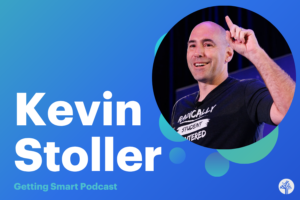
Catching Up: Early Reading, Cognitive Luxury, and Monarch Butterflies
Key Points
-
Early reading development is influenced by home environment and brain pathways that begin forming at birth, emphasizing the importance of early intervention.
-
AI tools in education, like YouTube’s new personalized learning features, are reshaping how students engage with content, but privacy and ethical concerns must be addressed.
Shownotes





In the latest episode of the Getting Smart Podcast, Nate McClennen and Mason Pashia dive into a dynamic mix of topics shaping the future of learning and beyond. From exploring early reading development and its ties to brain pathways, to addressing the ethical concerns around AI and student surveillance, this episode balances critical education insights with thought-provoking discussions. The hosts also delve into the concept of “cognitive luxury,” emphasizing the importance of creating space for deep, free, and slow thinking in today’s fast-paced world. Wrapping up with the awe-inspiring migration of monarch butterflies and their remarkable precision, this episode offers a unique blend of education, innovation, and human connection. Tune in to explore how these themes intersect and inspire a brighter future for learners everywhere.
Outline
- (00:00) Youth Perspectives on AI and Surveillance
- (05:17) Early Reading Development and Brain Pathways
- (10:24) Gifted and Talented Programs: Rethinking Early Testing
- (16:06) Cognitive Luxury: Spaciousness, Agency, and Depth
- (24:55) YouTube as an Educational Ecosystem
- (36:15) Monarch Butterflies and Human Connection
- (42:08) What’s That Song?
Youth Perspectives on AI and Surveillance
Nate McClennen: Mason, how’s it going?
Mason Pashia: It’s great. It’s good to see you. It’s been too long.
Nate McClennen: It’s been too long, and it’s really good to catch up. I am excited to talk about today—a bunch of different things. I’m going to throw a few things at you around early reading and precursors to reading, some research on gifted and talented programs, which I’ve long been fascinated with. Then we’re going to do a deep dive on cognitive luxury.
I’m not going to elaborate on that. I’m just going to leave that hanging—cognitive luxury. And then we’re going to end with something about monarch butterflies. I mean, what a beautiful sandwich of a podcast I presented for you. What do you got for me?
Mason Pashia: That is beautiful. I’ll talk a little bit about youth perspectives on AI and a recent lawsuit around surveillance. I’ll also talk a little bit about YouTube. It’s a new app I think you’re all going to hear about pretty soon.
Nate McClennen: I’m interested to learn.
Mason Pashia: There’s some cool stuff going on there. So we’ll talk about YouTube and tearing your food and how—
Nate McClennen: I mean, monarch butterflies and tearing your food. Everybody, stay tuned. We’ve got a good episode for you today.
It’s a list, it’s a twist of hearts breaking, hands raised, and a world in its ha—
It’s a tale I—
Nate McClennen: Hey, Mason. Excited to catch up today. Yeah, it’s been a while. I think—I don’t know what’s happened in our world. I feel like we’ve all gotten busy. You have house-moving stuff. I have been traveling a lot, and work is just busy. It’s good. It’s exciting. We’ve been working on the framework, and you and I have been noodling on this platform.
We’ve got a prototype up about how to really coordinate the system around system transformation. So, a lot of exciting stuff.
Mason Pashia: Super exciting. I know, I know. It’s been a while because my dad texted me this morning and said, “When’s the next episode of Catching Up?” which is my litmus test for when we’ve gone too long without a drop.
Nate McClennen: I’ve got at least a million tweets saying, “Hey, we need another episode,” because we have a lot of followers, and they’re eager. So, I’m hoping this will be a good one.
Mason Pashia: Yeah, for sure. For sure. Well, it’s great to see you. Welcome home, at least for a little while.
Nate McClennen: Yeah, yeah. No, thanks. Well, I’ve got a few openers today. I’m going to start with one, and maybe we’ll ping-pong back and forth. I’ve got a good song at the end that I think you might like—we’ll see—and we’ll go from there. So, if you’re listening, everybody, remember there’s a song at the end, and you’ve got to listen to the whole thing to get the gift of the song at the end.
So, we’ve been collecting all sorts of interesting news, and I wanted to start with this idea about reading and brain development. There are all sorts of interesting things about learning to read, and it’s a critical skill for young humans as they grow.
There’s all sorts of influence—how many books are at home, what your parents or caregiver read to you—and there are all sorts of challenges with that, of course, depending on the situation at home. But we know that the brain is changing as young people learn how to read, and new research has shown this idea that when they do MRIs and look at brain development, the precursors to reading start at birth. Those pathways are starting. Even though they know nothing about reading, there are some fundamental building blocks that, when tracked back, show that a child who learns to read in, say, first or second grade already had those building blocks starting at birth.
The second part of that that’s interesting is that the signs of reading challenges can emerge as early as 18 months old if we have those indicators. We’re not putting kids through MRIs a lot, and we’re not doing brain scans, but it does make me think about the study and this idea of academic skill acquisition. It’s emergent—meaning it’s a pre-reading skill that you might not even know about. It might be verbalizing or recognizing a symbol or whatever the case may be. Early identification for kids who struggle might hold some promise. It’s just interesting because reading is so important to understanding and long-term success.
Mason Pashia: That’s really interesting. Have they detected similar pathways in other creatures?
Nate McClennen: This was about reading and brain development, and not many other creatures that we know of know how to read, so that wasn’t included in the study. But—
Mason Pashia: Just like signal recognition, though. If reading is actually like a recognition of patterns and symbols over time, or whatever that looks like in the brain—
Nate McClennen: Yeah, I was thinking about bird calls or whale sounds or things like that. Even just early stages of communication. Something came up in my feed the other day—this is really crazy, and I didn’t dig deep into it—but birds will signal, like flying and flocking birds will communicate with other birds that there are wind turbines ahead. There’s some signaling system so they don’t crash into a wind turbine. But then I was thinking, well, you’re right. The brains of those other animals—they have some sort of pre-development, I imagine, about processing communication in some way. So, a topic for another time. Anyway, that was just reading and brain development. What do you have for me? Ping-pong to you.
Early Reading Development and Brain Pathways
Mason Pashia: So, something that I saw a couple of weeks ago that struck me as a signal of what’s to come—we talked about Alvis School on the last episode of this and kind of this new AI monitoring world that we’re in.
The Lawrence School District has filed a lawsuit against a software called Gaggle, which is an AI tool. Basically, they’re saying that it is infringing upon their privacy rights as students. It is scanning all of the Google Workspace of the students for safety risks, for good reasons like self-harm, violence, etc. But the students are saying that it violates their First and Fourth Amendment rights. I think this is a really interesting case. There’s going to be more like it as all these tools are crawling, essentially, everybody’s personal information. It’s just really interesting to think about how so many of these tools only work if they’re given that amount of access. If we’re reticent to give them the access, the tools kind of lose their efficacy—or at least a big part of it. It just got me thinking about personalization, surveillance, and some of these other things I know we’re just going to see a lot more of in the next 12 to 18 months.
Nate McClennen: Yeah, that’s super interesting. I was listening to Hard Fork this morning, and they were talking about AI robotics and a new robot called Neo. That robot is basically going to do household tasks—that’s where they’re trying to work on it. The big challenge in physical robotics is there’s not enough data out there. With an LLM like ChatGPT, they can scrape the web, and that’s all the data. They can use that to do probability models, to predict, to create all these wonderful things that ChatGPT can do. But with physical robotics, they don’t have enough real-world situations.
What they’re doing is, they actually have—it can do some automated things, like 95% of the time it can close a door. This is a humanoid robot, right? So, it looks like a C-3PO or something, but it’s covered in fabric, so it’s soft. It’s really interesting.
Mason Pashia: It doesn’t have a face?
Nate McClennen: Right. Okay. Yeah, I don’t know why they wouldn’t make a face, but maybe that’s hard. It feels a little bizarre. Maybe you listened to the same Hard Fork, but for our listeners, the idea is that what can happen is it can do some automated things. But they also have all these AI humans that are driving them around the house to watch them because they want to have them do and practice certain things, but they’re just humans driving them.
The big question came up in the podcast: is it listening all the time? What happens? Is it going to be watching? So, if my teenage kid comes in and they’ve been out doing something not appropriate and they’re talking about it, will the robot snitch to the parent? Is there a snitch bot version of it? It goes back to this privacy thing—they’re collecting massive amounts of data with this. Who owns it? They’re using it to feed and make their system better.
It’s the exact same with what you’re talking about in Kansas. Yes, we can hyper-personalize it. If AI has all the data of a student, it actually will be better at teaching that student. But then you have this privacy and invasion of privacy issues. What do you think? Is it going to be a dealbreaker or not—or unknown?
Mason Pashia: I mean, the district is not using the tool anymore, so the students at least had that small success. I think we have a really interesting confluence of people who have never been more worried about mental health. So, they’re always going to be trying more and more to understand what students are thinking, going through, and getting early signs. At the same time, we have a bunch of students who, in various ways—my other story is a little bit about this too—are kind of rejecting AI at some level. They’re like, “I don’t know. We don’t know enough about this. It doesn’t totally help me.” People are using it, but I don’t think it has the—it’s not the silver bullet that I think a lot of us are led to believe.
My third thought is just that if we start seeing washing machines as a part of the Google capture, we’ll know that Google is about to build a humanoid helper robot. That’s like all the training data for self-driving cars—motorcycles, buses, stop signs. I think they’re going to start coming into the appliance world soon.
Nate McClennen: That is really interesting. It’s like a canary in a coal mine kind of thing. It’s like a precursor. Apparently, they didn’t do the cat that got hit by a Waymo car, which was problematic because it was a well-loved cat, and that was sad. But yeah, I think there’s something interesting here. I think the rest of the world outside of schools—there’s going to be a lot of AI. Already, if we think about our own media, our use on the internet, we have massive amounts of data that’s been captured from us. But we’re much more careful, rightfully so, with young people. How will that impact? We’re seeing the pushback against Alpha, right? There were some more articles that came out as you and I are trying to write that blog post. It’s pushing back on how much surveillance should be done of young people and what that looks like, etc., etc., etc.
Mason Pashia: Yeah. Super interesting. Something to keep an eye on for sure. I’m sure we’ll see a lot more of them. What else do you have for me, Nate?
Gifted and Talented Programs: Rethinking Early Testing
Nate McClennen: Another short news item that came up was about gifted and talented programs—G&T. In public systems in the United States, and sometimes in private systems, there is a testing protocol to test into a gifted and talented program. I’ve long been an opponent of this. I think personalized learning should be the antidote to testing in. My theory, prior to reading this article, was just that students are growing and developing at all sorts of rates and speeds. If you test in—typically between first and third grade—you’re in the program. Once you’re in, there’s rarely retesting, and you’re sort of in this program for a long, long time, especially through upper elementary and early middle school, until you get to high school. In traditional schools, you can branch out with honors courses and things like that.
This research article, originally written in 74 Million, highlights some key findings. They were tracking students in a longitudinal study—watching for 10 to 15 years. They found that students identified as having high levels of cognitive abilities in the early years—and thus presumably qualifying for gifted and talented programs—only 16% of those children remained “high” at age 16. That’s a pretty revealing piece. Parental education and socioeconomic status all increase ability as kids get older, playing more and more of a role. But when they’re younger, they use this idea of cognitive mobility—kids are all over the place. There’s real danger in having these prescriptive ages, like second grade, for G&T testing. Those kids get all this extra cool stuff, while a kid who gets to third grade and suddenly has this blossoming in their brain misses out.
To me, it goes back to why we’re so bullish on personalized learning. When you have personalized learning, it shouldn’t matter. You shouldn’t have to have a test. I just thought it was interesting, and I like seeing research that really pushes back on norms in our systems.
Mason Pashia: Yeah, I was in that program growing up. I think I tested in, in first grade. The program was great. The test, actually, for me—I had to build a project, and it got sent to the president. I got a note back from George W. Bush and their dog at the time.
Nate McClennen: Wait, what was the project?
Mason Pashia: It was right after 9/11 happened, and that’s my birthday. So, I was additionally affected as a young kid being like, “This is so sad, and also I’m so sad.” I built this thing called the Tower of Peace, which was to sit on the site where that happened. It had this big spiral in the middle that just had artwork on it that people had made. It was always spinning and always changing the art. It was sort of like a park urban design project. That was my project, and then there was a little report alongside it on why we need this at this time.
Nate McClennen: What grade were you in?
Mason Pashia: First.
Nate McClennen: Oh, you did it in first grade? Okay.
Mason Pashia: Yeah, yeah. It was a formative learning experience.
Nate McClennen: Well, from the research, it appears that we may be missing those who can build other magnificent sculptures and things like that.
Mason Pashia: I have no doubt about that. Good flag, and that’s a great thing to dig into.
Cognitive Luxury: Spaciousness, Agency, and Depth
Nate McClennen: All right. Let’s go deep dive. We’ve got some big deep dives. I’m going to start us off. This is a blog post that got me thinking from Nest Labs. Thanks to Victoria on our team for sharing this with us through our Slack channels. It really got me thinking. The article was around cognitive luxury—thinking as a luxury good.
They talk about three different things that are getting harder and harder in our world. That’s because of AI, social media, or just our ability to put significant attention on something and think deeply. The blog post breaks it into three different things: thinking as a luxury good.
The first is spaciousness—thinking slowly. How do you give yourself space to not have constant input coming in? Someone the other day talked about “mainlining news,” like you’re mainlining media—it’s just coming in relentlessly. The first cognitive luxury element is spaciousness. How do you think slowly when you can take time to do that? As I told my kids all the time when they said they were bored, I would tell them that boredom is the crucible of creativity. They would be like, “Dad, stop saying that.” But this is about spaciousness. When we give ourselves time to stop and think slowly, good things happen.
The second is agency—thinking freely. The ability to create rather than just consume. Creation over consumption. Like your first-grade project—the sculpture tower that you built—that’s incredible creativity. But more and more, we’re consuming. We have to actually resist that and make sure we’re developing agency to think for ourselves. That ties into some of the conversations around media that we’ve had. When there’s more and more media blasting at us, it takes away our agency to think and come to our own conclusions because our minds are being filled with all sorts of ideas.
The third is depth—thinking deeply. The ability to engage fully with challenging ideas. What does that mean? That might mean reading an entire book and wrestling with those ideas. What a concept—reading a full book. I even find that when I read books now, I’m reading fast. I’ve always been someone who reads fast, and sometimes I skip things and miss nuances—that’s just the way my brain works. But I’m finding I’m doing it quicker now. I’m less patient with things than I used to be.
So, spaciousness, agency, and depth. This article was generally talking about how we need more of this in our lives because it’s going to get harder and harder to find these cognitive luxuries. That made me think, for our podcast here, where does that happen in schools?
So, in the spaciousness part, I think of things like nature-based preschools, where kids are outside a lot. Experiential education opportunities, where students go out into the world and explore—explore an urban ecosystem or explore a wild ecosystem. Even sometimes meditation. There are some schools that will start with deep breathing exercises—things for spaciousness. That’s an area I think about. As I go through these, I’m going to prompt you at the end to say, where else does this show up in schools? Because I couldn’t come up with a lot of it.
For agency, this one was easier for me because we talk a lot about learner-centered schools, personalized schools, competency-based practices, student-run enterprises—places where we’re giving responsibility for learning back to the learner. There are a lot of examples of that. It’s still not mainstream, but there are a lot of examples.
And then depth. I was at an IB school for many years, and IB has this thing called the extended essay, which you do through 11th and 12th grade. It’s a deep dive into a singular topic that you’re interested in, and then you write a big 10,000-word essay, or whatever the case is, and do a presentation and a defense. We also did thesis defenses, much like graduate school. We would do those for high schoolers as well. Things like Genius Hour, where students were diving in and researching things they really love, and capstone projects. At the school I was in for a while, we had capstone projects at second grade, fifth grade, eighth grade, 10th grade, and 12th grade, where students would choose something they were interested in and go through a process to really dive deep.
Schools do this. Systems do this. But I actually think we need to be way more intentional. So, after this long preamble, where else do we see spaciousness, agency, and depth in schools that you think could be helpful for us to talk about?
Mason Pashia: Ooh, it is hard to think of. The first thing that comes to mind for me for spaciousness is actually more like physical activity. Like, on runs is often when I have my best thoughts—if I’m not listening to something. I’m thinking of cross country, like these other places where you’re kind of using your body in a different way than trying to retain information. I do think it distills down to something about directionality. I’ve noticed in my own life, if I want to have a productive creative writing week—not for Getting Smart purposes—if I listen to no podcasts, I write much better. But for the kind of stuff that we write for Getting Smart, if I stop listening to the news, I have fewer things colliding with each other and making me think differently.
So, it’s totally a different—I guess it’s a different end. Something in there is like the directionality of what you’re doing matters. I would say physical activity is one for sure. I’ve always found there to be a—this is sort of an abstract response to this—but I’ve always found if I had an interdisciplinary experience, like if I was learning about something in one class and then another class talked about it, and I could see how they could connect, it was almost like I had a third class where I could just do all of my own thinking. I could be like, “Oh, this is really interesting.” That doesn’t feel like it’s facilitated by the school, but it is not inherently a space or a class within the school. It’s kind of this space that we make for ourselves, which can lead to depth and can be agency. But I actually think it resonated more for me as spaciousness. It was like free thinking a little bit more. I got to find the boundaries of where I thought that started and where that ended.
Nate McClennen: Yeah, I like that idea of the exercise piece. I just think of, generally, where different parts of our brain turn on. Same for me—if I’m out for a run or working out in the morning, or whatever the case may be, when I’m not thinking about work, that’s when some of my best ideas come. I actually have to have a piece of paper nearby because I have to write these things down. I think I need to do that experiment with no podcasts because I do listen to podcasts when I work out, and that’s where I get some interesting ideas too. But I definitely have a lot of input all the time.
Mason Pashia: No, you’ve got to carve it out. There are some times where it falls flat for me, where I’m like, “This is a day where I don’t want to listen to anything,” and I’m like, “Man, I just don’t have any good ideas right now.” But I actually think you can consume in a creative way too. When I’m thinking about something and I’m starting to put together the pieces, it almost feels like consumption in that direction is creation. It’s curation at that point, but it does start to feel less like something that you’re consuming and more like something that ultimately is being stacked in a new direction. So, I don’t know. I think all these are a little bit nuanced, but they are fundamentally critical to having new, original ideas, which I think we’re all pretty passionate about.
Nate McClennen: It’s like that sequence we talked about—I think we talked about this before in a past episode—but this idea of, we’re all consuming, but the superpowers will be around how do you curate from that consumption, and then how do you create from that curation? The consume-to-curate-to-create sequence is really, really important. Of course, many schools are just on the consume side rather than on the curate and create side.
Mason Pashia: Totally. I love when, in the spaciousness feeling, something that you consumed months ago that you felt like had no resonance comes back up as this thing that’s really—like you don’t know it’s sticky necessarily until you’re kind of alone with yourself. You’re like, “Oh, this is fascinating that I’m still thinking about this weird data point that I read.” Super cool.
Shorts Content
YouTube as an Educational Ecosystem
Mason Pashia: So, mine’s kind of random this week, but I promise you it’s a little bit related. You and I had the chance to sit down with someone from Google a few weeks ago, and afterward, my brain was just kind of spinning on the scale at which they’re implementing things. It’s just like—we’re thinking about numbers all the time, but when you hear someone like a Google product manager thinking about numbers, it’s just a whole other planet of size and scale.
This got me thinking about YouTube, which I’ve heard Tom say for a long time is arguably one of the most important innovations to education that’s ever happened. I always think that’s really catchy—true of my experience in some ways—but also, I was like, how true is that? So, I looked into YouTube a little bit, and I promise I’ll make this not just like a lesson on YouTube by the end.
Nate McClennen: It’s okay. I need to learn something.
Mason Pashia: Yeah, no, I’m going to throw a bunch of numbers at you. So, YouTube started in 2007. As of 2024, there are over 2.7 billion monthly active users. These are unique users, so that’s 2.7 billion accounts. More recent numbers say it’s more like 2 billion users a day. There’s a lot of recurring users, but I want to put this into perspective for a second. There are approximately 74 million school-aged children in the United States. If you extrapolate that further, there are approximately 2.6 billion people under 20 in the entire world. Analogously, YouTube and people under 20 are the same number, which is crazy because that almost represents the entirety of our education system as just this one tech platform that people are going to.
It’s true that YouTube has a super wide range of content. It’s not all educational—not even close. But over 500 hours of video are uploaded every minute. According to this media research firm, which is a great firm on the creator economy, they say that the number of creators is set to surge by 76% to 1.1 billion creators by 2032. When you’re thinking about supply and demand questions—which you and I always are—we have this arguable number of creators, which I’m going to kind of use as synonymous with teachers for now, to 1.1 billion teachers by 2032 on this digital platform. At the same time, you have 2.6 billion users, which is going to just continue to grow by 2032 as well.
These numbers just—continuing to look through this lens at what we can learn from YouTube as an education ecosystem and learning experience designers—it was just kind of in the back of my head as I kept digging in. That’s kind of the tip of the iceberg in terms of the impacts of YouTube. They obviously have their YouTube TV; they have all these other places where they’re dialing in. But I wanted to talk briefly about the algorithm, which I think YouTube is really uniquely good at. Their algorithm is still voted as one of the best and kind of scary.
If you haven’t ever checked out the New York Times podcast The Rabbit Hole with Kevin Roose, who is one of the Hard Fork co-hosts, it’s a really interesting study of what that can do. The way that the algorithm works is essentially: a video is published, and they just show it randomly to a few people. I’m sure if you’re a YouTube user, you’ve seen in your sidebar a bunch of videos with 5 million views, and then there’s one that has like 73. You’re like, “How am I seeing this video?” They’re basically testing if the video is going to be catchy, and if you’re going to watch it. Then, based on that performance, if people are sticking with the video, they start widening it out. They widen it out until it eventually hits a threshold. Maybe this video has gotten 15,000 views, and not as many people are watching it anymore. It’s kind of like a wildfire, right? There’s no more fuel at the edge, and it’s just kind of burning. But it still burns—the video is still there—because Google also owns our avenues for how we find content, at least for now. This feeds a lot of what we find and how we see it and what’s summarized in a Gemini summary.
It’s this really interesting algorithm that has been very effective at finding the most users and really just sticking around for a long time. I’m always struck by this. This weekend, I had to fix a latch because my car seat stopped going down. The video had 1.1 million views, and it’s just fixing this very niche latch in the backseat of my car. I think there’s something super interesting to this self-directed learning of YouTube where you’re not really looking up something unless you’re about to do it—unless you’re, I guess, just vaguely curious about backseat latches.
All of this is sort of where YouTube has been and where it is today. The reason this came up this week for me is last week—or maybe a month ago, but I noticed it last week-ish—they quietly rolled out an “ask” feature to non-business YouTube accounts. Now, if you are not on your business email and you’re watching a YouTube video, right below it, next to the share button, is the little Gemini icon. You can ask questions about the video. You’re interfacing in real time. It knows everything that’s in the video, and it knows everything that’s in Google. You can just ask it questions as you’re going and basically self-pace your learning.
I tried it with some stuff like music theory, which has always been elusive to me. I was like, “Can you explain that to me differently?” While it paused the video, it told me in a different way. Then I was like, “Okay, I understand. Keep going,” which is a really interesting move toward personalized engagement. One has to think it’s primarily a play toward education. That’s not super useful if you’re watching primarily entertaining content. That really struck me—that it was so quiet. It’s also building on top of this kind of educational giant that has always just been sitting in the background as this huge disruption. It just got me thinking.
So, my question for you is: first of all, react to what I said—if any of that is particularly interesting. But two, what can we learn as people who are designing learning experiences from the way that YouTube has met the supply and demand problem? I really think there’s something to that, and we haven’t interpreted it as something we should learn from yet as educators and designers.
Nate McClennen: Well, so that’s all super interesting. The scale is incredible. My brain was going to the data centers and the energy needed to support all the storage of 500 hours of video uploaded every minute. But that’s a different topic. The idea of—and I, too, I’ve done this—whenever I’m trying to do DIY stuff at home, I’m going to do a quick search on YouTube, and it’s going to come up with something. I’ll choose one, and if I don’t like it, I’ll select another one. So, we’re learning—your latch and my thermostat or whatever I’m doing—we’re learning something that we didn’t know before.
The couple of things that are interesting to me that are maybe different from education, traditional education, are: one, it was important for us to learn it. You needed to fix the latch in your car. I needed to fix the thermostat in the bottom of my hot water heater. So, there’s this relevance piece that I think we haven’t cracked in education.
The second thing is this ability to select that you alluded to. If we don’t like it, we can go another way. We can try another one and try another one until we get something that resonates—a teacher or someone who’s teaching it in a way that makes sense to us.
And then the third thing is this ability to question it, which is fascinating. If I can interact with the system, then I can reinforce what I’m learning or clarify anything, even without going to look for another video.
The one thing I’m wondering if they will include or add at some point—because this would complete the picture—is some sort of assessment system. So that once you watch a video, it says, “Hey, do you want to be assessed on this so that you can get a microcredential in fixing the latch on your car?” Then Google has a complete learning system there, and you start stacking—kind of like a Khan Academy for anything rather than just the content Khan Academy currently does. They have all the systems. That would be very easy to introduce. Then suddenly, you have your learning expertise. It goes back into our badging and credentialing and digital wallets. You now are an expert in dealing with the latch in your car.
But traditional learning or learning in traditional systems—or most systems—isn’t like that. Let’s walk through the analogy and see if I’m right here. It’d be kind of like you are given a YouTube video that’s random. You have to watch it—the whole thing. You might or might not be able to ask questions of it, and then you’re tested on it, perhaps. YouTube opens that whole thing up, and you have an infinite number of ways to learn something, which is really our holy grail. It’s what we’ve been talking about. I think it’s fascinating. Maybe we need to learn something more about that. Maybe we need to start a YouTube school where students only learn on YouTube.
Mason Pashia: I mean, honestly—so, if you all, or listeners, aren’t familiar with the YouTube personality and scientist Hank Green, he is one of the brothers. Hank and John Green, I feel like, are big personalities in the world. His channel—just go there, click on one that looks interesting to you, and observe the way that he teaches. I watch them every once in a while, but once I start, I don’t stop. I watch the whole thing, and I’m like, “I learned something today.” It’s not how to do a latch. It’s something a little more—sometimes more ephemeral, sometimes more scientific—but it’s not real-world applicable in that moment. I think there’s a lot to be learned from something like that.
There was a really great podcast last week that also got me thinking about this with Derek Thompson, one of the abundance writers and host of the Plain English podcast. He was talking about this media theory that everything evolves back into television. Basically, every format just keeps going back to TV. He has this underlying theory that there’s some semblance of the seemingly bottomless content that is really addicting to us. The way that the story never really stops and never really starts—it’s just kind of always going—and sort of the illusion of infinite is just really, really captivating. It self-selects for this thing that’s really hard to put your finger on, which is how good you are at going direct to camera, which is kind of what communicating is, especially in an asynchronous format.
But he was citing—you know, TikTok, all these different tools have kind of become that. YouTube has YouTube TV. Everything just becomes TV at a certain point. Facebook or Meta said that they’re not a social media company anymore—they’re just a media company. Everything ultimately becomes this thing. I have more big questions about what it means to be good at going direct to camera. I think we’ve seen it in politics especially. They’re making the case that Obama has it, Trump has it—whatever it is, it’s like you are really good at being authentic and knowing your narrative. Sometimes I wonder if that piece of narrative is really what’s missing in the education context. Do we know our narrative? What is the thing we’re actually trying to say and sell to students in our context?
Nate McClennen: Yeah, that’s super interesting. The convergence to video—maybe because, evolutionarily, we thrive on this human-to-human contact, and maybe video is the closest way to do that in a technology-rich world. I don’t know how many educators think about themselves as thinking about how to sell an idea—how to really think about presentation, etc. I think there’s probably a lot to learn here. We should keep an eye on this. I’ll be curious to see how Google evolves. What’s next? Is Google going to jump in and say, “Yeah, we’re going to now quiz and badge. Guess what, everybody?” Maybe it links into Google Classroom, and the ecosystem continues to be dominated by only a few firms. But we are learning a lot, and they put a lot of money and a lot of people and a lot of intellect into this thing.
Mason Pashia: Well, in all their videos, they basically get them for free because ads pay all their creators. The creators are well paid, actually, compared to a lot of other platforms. But it is not Google’s dime.
Nate McClennen: Yeah, I mean, people are being paid to create content essentially by ads rather than by a third party.
Mason Pashia: Right. Rather than Netflix paying a director to make a show for their platform. Super interesting.
Monarch Butterflies and Human Connection
Nate McClennen: All right. I did—we’ve done two deep dives, so human expression. I’ve got two. One is that I didn’t write down in our notes, but I was reading this morning about how they finally figured out how to tag monarch butterflies with a tracker that’s the size of a grain of rice. They started to map these things as they migrate from northern North America, southern Canada, all the way down to Central Mexico to these gathering spots. I guess I’m just in awe of a monarch butterfly that can fly thousands of miles and get to the same spot. That is my one—the human expression for me is just this idea of awe.
Mason Pashia: I love that.
Nate McClennen: So, that’s number one. You can go online and see these little lines that are zigzagging down through the United States. The second one is Arthur Brooks, who’s an author I like. He just wrote a book called Love Your Enemies, and the subtitle is How Decent People Can Save America from Our Culture of Contempt. I really like that—that’s a really interesting title for me because I have long thought that I’m an optimist, and I see too many adult humans falling into the contempt world. His idea was that the more time you consume social media or watch the news, the greater your contempt because you’re being forced to take sides. Going back to critical thinking, we’re actually doing less thinking for ourselves. Like we were talking about earlier in the podcast.
He wrote this book, and that made me—I haven’t read it yet, but the reviews made me think about some great organizations out there that are doing work. One is called More in Common, which is bringing people together to hash out things they have differences around. Then there’s the Builders Movement, which is more of a political organization, but it’s really about how you get politicians, but also humans in general, to come together around something controversial—like gun rights or voting, or whatever the case may be. How do we find common narratives and common agreements so that we can move forward together?
I appreciate that one of the fundamental pieces about being human is about connection. I think that media, especially news media and social media, are disconnecting us and only connecting us with people who think exactly like ourselves. I think we need to do more connection across differences. That’s my viewpoint for today. What do you got?
Mason Pashia: It’s like the interdisciplinary spaciousness when you—
Nate McClennen: Nice tieback.
Mason Pashia: I love that monarch thing. I want to share on it for two seconds because I grew up in Kansas City. Monarchs are everywhere. I loved them. They’ve always had this kind of magical thing to me. I read something last year about whether the idea of an invasive species should exist—like if a species is actually invasive if it’s thriving, or does that just mean things are changing? Apparently, the monarch’s favorite tree to nest in, in California, is verging on extinction. An invasive species has taken over, and they also love that tree. People are like, “This is weird. We’re mad at this tree, and also, it’s working.” That’s kind of poetically beautiful in a way. At the same time, there’s something about the fact that they can adapt to something like that as a species and still find home. It’s this kind of weird genetic, millennia-long thing that is so fascinating. That immediate resilience and that long-term ability to hold the same thing—I don’t know. I find them, and salmon, fascinating.
Nate McClennen: Yeah, that’s super interesting.
The Art of Touch: Tearing Your Food
Mason Pashia: My last thing is super short. Basically, I watched this video years ago with the chef Alice Waters, who was talking about making food. She was saying that she never cuts her lettuce—she only tears her lettuce. I was like, “That’s interesting.” Whenever I have time—spaciousness—I make a point to not cut any of the ingredients unless there’s no other way. I always tear them with my hands. There is something in that act that is so sensuous in the best way. It’s just sense—you’re just feeling so many things that you never actually spend time touching. My human expression is this idea of touch and focusing on touch, which we don’t do enough of. We’re always touching plastic and fake wood and all these things—metal. The next time anyone’s going to cook, especially with vegetables—I’m not sure I would recommend this with raw chicken or something—but with lettuce, whatever, just tear it instead of cutting it and see how that feels. You get strange shapes. It’s kind of lovely. Tear your food.
Nate McClennen: I almost always—well, lettuce I tear, but all the rest of the things I cut. That’s an interesting—
Mason Pashia: Mushrooms are a fun one to tear.
Nate McClennen: Which ones?
Mason Pashia: Mushrooms.
Nate McClennen: Oh, mushrooms. Interesting. I’m also going to think about what you do with carrots. Do you—
Mason Pashia: You’ve got to chop your carrot. Or you just—yeah, that’s—
Nate McClennen: Okay. All right, let’s go to our music. Let’s finish this thing off. Okay, you ready to play and see what I’m thinking about?
Mason Pashia: Yes. I’m not sure you’re going to be able to hear it this week because I was not able to download it, so I’m going to just play it on my speakers. I think only I can hear it, so you’ll have to awkwardly watch me.
What’s That Song?
Mason Pashia: All right. I’m going to play the song now. I’m not sure you’re going to be able to hear it this week because I wasn’t able to download it, so I’m just going to play it on my speakers. I think only I can hear it, so you’ll have to awkwardly watch me.
(Music plays.)
Nate McClennen: Okay, so what are you thinking? What’s the vibe?
Mason Pashia: Oh goodness. This feels—it feels Lumineers to me. It’s definitely that folk, kind of stomp-clap vibe. I don’t know if there’s a specific artist, though.
Nate McClennen: Yeah, I put in Ryan Adams because we were talking about him.
Mason Pashia: Oh, nice, nice, nice. Yes, that was right. You were learning “Wonderwall,” I think. So, did you hum a melody on top of the guitar part, or is the melody all AI?
Nate McClennen: No, it’s all AI. I just said, “Create a song about catching up on the last month of education news in the style of Ryan Adams. Add lyrics and music.”
Mason Pashia: And you put the guitar in, or it’s—
Nate McClennen: No, no. It did all of it. I didn’t do anything in this.
Mason Pashia: Oh, wow. That sound—that warble in that guitar makes it sound like it was a voice memo that tried to edit itself.
Nate McClennen: Yeah, I know. It’s almost—it’s not super clear, like they put some background in it.
Mason Pashia: Super interesting. Well, that—I mean, that’s a good little vibe, especially getting into autumn. That’s like a really tall song.
Nate McClennen: All right, Mason, thanks. That was awesome today. Good to catch up. Listeners out there, send us topics, send us ideas, tell us what you think, and we’ll see you all next time.
Links
- Watch the full video here
- Hechinger Report
- More in Common
- Builders Movement
- Arthur Brooks – Love Your Enemies
Guest Bio

Mason Pashia

0 Comments
Leave a Comment
Your email address will not be published. All fields are required.