

Bruno Manno on Opportunity to Rise and Social Mobility
Key Points
-
Mobility has to encompass more than economics… it has to also include social mobility. The future of success lies in relationships.
-
We must guide students on the best path, not always the official one.
This episode of the Getting Smart Podcast is a part of our New Pathways campaign. In partnership with American Student Assistance® (ASA), The Bill & Melinda Gates Foundation, Stand Together and the Walton Foundation, the New Pathways campaign will question education’s status quo and propose new methods of giving students a chance to experience success in what’s next.
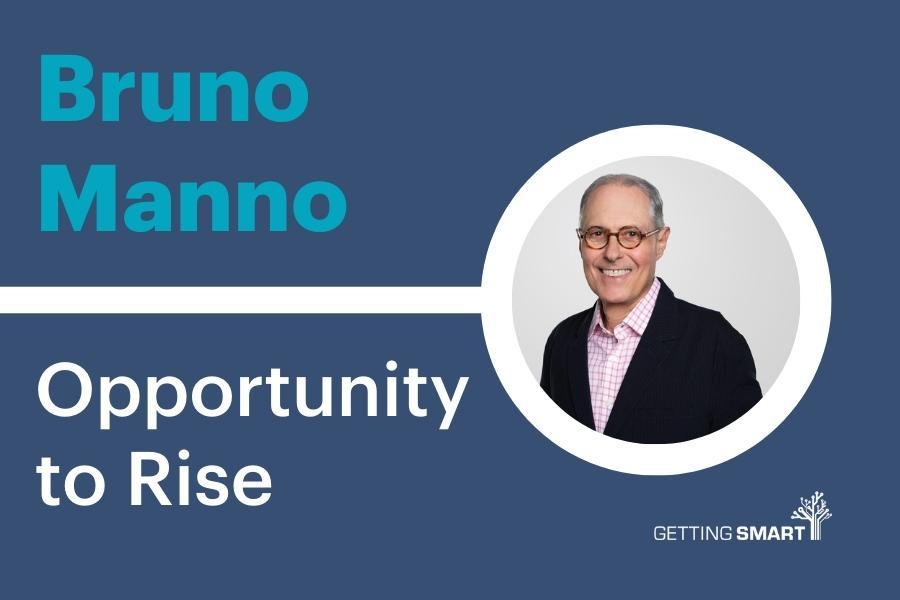
On this episode of the Getting Smart Podcast Tom Vander Ark is joined by Bruno Manno, a veteran of education philanthropy and editor of a new collection of essays, The Opportunity to Rise: Rethinking K-12 Education Pathways to Social and Economic Mobility.
Opportunity pluralism, I think, is a way of reframing it and talking about multiple pathways to opportunity.
Bruno Manno
Links:
- Bruno Manno
- The Opportunity to Rise: Rethinking K-12 Education Pathways to Social and Economic Mobility
- Joseph Fishkin – Bottlenecks
- New Pathways
- Innovating Together: the Geopolitical and Educational Path Forward by Tom Vander Ark
- Bob Schwartz and Nancy Hoffman
- Real World Learning Kansas City
- The Power of Place
- Julia Freeland Fisher
- Kristen Soltis Anderson
- Ryan Streeter, AEI
- Martin Luther King Jr., American Dream Speech
Transcript
This transcript has not been edited for spelling accuracy.
This episode of the Getting Smart podcast is part of our new Pathways campaign. What is something you used to think that you’ve changed your mind about? It’s time for us to do that with all things learning. Previous Getting Smart campaigns have laid the groundwork of networks, place, purpose, and innovation. Our latest effort, the new Pathways campaign, will serve as a catalyst for an unbundling education
to allow for new learning models that are sustained by supporting guidance and embedded in scalable systems. In partnership with ASA, the Bill and Melinda Gates Foundation, Stand Together and the Walton Foundation, the new Pathways campaign will question education status quo and propose new methods of giving students a chance to experience success in what’s next. Find out more at www.gettingsmart.com backslash new pathways.
Hey, Bruna, what is the vocational self? It’s a term that I picked up, I guess, and adapted to the interests that I have in talking about how people think about what they are going to do with their life. I guess that’s the short definition, but it encompasses a couple of different ideas. Technically, the etymology of the word, as you probably know, means a calling.
So I think built into the definition of a vocational self is this notion that people are called to do something that gives them meaning, that gives them a sense of purpose, a sense of self. Now, it’s not always easy to discern what that might be. That’s part of the challenge, but it’s a way of talking more than just about a career or a job. There is something more to life than just a career or a job.
It is a calling in some sense, and a career or a job and a pathway to a job is an important part of that, but it’s not all of that. And I think sometimes we get those ideas confused. So vocational self is a way of thinking about what we aspire to do with our life. And some of that is make a contribution in the place that we call work,
but some of it is also make a contribution in the place we call family. Some of it is also make a contribution in, as some sociologists say, in third places, sort of public spaces or even private places, meaning businesses where we meet friends and have a good time with people. So it’s a concept that encompasses all of these different dimensions.
And it’s not unrelated to developing, to use another word, a sense of character, a strong sense of commitment to a core set of values that guides this longer vocational purpose that we have. So that’s how I would begin to talk about it and explain it. You’re listening to Getting Smart Podcasts, and I’m Tom Van Der Rook. Today I’m joined by an old friend Bruno Manow.
Bruno for about 30 years has been working in philanthropy and advising grant makers. He has written and assembled a terrific new book called The Opportunity to Rise, Rethinking K-12 Education Pathways to Social and Economic Mobility. Bruno, it’s great to have you on the podcast. Tom, it’s a pleasure actually to see you.
It’s been, I guess, whatever, three years or so since. It has since we met at a various conference. I think our first sustained encounters were really around grant makers for education when we were on that board together 20 years ago. Many years ago. I appreciated your sage advice for a long time and jumped clear out of my chair when I saw the outline for this new book.
And I was so excited about reading it. And it says that you edited it, but having read it, I think you wrote the majority of it. So it’s a terrific contribution. Look forward to diving into that. Thanks. It was an unexpected experience and maybe we’ll get into that at some point.
What’s the origin story of the book? It was one sponsored by the Walton Foundation. Is that right? Yes, right, right. I never intended to write a book or have a collection of essays.
But about three or four years ago, during a performance evaluation of all things, someone that we both know, you know, Mark Sternberg, who ran the K-12 program here for a number of years. And about a year ago went on to another job with Walton Enterprises. He offhandedly said to me in the course of performance evaluation, you should write more. And I sort of smiled and shook my head and said, okay. And I took it seriously, probably the only time in a performance evaluation I’ve taken anything seriously, but that’s another story.
But I took it seriously and I went back and thought a little bit about what I might write about. As I thought that through, I came up with a couple of initial ideas that carry over into the book. One was to think a little bit about the 40 or so years I’ve been in the K-12 space, going back to when I first arrived in D.C. in 1979, you know, shortly thereafter a nation at risk came about and so on and so forth. And then the sort of current situation where we’ve seen a breakdown of what existed as a bipartisan consensus on a number of education policy issues. And then thirdly, the growing interest over the last several years that people have had in what we’ll talk about here, almost the subtitle of the book, Pathways to Opportunity.
So I scoped out these sort of three general themes and then began to dive in and one essay led to another led to another. A lot of these are shorter pieces, you know, op-eds, thousand words. There are a couple of longer ones in there that are four or five thousand words. But that’s the origin story. It was never intended to be a book. At one point about six, eight months ago, the new director here and the director of communications, folks you also know, Romy Drucker and Christine Patterson, said, wouldn’t it be nice if we compiled these because a lot of them have things to say about our current strategy.
And I said, up to you is never meant to be, but we’ll do that if that’s what you want to do. And that’s what led to the actual compilation of the essays. And as you know, we asked various individuals, some of whom are grantees of the foundation and others of whom are not, to do introductory chapters to each of the sections. And so it’s come mostly essays that I wrote, but also contributions from folks on the outside who tried to frame each of the chapters.
Well, I’m glad Sternberg gave you the prompt because they did three years ago start to see you show up more frequently in journals. So it’s been a productive journey for you and for the sector. The section one argues that there is a new North Star and that it economic and social mobility. I love that idea, but what’s the backstory on that insight? Why is it important? Yeah, and let me start by saying that both words are important before mobility, economic and social.
Oftentimes, people get hung up on economic mobility and of course, nothing wrong with that. But I think that our notion of what mobility means has to encompass more than just the economic dimension. It needs to encompass the social dimension, which has become the North Star of much of what the Walton Family Foundation does. So the kind of goal here is a long term goal that puts people on the pathway to both economic and social mobility. We can probe that a little bit more obviously, but economic mobility is clear enough.
Putting yourself on a pathway to economic independence, but it’s not only that. There is also this sort of social dimension that’s encapsulated in the phrase that a lot of us use all the time, social capital, developing the networks and the relationships. That are important to us as to go back to one of the ideas we talked about, vocational identity and the wider responsibilities we have to the people we live with, to the people that we encounter, to the society we live in. I really appreciate that framing in, for two ways. One, I’d like to expect that idea of vocational identity that you talked about.
We think about it in the form of the contribution that we invite young people to begin to understand who they are, what their strengths and interests are, and where and how they’ll make a contribution, right? And that can be both in work and in the community. And so I love the framing of economic and social mobility. I appreciate the nod to social capital and I think our friend Julia Freeland Fisher helped us all understand its importance and why we should begin to view it as one of the outcomes of youth development and schooling. I also think it’s important because the American escalator stopped six or seven years ago, right?
The American dream was that you do better than your parents. If you just go to college and pay your dues, work hard, things will be better than for you than they were for your parents and that bargain is broken. And we’re, I think, trying to understand and perhaps recreate a new American dream, a new bargain, and reimagine it both around economic and social mobility. Yeah, I think you’re used to the phrase here, American dream is spot on. And as I said, there are two words here, economic and social.
The dream is oftentimes primarily defined in economic terms, like better, fuller, richer, things like that. But that’s only part of it. I think this other part of it is what we’re talking about here. The social part, in fact, the first, the sort of framing essay in that first part is by Richard Reeves and the title of it, The Future of Success Lies in Relationships. So again, we’re in this realm of networks, social capital, as well as, of course, economic success.
Yeah, Reeves said it’s not just in economic terms, it’s a veteran, richer and fuller life. That’s right. That’s exactly right. That’s exactly right. Section two dives into this idea of an American dream. So I’d love to have you just talk about that. And if the American dream is still alive and some of the interesting things that you learned through going through survey data, I found some of that quite interesting.
Yeah, I spent a firm on a time thinking about this issue. And it included, and if folks have never done this, it’s worth doing. You know, Martin Luther King gave a number of addresses, both in secular places as well as in religious settings, on his thoughts about the American dream and what it means. And if folks have never dug those up or read those speeches, reflections, it’s worth doing. So I spent some time thinking about this from a variety of issues, including a lot of survey data that you saw.
One of the interesting takeaways, I think, was that as much as we hear about how down young people are on things at large, many of them are actually quite hopeful and believe in the American dream, what we would call the American dream. Understood in this wider sense that we’ve talked about, they’re quite critical of the present situation for all the obvious reasons. But they haven’t lost their aspirations here when it comes to thinking about the American dream. And there’s enough survey research around, some of which is quoted, I quote, and then the person who does the introduction here, Kristen Soltus Anderson, is a pollster who has spent a lot of time thinking about millennials and Gen X and other things. And all that sort of stuff.
So, you know, the title of her chapter is actually quite interesting. Young people are resilient and ready for change. And they have aspirations about what the dream means. And so I think it’s interesting to pay attention to their aspirations as well as their critiques here. Bruno, the third section dives into what I would call a real pathway topics of what’s high school for how do you make it work and how do you link particularly high school education to opportunity to social and economic opportunity.
And I think that’s really interesting as much as anybody in the country have some culpability for building momentum around all kids college ready which turned into kids should go to college and for attacking the graduation gap in this country and so the good news is a lot more kids are in high school than when you and I started our careers in philanthropy and a lot more young people attempt college, a few more finish. But that that old adage of everybody ought to go to college is is now sort of frayed around the edges. And it’s resulted in this unintended consequence of millions of young Americans that have debt without a degree. So, could be a couple old guys reconsidering some of how we frame this but let’s launch into this third section where you talked about pathways and I’d love to have you talk about how you you think about the new path and the best path and how
how we should help young people express their aspirations for post secondary success. Yeah, I think you hit on you use this word which I like. You know, I think we do need to reframe this issue a bit. And the phrase that I’ve stumbled on and I picked it up from somebody else so I don’t claim to have invented here is to think about opportunity, but the phrase is opportunity pluralism. I picked it up from a guy named Joseph Fishkin whom you may know but he wrote a book on this topic about kind of reframing what equality of opportunity might mean today and not getting hung up on what others call the sort of credentialist bias that is the
only way to really pursue opportunity is by getting a college degree now there’s no doubt and no one has an argument I don’t have an argument here that clearly those who get college degrees have a lot of benefits associated with those degrees, whether it’s more income or better connections to other people or, you know, longer lives, better health, all of these benefits that are let’s say, and I, the word the important word or is associated no one is really talking necessarily about causality. But that’s not the only pathway to opportunity. And so this notion of opportunity pluralism I think is a way of reframing it and talking about multiple pathways to opportunity. Now that that that has built into it it’s not an either or thing in my mind either you didn’t get a degree or you don’t.
I think we have to become much more flexible in how we think about going in and out of education. Because you don’t have a degree and you go get a job right away doesn’t mean that you can’t while you’re at that job. Beginning credentials or degrees of different kinds doesn’t mean you can’t leave at some point for a couple of years and maybe spend full time in a in a degree environment so I just think we have to think much more flexibly about what all this stuff means today. And one way of framing that is to think about opportunity pluralism and pathways to opportunity that involve dropping in and out the and you know was stackable credentials and all the other jargon and euphemisms that are used to describe what’s going on today. I want to talk both about high schools and colleges.
But maybe let’s start at the college and work backwards I guess one way to frame this around multiple pathways is that it seems more important than ever to introduce to young people as they imagine possible futures as they begin to develop the vocational self as to make sure that young people and families know that there’s a lot of interesting and affordable alternatives to traditional higher education. Some of those are online some of those are job embedded where you earn and learn ladder to high wage high growth employment so it feels like one thing that’s happened in the last 10 years is that the. We’ve seen an opening up and unbundling of the post secondary space. I find that encouraging but a bit confusing and and on that note.
I appreciated your essay on that college mobility report cards that really analyze both traditional colleges and new pathways in terms of their contribution to mobility so. Are you encouraged by the movement you see in post secondary now to pay attention to mobility outcomes. Yeah very much so. Again to go back to what we talked about this earlier though the focus is always initially the focus is always on the easy stuff meaning. It’s easy to talk about economic mobility and wages people make and tracking those but we also need to think about the larger framework we talked about earlier which is both social and economic mobility.
You probably picked up in some of these essays I’ve come to think about opportunity in a little equation. And it’s not the only way to think about it but it’s helped me to keep something in mind. So my question is like every a plus B equals C. And I’ve come to think about opportunity as the A is knowledge plus B networks equals C opportunity knowledge networks equals opportunity. You know what you know and who you know is the old phraseology.
Right you also. Another phrasing of it was habits of mind. I love that it’s ways of thinking and ways of getting along. I actually just wrote a piece Bruno called innovating together that is that the new. The new focus I think of schooling and it’s really habits of mind.
What’s habits of association. It’s it’s being able to frame up and take on complex problems and doing it in diverse teams using smart tools often attacking unknown problems and delivering value for a community and it feels like that is the new core that our secondary and post secondary institutions need. To better prepare young people for. Yeah, I mean I totally agree in your your example is spot on it’s spot on. And I do as you imply it’s not just for colleges to think that way but it’s also for, you know, our high schools it’s a way to think about I, I, in my mind, what what the continuum is lifelong learning.
And as you know, you know, you begin to get into this let’s take the association issue or the network issue. The different kinds of relationships that we have the so called strong ties and we ties social capital and bonding capital. These are all ways of beginning to unpack what association means what relationships mean. And there are people who have spent a lot of time thinking about this stuff but it just to step back the framework has helped me sort a lot of this out. I appreciate that.
And on this on the on the demand side of sort of team up and making more visible good jobs. I appreciated that the shout out for JFF pathways to prosperity. So you think this is an important part of the work of on the demand side of organizing and making more visible. It’s not traditional but emerging career pathways. Yes, absolutely. And one of the things of course we both know Bob Schwartz and his wife Nancy Hoffman who have done a lot of this work, going back a long time.
And to see that their writings and the stuff that they did help me begin to think about this framework and as four or five elements to it that that describe what these what these pathway programs should entail. You know, credential I don’t know that I remember all four or five out the top of my head but they lead to credentials. There’s an advisory dimension to them. There is workplace learning, etc, etc. They pioneered a lot of thinking around that and developed a lot of the framing of it and, you know, have written tomes on it including conducting steady trips to Europe to kind of show how this all together etc.
The involving employers trade associations and local organizations, and then the focus on agreements. Civic compacts or civic agreement. Yes, we, we’ve been supporting the real world learning initiative in Kansas City for five years and the most important part of that work is a set of bedrock agreements between the school systems and the business and civic institutions that I community around what valuable advantages are that all young people should have and for me that is a beautiful agreement that I think hits at all of those characteristics of quality programs and credentials that matter agreements, mobilize business and labor. So, I appreciated that.
What is what’s brave and you highlighted them in the book. In fact, the woman who founded it, Amy wrote the introduction to believe it’s section three yeah, guiding students on the best path, not the official one, which I think is a nice title. Amy founded an organization called Raven that actually works at the college level with young people and helps them, you know, sort of adjust to the new world that they may be encountering for the first time, because many of the people she works with are first generation college students who have all of the problems. You know, I was a first generation college kid.
And while it was a different world 40 or 50 years ago. It was still a new world to me. My parents graduated from high school, my mom went on to a business school, but it was still a very, very different world. She went to one that was few miles away from her, I was 300 miles away from home. Okay.
So that the kind there are all sorts of costs associated with that that are unanticipated and supports that are needed. And so Amy has created this organization called Raven that works with young people who are in that kind of situation, mostly minority kids but not exclusively. Section four is on community based focus. What does that mean and why is it important. One of the things I’ve come to appreciate I knew about it but I’ve come to appreciate it in a new way it’s simplistic I guess one could say but the importance of place, the importance of place of anchoring yourself in a place that place that place might be a family,
or later on place might be work. My place could be a school. So I’m talking about place here in a generalized it might be a neighborhood. We are we’re always anchored in some place. And that may seem simplistic but on the other hand it’s pretty important.
It’s pretty profound in some respects. So when we think about community and being part of a community it’s always being anchored in a place because the community is always in a place. And as I mentioned earlier you know there are also these third places that sociologists talk about. Roy Aldenberg is the one who is so-called credited with developing the freight third places. The first place is home the second place is work but then there are these other places that are both commercial like coffee shops cafes restaurants, but there are also public places like parks and libraries places where we go to be together with people in a different kind of way.
The famous way of talking about this everyone probably at least those of a certain age remember the TV sitcom Cheers. And the theme song for that movie was everyone wants to go to a place where everyone knows your name and they’re glad you came. So this notion of place I think is really crucial to a lot of this stuff so I don’t know how much people actually think about it but I’ve come to appreciate it a lot more. Bruno we the day that WHO declared a global pandemic we released our book called The Power of Place. That really celebrates the opportunity we have to help kids really come to know and appreciate who they are as a result of where they’re from and that every place is a place worth studying and falling in love with.
So we have deep appreciation for those insights. Right and the other part of this is that while you’re from a place you can go to other places. You’re not captured by that place even though a lot of people think that we are but we’re not. Now it’s that beautiful paradox that we want that every place is a place worth studying and and learning from and the opportunity for travel based learning and now immersive virtual reality learning. And then experiencing other places if we think about those habits of mind and habits of association as being super important then then both immersing yourself in place and and visiting new places I think are both important to both of those dispositions. I guess I could ramble on here for a while but you know what one of the tragedies of the pandemic and the lockdowns was that we were cut off from so many places.
Particularly third places but not only third places. You know so one of the great I think aims of post pandemic or whatever you want to describe the world where now is to reestablish our connection to places that we have been cut off from for three years now. And and all of the downsides associated with that disconnection. Anyway, you had the opportunity to work with a number of really remarkable people and putting this book together. Are there one or two that really help shape your thinking about the opportunity to rise.
What that means and how we can create more opportunity for more young people. Yeah, several I don’t know that I’ll have time to go into all of them but I did mention one idea this opportunity pluralism which came from Joseph Joseph Fishkin and what he’s written in his book called bottlenecks. Yeah, where he talks about bottlenecks to opportunity. So that was that was important to me. And then I sort of cracked, cranked up this equation on my own, but it was inspired.
You mentioned Julia before who talked about thinking about an opportunity equation though she had a different sort of cut on it and I got down to making it a kind of a plus B equals C. But I certainly was inspired by her. A couple of other people who are more in the sort of not that the other ones aren’t but who are in the polling and and policy analysis. I mentioned Kristen soltice Anderson, but also Ryan Streeter who is at the American Enterprise Institute, and is part of a group there that that’s called the American Survey Research Center. I may get the name I may have the name a little off there but that’s more or less what it is.
But a lot of their survey research is closely linked up to thinking about issues that they write about based on social capital in place. I could go on here but those are some of the kind of ideas and people who were helpful to me. I will go back to make another point. Re-reading as I do often now because I teach the equivalent of a guided readings course for the new people who come on staff here that introduces them to history of ed reform and philanthropy. But I start with this notion of the American dream and rereading the speeches that Martin Luther King has given was really, really quite interesting because he anchors all that he thinks about the American dream in our fundamental principles as flawed as our execution has been.
Even the speech on them all is interesting for a variety of reasons because he talks about he’s anchored. His dream is anchored there but it goes beyond there. So that was really helpful and I go back to those now at least once a year because I do this sort of internal guided readings course once a year and go over those. So that’s a smattering of things. Bruno, that’s a beautiful place to leave things.
There’s 10 more questions I’d love to dive in. The last third of the book really goes into the pandemic and pandemic responses and some of the innovations that came from and could come from that horrible experience that we all went through and what that could mean in terms of better pathways for more young people. But I’ll invite you to get the book. We’ve been talking to Bruno Mano about the opportunity to rise rethinking K-12 education pathways to social and economic mobility. Bruno, what a treat to reconnect.
Yeah, it’s terrific. Thanks so much for the opportunity and hope we see each other face to face sooner rather than later. And I hope it’s out in Arizona as opposed to. Let’s let’s do it. Okay.
Bruno Mano and thanks for being with us. Thanks also to our producer Mason Pasha and the whole getting smart crew for making this this podcast possible. Until next week, keep leading, keep learning, keep innovating for equity. Thank you for listening to the getting smart podcast. The new pathways campaign serves as a catalyst for unbundling education to allow for new learning models that are sustained by support and guidance and embedded in scalable systems.
The new pathways campaign will showcase how learners can shine as difference makers and learning curators when opportunities are intentional, equitable and personalized. Find out more about new pathways at getting smart.com backslash new pathways. Thanks to ASA, the Bill and Melinda Gates Foundation stand together and the Walton Foundation for their support in this campaign.



0 Comments
Leave a Comment
Your email address will not be published. All fields are required.