

Brent Maddin on Reimagining the Teaching Profession
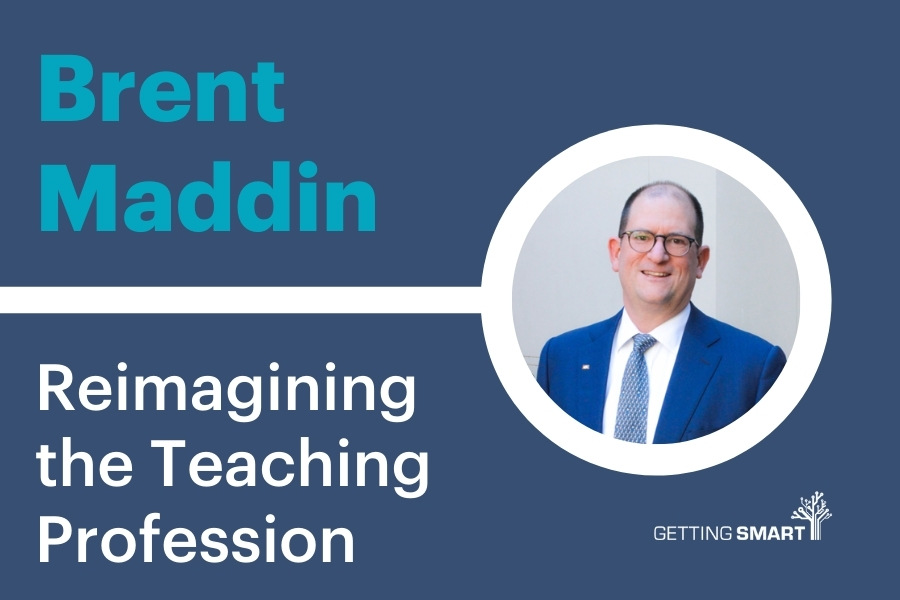
On this episode of the Getting Smart Podcast Nate McClennen is joined by Brent Maddin, Executive Director of Next Education Workforce at Arizona State University. Brent leads a team that is collaborating with P-12 practitioners and higher-ed faculty to help design the roles of current educators, expand who enters the education workforce, and rethink how we develop and credential these educators.
Prior to coming to ASU, Brent was a co-founder and Provost at the Relay Graduate School of Education and also founded TeacherSquared—a national center dedicated to increasing collaboration among teacher preparation institutions.
On Teacher Recruitment
Can we stop pretending that a degree in elementary education is the signal? Instead, what if educators came with a set of true specializations […] you start hiring educators with experience in trauma-informed instruction and some knowledge of what it means to teach in a blended environment.
Brent Maddin
On Educator Agency
[educators] have to have agency, voice and the ability to personalize their path.
Brent Maddin
One-Two-One
One person who shaped your mental model
- Steve Sexton
Two key insights for edleaders (in summary)
- As we think about learner experience, the body and surroundings, we must remember that relationships matter.
- As our understand of learning science continues to shift, we must reconsider learning goals and the purpose of learning/development.
One additional insight from Brent Maddin
- The metaphors we use to understand ourselves shape our thinking. Brain as computer and brain as muscle are limited.
Transcript
This transcript has not been edited for spelling accuracy.
Hey listeners, before we get to the conversation, I just wanted to tell you a bit about the services and solutions that Getting Smart offers. Did you know that we collaborate with and advocate for impact-oriented partners who are committed to accelerating the future of teaching, leading, and learning? Our strategic solutions are tailored to best support each partner in achieving their goals
and helping leaders know what to do next. Working with our vast network of resources and partners, we design and form strategic solutions that last. Whether your organization needs support with learning design and coaching, strategy, professional learning, media, communication and marketing, or are looking to build your next campaign,
we are here to help. If you’re interested in learning more about our services and working with our team, email Jessica at GettingSmart.com or visit GettingSmart.com slash what we do. You are listening to the Getting Smart podcast. I am Nate McLennan and today I’m joined by Brent Madden, executive director of the next
education workforce at Arizona State University. Brent leads a team that is collaborating with pre-K through 12 practitioners and higher ed faculty to help design the roles of current educators, expand who enters the education workforce, and really rethink how we develop and credential these educators. Prior to coming to Arizona State University, Brent was a co-founder and provost at the
Relay Graduate School of Education and also founded Teacher Square, the national center dedicated to increasing collaboration among teacher preparation institutions. At Getting Smart, we’re excited to continue partnering with Arizona State University in all sorts of ways. We work extensively with Arizona State University’s prep schools, immersion and prep digital,
and are integrating in all other ways, thinking about the ecosystem of innovation that’s happening at ASU. This is a very collaborative, highly innovative, which leads to incredible opportunities for advancing education and systems and communities worldwide. Brent, welcome.
Super excited to have you on the podcast today. Nate, I’m so glad to be here. Thanks for having me. Yeah. Let’s start with a question about your earlier years.
From the beginning and thinking about that you’re teaching professional learning and teacher development, favorite teacher and why? All right. As an educator, you’re not supposed to have favorites. I think maybe as a student, you’re also not supposed to have favorites, but let me give
you my second grade teacher. Her name was Marianne Chatters, or at the time Olson. When we talk about actually personalizing learning for kids, this was like whatever, I think it was like a little bit of a little bit of a little bit of a little bit of a little bit of a little bit of a little
bit of a little bit of a little bit of a little bit of a little bit of a little bit of a little bit of a little bit of a little bit of a little bit of a little bit of a little bit of a little bit of a little bit of a little bit of a little bit of a little bit of a little bit of a little bit of a little bit of a little bit of a little bit of a little bit of a little bit of a little bit of a little bit of a little bit of a little bit
it kind of clicked on me. I remember also, I think it was my second grade teacher I grew up in New England, and there were chestnuts grounds and we somehow incorporated into the curriculum or at least how I remember it, we roasted those chestnuts as part of a learning experience. And I remember very little from
second grade, but I do remember roasting chestnuts. So again, teachers who are adaptable, teachers who are creative, teachers who personalize, love it. Okay, so let’s talk about your journey. You have done some really interesting things in your life. Love to just give me a snapshot of it and definitely start or incorporate somehow you were involved with studying forest fires at ASU when you were a student. So I’d love to hear how that trajectory fits with where you are now.
So ultimately, I did not think I was going to be an educator. I thought that I was going to be a forest fire recologist. I was as an undergrad at Arizona State University, which is now where I’m working, right? I grew up in the mountains of Arizona, small rural community, lots of trees, lots of forests, lots of fire. And it was ultimately a professor at ASU. He was a MacArthur Genius Award winner, this guy, Stephen Pine. He was the kind of course that’s listed at college
that is cross listed between four or five different departments. I would always look for those courses because those were always the most interesting ones, right? And he wrote a book called World Fire. I said, oh, this is amazing. And then I won a fellowship to essentially circumnavigate the globe studying forest fires on six of the seven continents. And yeah, I came back from that. I thought I was going to win a Fulbright in South Africa to study illegal immigration into South
Africa from Mozambique because you could actually use Landsat images to study these rings that people would light at night to keep the lions at bay. And so I was like, oh, you can use Landsat images and fire to actually study. And the South African government, I think, eventually was like, wait, wait, wait, wait, wait, wait, this isn’t about ecology. This is about forest fires. And so that kind of fell through at the last minute. And I joined Teach for America sort of on a whim.
And and found myself teaching in rural South Louisiana. And it was the most incredible job ever. I mean, just truly, truly stunning. It was a high school biology, chemistry, physics, physical science, ACT prep, tennis, academic to catholene teacher. And it was, you know, I learned as much every day, I think, as my students did. And that just set me on a trajectory, eventually taking me to the Rio Grande de Valia in South Texas to help found the first idea college prep high school
with with another group of amazing educators went to Harvard, got a doctorate in education policy, got plucked out of the libraries at Harvard to help found relay graduate school of education, which was like going to be sort of my life’s work. I was like, I, you know, like, I’ll get a doctorate in education and then think a lot about teacher prep. And so, you know, I was in the middle of doing that and and building this program at relay. And, you know, ultimately couldn’t shake the
fact that, you know, after 20 years of working in teacher preparation, many of the teachers that I thought were truly amazing, right, the teachers that I would want teaching my own kids, they were leaving the profession. And the return on investment and the preparation of new teachers just really got in my head. And I was like, Oh, my gosh, like, we’re spending an inordinate amount of time, resource and energy preparing people for a job that most of them leave in the first couple
of years. And that feels kind of weird. Right. And you think about the the data is challenging as we look at it. So salaries aren’t keeping up with inflation. The general perception of teaching is not great as a profession. We you and I both know I was also a high school biology chemistry, earth science physics teacher and wore 100 different hats at various schools. And it was incredible work. And it was hard work. And so how do we keep great people in the classroom?
How do we recruit the best into the classrooms? And that’s really what I’m thinking about with your work and how you’re addressing that. So how would you articulate the challenge? What are the big challenges that are facing teacher education industry sector today? So so I’m like grabbing this book on my shelf right now. People you can’t see this. But the title is the first year teacher’s survival guide.
Like and then like listen to this hit the floor. It’s a huge book, right? It gets huge. And so right. Why are we building a job that comes with the survival guide for the first year? This is bananas. Right. And so, you know, I don’t even know that this is a matter of like residency programs versus versus, you know, an alternative certification program. Clearly, a residency program is preparing educators better for the for the work. But like I’m still not
convinced that even with a great residency or pre-service preparation program that we’re actually setting educators up for success. Because I think that we’ve designed a couple hundred years ago a model of teaching and learning that largely relies on a single educator being in a box alone with a group of students either for the entire day in most elementary models, or at least, you know, for 50 to 90 minutes until a bell rings in secondary models. And, you know, it’s oddly a job
that is incredibly isolating. Yet you’re together with people all day. Right. And some of this is the way that we’ve thought about, you know, the relationship and power dynamics between a teacher and students and who actually controls the learning. But it’s also the way that we’ve brought adults together around around young people. And I would argue that we’re like actually working against, I’m going to make this connection back to like nature. Right. We’ve built an ecosystem that
is almost completely not interdependent. Right. It’s siloed. It’s lonely. It’s isolating. And yeah, we talk about having teams at schools. But it’s like, you know, a team that gets together and have margaritas on a Tuesday, or they have a PLC on a Friday. And what we’re talking about at ASU is we’re conceiving this idea of what we call a next education workforce. And it’s like at the root of it, it’s bringing teams of educators together to deepen and personalize learning for not just
some kids, but for all kids. And the idea there is that these multiple adults actually have distributed expertise. We can talk more about any of this. But I’m convinced that the one teacher, one classroom model default normative model of schooling in certainly the United States and really most of the world is actually like probably not good for teachers and probably not good for kids. So, so you think about it and you add on to that isolation. So highly social with young people in
their classrooms, highly isolated in their single classroom, single teacher model. And then you add on all the outside pressures of increasing complexity of whether it’s testing pressure, whether it’s outside compliance, whether it’s community and social pressures of what you should teach, what you shouldn’t teach compliance. And so it’s making it a very, very challenging situation. So walk me through at Mary Lou Fulton Teachers College, you’re thinking about this next
education workforce. What does it look like? So if you walked into a school that had fully implemented this in a way that you and your team perceive is the right way, how would it look different? So, you know, to add to add on to that framing quickly, I think that it’s also that the work of being a teacher like the actual craft, right? You said this yourself, right? It’s very difficult. And the more that we learn about, you know, brain based learning or science, right? Just like the
more data that we actually have as educators, it’s not even just these external pressures, it’s the actual work and craft of being an educator. It’s actually, it’s becoming more complicated because we actually know a lot more. And so, right, you are an educator on one of these teams. What does your day look like? And I think that it really does look different between elementary and secondary or it certainly could. So imagine a third grade.
Yeah, there’s like four third grade teachers in a school. The harsh reality is, at least in Arizona, the likelihood of finding four completely awesome teachers is really, really challenged. But let’s just say that we’ve got those four teachers for a second. Each of them are basically in a box. And, you know, they go throughout their day and maybe they get together once a week or a couple times a week. You know, if you happen to be,
say, a black male student, you kind of have to win the lottery to get one of those four teachers who also happens to be a black male educator. Or as a parent, your, that first day, like as you’re learning who your kid’s teacher is, like you’re like, you’re sitting around on tenterhooks, right? You’re like, oh my gosh, like, please, like, let it be like the story fable teacher that, you know, my neighbors told me is awesome. You know, I don’t know about this first year teacher,
like this other person, like, so many unknowns, right? And the reality is even there, that person might not be the right person for my particular kid. Even the long story, like awesome teacher might not be the right individual. So imagine a different reality, right? One where, you know, some of the schools with whom we’re lucky enough to work have made major changes to their actual physical plan, right? Like, they’ve, you know, made some cut-throughs and some walls. And so
what used to feel like four classrooms where third, four third grade teachers were all working, suddenly feels like one more large, single learning space with kind of different zones where different learning is happening. You know, it could be that the construction hasn’t been massively modified, and they just like have like four classrooms that are proximate to one another. But like, here’s the thing, if you walked in, you may not see something
that’s like dramatically different in a single snapshot. But imagine that we put trackers on the shoes of the kids and the educators, and we just watched their paths throughout the day. What you would actually see is like a massive amount of movement of single kids, of educators, of different educators coming around different kids in proximity to one another, right? Like, that what we’re doing ultimately is we’re saying to the professional educators, hey,
like, you have more autonomy over your time and schedule, and that you can group and regroup students differently. Some of the models in which we’re working, Nate, like, they’ve gotten rid of the age-graded school. So they’ve actually got fourth, fifth, and sixth graders together in one of these learning spaces, like 80 of them. And they’re kind of moving between these four rooms. And sometimes the teachers are kind of departmentalizing at an elementary school. But sometimes,
you know, they’re all teaching ELA, but they’re dynamically grouping the students because they had some time at the end of last week to think about what do these particular students need in this particular moment in time, and how can we as a set of four educators actually deliver differently as a result of the way that we group. Now, you could walk into a secondary school, you and I are both teaching biology, maybe we do that, you know, and I don’t know if this is
true for you, but like, I needed like a double-blocked lab period, not because it was Thursday, but because it was the right time in the curriculum. So imagine a team, right, of four high school teachers in a ninth grade that are sharing a group of 150 kids, or 100 kids, and imagine that we as a team of teachers are doing a couple of things differently. One, we’re looking at our schedule and we’re saying, hey, like I need a double-block of biology on
Tuesday, because this is what’s happening. And we can double-block ELA on Thursday to make up the time, and that we are as a team having conversations. Imagine that we as a team are looking at student work, all of us together, right? And we’re saying, oh gosh, like I see how we could be reinforcing things differently in all of our different subjects. Or imagine that, and this is true in some of the schools with with whom we’re working, that they’ve got
serious blocks of time to do interdisciplinary work in the, you know, in the week. And so they’re actually truly deepening learning for this group of students, because you’ve got your biology, your math, and your ELA teachers coming together, along with someone that’s doing, you know, social justice work, social studies version of a course. And they’re doing community embedded project-based learning two times a week. So, you know, depending on when you walked in, it would
look different in any of these models. But what I would sum it up as is, one, it’s a team of professional educators who might be co-teaching, who might be like, you know, multiple adults in a space, two, sharing a common roster of students, three, dynamically flexing the schedule and the groupings. And then we’re not there yet in this conversation. But ultimately, we’re actually really talking about new roles and bringing members of the community in and really defining
and pushing on the monolithic role of an educator, which right now, like we haven’t gotten there in the conversation. Right, right. So, okay, so I have the vision. So it is teams of teachers. So you break down those silos, the walls, typically physical walls between classrooms, larger groups of students, movement of students and teachers to be right time, right place teaching and right place coaching and mentoring. And it reminds me of what we know about motivation and learning around autonomy and
mastery and purpose. So teachers have autonomy in these small teams to make the decisions on the fly to say, this is what this student needs now, which gets into that personalized learning, the deeper learning, all those things we know are critically important. And it’s very contrary to a very prescripted one size fits all, you know, the five minute ticker of every five minutes you’re doing this and every teacher is on the exact same thing at the exact same time, the exact same day.
So let’s now move into this specialization piece, because I’m fascinated by this. I have this vision once that I think that we some teachers are fantastic at instruction, some would be happy just assessing all the time, some would be really excited to be curriculum designers. And you and I have talked before about how do you even make that even more granular role specialization so everyone is the right place where their highest level of talent can best serve
students in equitable ways. So tell me about role specialization. How does that work in these teaching teams? Yeah, it gets really exciting when you start to challenge the sort of the monolithic version of an educator to begin with, right? So that like one person has to be all things to all people at all times, right? And this is exactly what you’re getting at, as you describe the specialization piece of the model. So imagine, right, again, at a secondary level, in some ways,
we’re like, okay, like I got it, like we each have our, you know, our superpowers around the content, we’re probably not messing with that specialization. But imagine, though, that as a team, we need to be communicating, you know, bi-directionally with with parents, we need to be created, actually, someone on the team could could have responsibility for really owning parent family communication. And that we’re not asking for people to do that, and to send sort of these like,
you know, random messages to parents that are sort of feeling disconnected. At the end of the day, you know, families have, you know, a single student involved in this work, and to be coming together as United Front, like there’s an example there, to pick up on the piece around curriculum design development, we don’t have any schools that are doing this yet. But they’re probably schools that might be listening that are and you should contact me, right? Imagine a role that that is
right around curriculum design and development, like I love curriculum design, I loved it, this could be my job, right? Like imagine that there’s a team for four teams that are sharing a person who just loves project and problem based learning, maybe they’re embedded in an elementary school, 80% of their time, they’re actually designing, they’re designing, they’re designing problem or project based units, you know, taking the lead on that work and 20% of the
time they’re actually embedding in those teams, those four teams, through the implementation of those project based units. Imagine, you know, the coherence that could be possible, if that person is working with a, you know, a first, second, third and fourth grade team, you don’t get the dinosaur unit four times in a row, right? Like instead, like you see how these things could actually build on one another, that person might also be responsible for making inroads and connections with
community partners who are, what we think of as another part of this educator workforce. So talk there for a second, I just want to pause and because you mentioned this twice, we think of educators in the traditional system as those that are in schools and then you have the non-traditional that are outside of schools and the interaction tends to be non-traditional, might be after school, summer, all those kind of things. You’re thinking about community educators
in a really interesting way at next education workforce. So tell me how these different, like the community educators interact with the certified educators in the school, what does that look like? What’s that overlap? What’s training look like? I love it. So we’re early in this work, we’re seeing some examples, let me give you a few concrete examples. And again, the role of community educator isn’t monolithic. So imagine that you’ve actually got parent volunteers that really want
to show up, that they want to be a part of this work. Maybe we’ve got them hanging up coats and putting backpacks away, which is meaningful, helpful work, but at the end of the day, what if they had a modest bit of training and that they could be helping run or reading with students instead? Or imagine that there are, I think it’s Bank of America’s got this really amazing sort of policy where Bank of America employees can spend a couple of hours a week
embedded in community-based work or service. Instead of showing up and painting a school or picking up trash, whatever, imagine that they’re serving as project-based mentors to students as they were thinking about or building presentations, they became an authentic audience. Imagine one of those high school project-based units that I was just describing, and let’s say that they’re doing a project on sustainability and someone from either the university
or the local utility companies are embedding with that group for one to two hours a week for a four-week unit or a six-week unit. The perspective that they’re bringing in is invaluable. And so what kind of training is required there? Again, it depends. If you’re going to be a tutor, maybe one of the local high school has a group of aspiring educators who are seniors in high school and maybe instead of just learning about John Dewey in some sort of education CTE class,
that they actually could be working with students and that they’re going to start to run some high dosage tutoring similar to what Saga Education does. And then we’re actually able to bring in and train up those folks. They might require a fair bit of training, 20, 30, 40 hours of training, prepare them. But that community educator from the public service company, they’re not going to do 20 or 40 hours of training. But if you had an hour with them or 30 minutes, what would you want
that person to know? It probably includes things like how do you quickly build relationships with students? How do you ask good questions? How do you provide feedback that doesn’t shut down kids? Like if you’re looking at their work or their projects, right? And that’s going to just probably make them better people, both with their own kids or grandkids. And it also, here’s our bank shot a little bit, right? Like the moment you step into a classroom in a way that’s actually
meaningful, I suspect you vote differently. Right. So you change the perception. And what’s interesting is that, so we’ve always had internships and apprenticeships and schools in the CTE world, but more and more in the project-based learning world, place-based learning world, we’re interacting with community more and more. And I think that’s aspirational for a lot of schools and really, really important for young people as they think about how to make a difference and
build agency and all those things. So what you’re starting to think about is how do we formalize the process so that there can be, I’m going to call it badging or micro-serts or something along the lines of how do you up your skill so that you can work with young people, whether you’re in the community, whether that you’re a teacher who wants to get better at project-based learning or better at competency-based. So instead of certifying at the discipline level or the division level, which
probably will still happen, there’s these levels below that of granularity of how do you think about certifying specific skills, which then you think about your young people that you’re working with. It could be the certified teachers, where their set of skill sets, it could be a community educator, where their set of skill sets, a leader, where their set of skill sets, and you’re matching those skill sets with the immediate needs of the learners that are in the classroom at that time.
Is that what you’re thinking about? And are you building out a platform that starts to think about how do you badge this or certify it or make this formalized in some way so it’s not haphazard? Bingo. Like all of what you just said is exactly right. So are we building a platform? The answer is yes. Are we building two platforms? The answer is maybe. Because we actually, in a more perfect world, we would have a single unitary platform where all of this stuff worked
in really nice harmony. The reality is that especially our community educators, I, this is my own bias here a little bit, but most learning platforms are like sort of like a, I don’t know, like a Craigslist version of shopping for stuff. You instead, you want an experience that is like really slick and really incredible. And so we’re building a set of what I think of, and I should also say not only is it just the design of the ease of use of these platforms,
then intuitiveness, but it’s also around the actual grain size of the work and how much time someone is actually going to spend in this. And so for our community educators, we’re thinking that the bites of this learning need to be a way like sort of more sort of intuitive and and also smaller. Because, right, like you’re not, if you work for like the Bank of America, like you’re not going to spend 40 hours doing this work, but you might spend an hour,
and then you might decide that you like it, and then you might decide that you want some more of it, right? And so we’re thinking of this as a couple of different markets, right? So there’s the market for what we think of as community educators and the market that we think of as professional educators to include, you know, pre-service teachers, experienced or veteran teachers. And there the grain size gets a little bigger. We probably still think that there are,
you know, I’ve done a lot of work in micro-conventioning and it keeps me up at night, this grain size question, right? Like at what point do we over atomize everything that we’re doing? And therefore it’s like, there’s no, there’s no forest. It’s, you know, it’s only a bunch of trees or branches or leaves or something. And that’s like really, that’s problematic. You know, at the same time, I do think that we probably over complicate things and we probably create false barriers
that actually keep people out of their ongoing professional learning. And so one of the things that we’re grappling with here is, right, like maybe the point of the realm shouldn’t be a master’s degree for professional educators, maybe, maybe it is in some sort of way stacked up version. But maybe there are things that feel more like specialization, which could be six to nine, Andrew Carnegie is really happy with me, six to nine Carnegie credits, right? Or maybe those are
single credits that could stack into a specialization, which could stack into a master’s degree. And if we can get this right, as an institution of higher education, it actually has huge equity implications, right? Like you imagine, you know, the cost of a master’s degree is like incredibly high. And you have to like basically do it all at once. And you have to do it like, you got to pay for it all at once. Imagine that if you could spread that out, right? In one
one unit chunks, and maybe even sub unit chunks. And then if we’re talking about these teams with distributed expertise, like, can we stop pretending that like a degree in elementary education is like the signal, and instead say, what if educators came with a set of true specializations? And so that you stop hiring third grade teachers, and said you start hiring educators with experience, right? In trauma informed instruction and some knowledge of what it means to teach in
a blended environment. And that’s the signal. And then you start to compose teams that actually have this like wide array of interdependent specializations. And we can get away from one person having to be expert at everything. So our program at ASU has just started with our undergraduates in teacher education to actually have them graduate with specializations, which hopefully start to change the broader educational ecosystem about what is valued
in terms of when you go searching for a candidate. Right. And so that and it matches what’s happening in industry right now is we’re looking for it in industry, you’re looking for skills matches, you’re saying it’s not sufficient, and sometimes not even needed that you have a college degree. What you really need is to be able to code at HTML or C++ or whatever it is. And that needs to be the documented skill set that then the company or the nonprofit organization,
whoever can hire based on those skill sets. And so what you’re talking about is having the same thing happen in the education industry, which is fantastic for personalizing learning for young people, right? Because we’re trying to meet the needs of every student. Every student has a is neurodiverse, right? So there’s neurodiversity everywhere. And every student needs something different. If we build teacher teams that are not just five certified elementary school teachers,
but our teachers who have all these specializations that are going to meet the needs of that group of students at that time, that helps do inspiring and it helps do with up a skilling for teachers. And then it creates that agency for teachers to say, Oh, I want to get better at this. I want to get better at this, rather than Oh, I have to go jump into a masters and it’s my only choice. Is that what you’re saying? Personalized professional learning for the educators, right? Right.
Exactly. Part of this is like we expect educators to be teaching in a particular way. And yet when we actually are super honest with ourselves about the opportunities that they have to have agency voice, the ability to personalize their path, like we’re kind of a bunch of hypocrites. Right. We don’t practice what we preach, right? Like we’re missing that. I think that that’s what we would say. Right. Right. All right. So, Brent, it’s been, we could
probably talk for hours and hours. And I think we might need to schedule another one of these. I’ve heard about teaming today. I’ve heard about building teacher agency skill development and using technology to enable that. This idea of community educators, fantastic thinking about how do you modernize that system and make it a bit more formal in a way that’s doable and accessible. So the community is part of the learning experience and better serves all students.
We love to finish off our segments with this idea of like a one to one. So one person in brief, one person who shaped your understanding, two insights for our listeners who are education leaders, teachers and admin, et cetera, they’re in the ed space and then one lever to advance equity. So the person, I think that’s probably shaped my understanding more than anyone else. When I was a teacher for America core member, I sort of, I won the lottery in this guy, Steve
Sexton, who was an incredible educator, really, truly personalized. My development is a rookie teacher and set me on a completely different path. And he did that because, I mean, he really did have a student centered approach to all that he was teaching and all that he was imparting, two insights from educational leaders. So John Daner tried to do this thing a while ago that was like too early, which was like on demand tutoring around, you know, particular common core
work. I think there is still something there about like how do we leverage technology to create immediate sort of on demand delivery for students learning particular things. And I think Desha Tol, you know, one of the co-founders of achievement first is onto something separate related, kind of different around something called Step Mojo, which is her new endeavor about delivering live, high quality online lessons to high school students all over the country world and allowing them to
truly personalize their journey. And so these two educators, they just really have me thinking differently about technology and the way that that actually could play a role in these team-based models, right? When we start to actually dismantle the one teacher one classroom model, there are all of these new opportunities to pull. And that would be the lever ultimately that if we’re serious about advancing equity for kids and for teachers, I think we have to get away from the one teacher,
one classroom default normative model of schooling. And so the moment that we pull that lever, I think a whole lot of other opportunities open up. You don’t have to win the lottery as a student to get the great teacher on that team. We know that having a great teacher three years in a row makes a tremendous difference in the life of a student and the opposite is also true. And so, the fact that we sort of create systems that again, sort of luck of the draw,
it was lucky for me to get Steve Sexton as like my teacher coach and Teach for America. We’ve got to get rid of the sort of the luck of the draw that comes in our educational systems. All it does is actually replicate inequity. And so if we’re serious about plays in equity, we’ve got to rethink the way that we organize our staff. Right. And that’s that makes so much sense to me. And so it’s not only the teacher, the teacher teams in the physical space, but then
what you’re talking about is, and this maybe is our next podcast, 612 months from now is, how does tech enable a variety of resources to come in, whether from the community, actual people or from the extended global community. And I’ve done a lot of work in rural ed. And that can make a huge difference in the rural ed space. And I know you and I’ve talked about that in Arizona as well. Brent, it has been an amazing 30 minutes of conversation.
Thank you for all that you do for developing teachers and teacher leaders and rethinking this idea of what does it mean to be a professional educator in the 21st century. Keep it up with your team and all the work that ASU is doing. So thanks so much. And we look forward to our next conversation. I can’t wait, Nate. This was my pleasure. Thank you. Thanks for tuning into the Getting Smart podcast today. We want this podcast to be
actionable and insightful and a great way to learn about what’s next and learning. In order to stay on the cutting edge, we need people in the field to tell us what they’re hearing, what they’re wanting and what they’re needing to learn more about. Got a topic or a guest in mind? Send your recommendations to me, Mason at GettingSmart.com. And if you like what you’re hearing, don’t forget to leave a review in Apple podcasts or subscribe wherever you listen.
Feel free to share the podcast on social media using the hashtag GSPodcasts. Thanks so much.



Gloria Pelaez
Exciting and much-needed take on preparing teachers.