

Dr. Belle Liang and Tim Klein on How to Navigate Life
Key Points
-
Agency is a core part of purpose.
-
The future of wayfinding is not going to be about grades, it’s going to be about narratives.
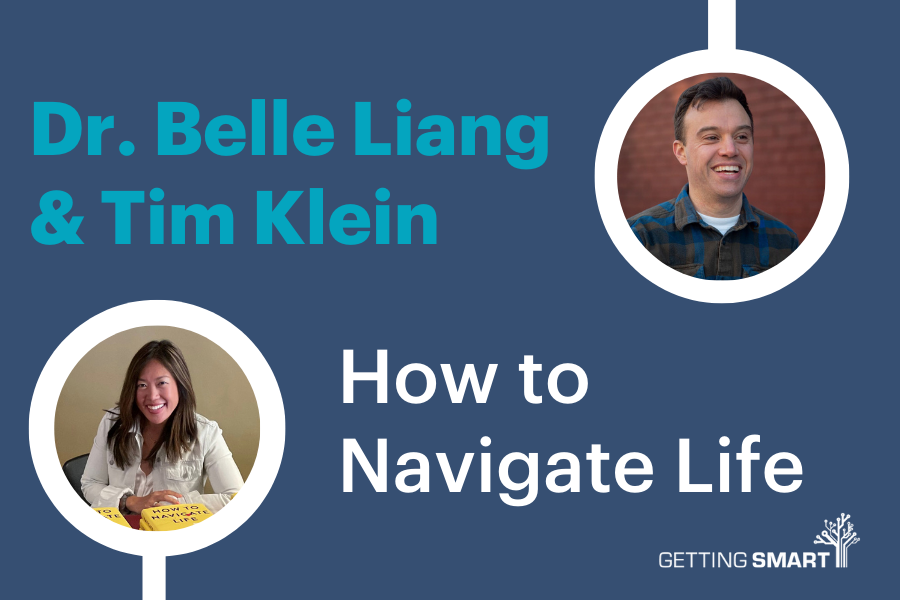
On this episode of the Getting Smart Podcast Tom Vander Ark is joined by Dr. Belle Liang, a professor of Counseling Psychology at Boston College, and Tim Klein, an award-winning urban educator, clinical therapist, school counselor and formerly served as the Chief Impact Officer at Project Wayfinder. Tim now works with Belle at the Purpose Lab.
Both are also authors of the great new book How to Navigate Life: The New Science of Finding Your Way in School, Career, and Beyond.
It’s actually almost impossible to learn if there aren’t positive feeling shappening while you’re doing it.
Tim Klein
Performance and passion mindsets are very me-oriented mindsets. When we are so focused on trying to attain all these things for ourselves: all the happiness in the world or all the achievement in the world… that’s a stressful proposition.
Dr. Belle Liang
Links:
- How to Navigate Life: The New Science of Finding Your Way in School, Career, and Beyond
- Howtonavigate.com
- Purpose Lab
- Dr. Belle Liang
- Tim Klein
Transcript
This transcript has not been edited for spelling accuracy.
Bell, why is a purpose mindset better than a performance mindset or a passion mindset? The purpose mindset leads to all the things that people with a performance mindset and passion mindset hope to attain. People with a performance mindset are looking for success and are looking for ultimate new breaching of goals.
People with a passion mindset are trying to follow their bliss, they’re trying to look for happiness. But ultimately, neither of those mindsets lead to those outcomes and destinations. The purpose mindset does. It’s people with a mindset that is about living a life that’s personally meaningful and that’s
about contributing to the world beyond itself. It’s sort of a perfect balance between the performance and passion mindsets. It’s a concern with what’s meaningful to oneself. It is about doing things that bring joy and meaning in one’s life. But at the same time, it’s also about contribution to the world outside.
It’s impact in the world outside oneself. And when you bring both of those things together, that’s when the magic happens, that ultimately you have all of these positive outcomes from our research. We see that it affects health, it affects mental health, it affects ultimately achievement and performance.
You’re listening to the Getting Smart podcast. I’m Tom Bannerick and today I have the pleasure of being joined by Dr. Belle Leang. She’s a professor at Boston College. She works together with our other guest, Tim Klein, at the Purpose Lab. And the two have written really the best and most important book of 2021 because it explains
human development. I were hearing how we should help young people develop a sense of purpose. The book’s called How to Navigate Life, the New Science of Finding Your Way in School, Career and Beyond. Belle and Tim, welcome.
Thank you so much. It’s so great to be here. Yeah, I’m really excited for this. Tim, your new book is so good. What a joy.
I just could hardly sit down when I was reading it. It’s really, really good. How long have you been working on the book? Oh, man, longer than I’d care to admit, I want to say this has been six years, five years in the making between when me and Belle started working together.
So five years in 2017 really started it and it’s kind of been this labor of love up to it. So I’m really excited to get out in the world. Belle, in a lot of ways, I imagine this feels like the culmination of your professional career and your teaching at Boston College.
There’s so much wisdom and science that you brought to bear in this book. You must feel good about the way it really weaves together your career in human development. Is that fair? I really appreciate your putting it that way. I think that this is very much living our purposes, that Tim and I are excited about
getting research out into the world that works. And particularly our hearts are for young people who are trying to navigate very uncertain times right now. They have always worried about these things that have to do with finding their way and now even more so in a very complicated world.
And so we’re just so excited to be able to bring to bear the research that we’ve been pumping out in our lab to an audience of real young people and their families and educators and as well as professionals. So your book just brought up a lot of memories and emotions of a 40-year career that for me started in the world of business.
I’m an engineer and an MBA and in my 20s just wanted to get rich and lived the flat out performance life. And then a series of explorations helped me find a real sense of passion for education. And so I feel like I’ve gone through phases where I’ve been very focused on this what you call the performance mindset over to the passion mindset of the…
And we’ve seen a lot of advice in the last 20 years of just follow your bliss. And I really love how your book explains the benefits and limitations of a performance mindset and a passion mindset and then really explores this idea of a purpose mindset. So, Bella, I’d love to have you describe in a little more detail what’s a performance mindset and is that really how we’ve organized schools for the most part today?
Is it around a performance mindset? It really is. For the last 30 years or so, the workplace as well as education has socialized young people to adopt what we call a performance mindset. And it really is what you described experiencing in your own life.
It’s this emphasis on achievement. It’s thinking that the purpose of life is to be successful and that I’ll stop at nothing to achieve that success. In this mindset, life is viewed as a hyper-competitive zero-sum game where there’s very few winners and many losers.
And so it’s kind of a race where you have to beat everybody else out in order to reach your goal of winning. So that’s the performance mindset. And Tim, how would you differentiate that from a passion mindset? The follow your bliss, just do what feels good.
Why isn’t that the answer? What’s the limitations to that? Yeah, I mean, and just to add where I think we’re at, I think we’re seeing the limitations of the performance mindset right now, right? Because we’re seeing young people, there’s a mental health crisis, there’s massive burnout,
the great resignation where people are quitting their jobs in mass. And so culturally, what we’re seeing is rejection of that performance mindset. And we’re seeing this massive shift to the other end of the continuum to what we call the passion mindset. And the passion mindset is the belief that the goal of life is to be happy.
And so what’s the point of being successful if you’re going to be miserable, right? And so it makes sense that people are focusing on happiness right now. The strategy can be problematic though, because the strategy of the passion mindset is to maximize positive emotions and it’s to reduce negative emotions. And what that subconsciously does, it sends a message to young people that negative emotions
are things to be avoided at all costs. And paradoxically, the research is very clear that the passion mindset leads to the same problems of burnout and mental health crisis of the performance mindset. Because it’s really just chasing personal fulfillment. Because the passion mindset is really about me.
The purpose mindset is the opposite. It’s not about me. It’s about a sense of contribution to a greater good. Is that right, Bill? That’s absolutely right.
That both of the other mindsets, the performance and passion mindset, are very me-oriented mindsets. And when we are so focused on ourselves and trying to attain all these things for ourselves, whether it’s all the happiness in the world or all the achievement in the world, that’s a stressful proposition.
There’s just so much writing on that in terms of your own self-worth and your self-esteem. And unfortunately, it doesn’t lead to those expected outcomes of feeling like you’ve ever fully come to a place that you’re satisfied with your success or you’re satisfied with your level of happiness. Because there’s always going to be someone who’s better than you.
There’s always going to be somebody who’s more. We’re in such a comparison culture where we determine whether or not we’re successful enough or happy enough by comparing ourselves with others. This is why looking at Instagram, you can go from happy to unhappy in 15 seconds. You’re just looking at others as your reference point for am I successful enough, am I happy
enough? And that’s just a never-winning proposition. And it’s a very different one than when you relinquish some of that need to fulfill yourself and you look outward from yourself to the world around you and you think about how can I contribute to the needs around me?
Suddenly, the pressure comes off. And I can share a little bit more about the research that shows why that’s the case. Bill, what does purpose have to do with agency? Do you like and use the term like learner agency? And what’s the linkage between developing a sense of agency and developing a sense of purpose?
Agency has such a large role in purpose because unlike the other two mindsets that are really about living up to others’ expectations or the world’s expectations for how happy we should be, how successful we should be. Purpose is about looking inward at what matters to you. And that’s a very different kind of emphasis.
And it’s not what we train young people to do in education or in parenting. We do a lot of telling them who they should be. And we do a lot of guiding them with all good intentions. We want them to be successful. We want them to learn from our mistakes.
We want them to understand things that they don’t understand yet in their young lives. And so we are constantly giving them advice. And unfortunately, that is a way of taking away young people’s agency and belief that they can make decisions for themselves. And so purpose, we think of as a compass, a decision-making framework, a compass for
making some of life’s biggest decisions, using one’s own sense of who we are, what internally motivates us, what is intrinsically valuable to us. And so purpose is all about reclaiming that sense of agency and voice and personal direction. Bill, your book made a beautiful case for difference-making. I mentioned that our last book is called Difference-Making at the Art of Learning.
And we argued that helping young people identify their strengths, interests, and values, and then connecting those to what the world needs, developing a sense of mutuality, that by connecting those two in the form of contribution, that we not only learn to make a difference, but develop the sense of agency, which might be the most important superpower. I think you made that case better than we did.
I don’t know about that, but that’s really kind of you to take notice that that’s an emphasis in our work that we’re doing. I appreciate the science that you brought to bear. And so I appreciated that about the construction of the first third of the book. Tim, I want to talk about growth games.
What in the world does that mean to play growth games? Now that you’ve begun to develop a purpose mindset, what is a growth game? I’m glad you brought that up. Yeah, it’s a growth game. So purpose is living a life that’s personally meaningful, that also contributes to the world
beyond the self. It has those two things. You have to do this deeper dive on what is personally meaningful to you. And so we found in the research that people with a purpose mindset, what’s personally meaningful to them is using the strengths that they feel makes them their best selves.
And so it can come down to this very cliched advice that we always hear, it’s like, use your strengths. But when we actually looked at the research on strengths, it gets kind of messy because how do you define a strength and who gets to determine what you are actually good at? And so we talk about the difference between growth games and fixed games.
And this is very, very much evoking back to Carol Dweck’s seminal work on growth mindset versus a fixed mindset. And we found in the work that there’s limitations to the growth mindset because we can tell people to play, to adopt a growth mindset, to believe that you can achieve anything. But if they are in a system that prioritizes a fixed mindset of achievement, competing
against other people, ranking how you are based on other people, they don’t actually get to use that growth mindset. And so a growth game in that chapter is talking about how we can design a learning environment for students that helps them by the very structure of the setting that they’re in. They will naturally develop a growth mindset where they get to use the strengths that make
them feel like their best selves. And so they have directly telling them, you know, you can do anything if you put your mind to it. So I love that. And I also appreciate that you’re a high school guy.
You’ve spent a lot of time in and around high schools and in guidance systems. So what it suggests to me is that there’s implications here not only for learning experiences, but learning environments, right? It’s creating a context that is that fosters growth mindset. Is that right, Jim?
Yes, that is exactly right. So a big part of our book is that we share these individual principles and elements of purpose. So the elements of purpose are the things we all need to feel like we are living a life that’s personally meaningful and contributes to the world beyond the self.
But individual mindsets, interventions can only go so far. We need to be changing, doing systems change at the same time. Because a big part of what we’ve ran into with our work is that every single person we talk to about living a life aligned with purpose, contributing to the world beyond the selves, being a difference maker, they agree with it, but then there’s a but.
And they’re like, that doesn’t feel like the world in which I live. You’re telling me to go pursue my own strengths and develop skills and go in a direction I want to. But I need to get these grades because my parents or my community is telling me to and I need these grades to get into the most highly rejective college that I can.
And so it feels out of place to tell people to adopt these principles of purpose in a system that is telling them to totally prioritize performance or passion. Yeah. So I want to jump ahead here. So it’s easy to read this section and sort of imagine how you would have shared that
with your advisory when you were in a high school. But what you’re suggesting is that math and chemistry class have to look different as well. If you take this seriously, so what might learning experiences look like in in these STEM fields if you take seriously the idea that we should create growth games?
Yeah. So you’re going to hear a lot of times with STEM and science and math. And so my whole career has been working with underperforming students, low income students who are barely graduating, barely going to college. And they’re going to say, when am I ever going to need calculus or algebra in my life?
How is when am I ever going to use this? And they’re not being smart Alex, who are just trying to push back. What they’re actually saying is what is the purpose of this? How is this personally relevant to me? And so it’s not about changing the content domain of chemistry or US history.
It is using the language of purpose to show these students how this domain can teach them where they can be using strengths in this class. They can be developing skills that they are motivated to learn. And it’s showing them by learning math or history or science or whatever. Here’s the contribution that you can be making in the world.
So essentially, there’s this two part domain. It’s helping students to identify their own elements of purpose. But it’s also using that language of purpose to help students know the purpose of whatever they’re learning. And if we can’t, as educators, explain the purpose of what they’re learning,
I don’t know how we can expect those students to take those classes seriously. So it’s not saying those classes aren’t serious. My wife is a US history teacher. It is very, very important. But it is framing what they are learning in a way that feels personally relevant to the students.
I’m hearing two instructional design implications. One is that there’s more co-authoring as you enter the experience. And two, that there’s more open-ended work than closed-ended. So maybe more long and open-ended challenges than short challenges with discrete answers. Are those fair?
Absolutely. And just absolutely. And so, like I said, my wife is a Boston Public School teacher. She does US history. And she’s teaching about the history of the United States, the history of Cuba,
the history of all these Latin American countries. But really, the way she frames what she’s talking about is through the lens of decision making. And so it’s like, when faced with unbelievable challenges, like how do you make decisions where you can overcome challenges? So the way she’s going to start her class next year is by saying, making it personally relevant.
And so it’s like asking her students, when have you ever had trouble making a decision in your life? When have you had problems overcoming adversity? That’s going to make that experience near to them. And then once students understand the importance of critical decision making in their lives, she says, now we’re going to learn, we’re going to take history as a way for you to learn
how these different countries have used different strategies to make critical decision makings in their lives. And that’s the co-authoring you’re talking about. And that’s the design principle of purpose. Because now students can see about what they’re learning is personally relevant to them.
Bill, you talked about future-proofing some skills and helping young people identify, identifying roles of contribution. You talked about being a creator, a facilitator, or a driver. What are those, are those roles? And are some people uniquely suited to those forms of contribution?
What are they? Yeah, so those three categories of roles really are a compilation of a number of skill sets. And we think that each of us has some degree of creator, facilitator, driver in us. But that there are certain kinds of skill sets that we lead with or that we’re most motivated to master.
Again, we’re going to go back to what Tim said, which is that we’re interested in what young people, young and old actually, want to become aspirationally, not just what they’ve been told they’re good at. So there may be a skill set that you are particularly motivated to master. Because it delights you.
It’s something that you’re intrinsically interested in versus that you’re naturally good at. And so those are three major categories that bring together what we call universal human skills. And some of the kinds of skills required, for example, as a facilitator. I see myself as somebody who’s got some facilitator and I also have some creator. And I might lead with a facilitator part, but the creator piece is very important to me too.
So facilitators are people who use relationship and the relational skills to get people behind a vision and get people working together effectively, are attuned socially and emotionally to your team so that you can help people to be at their best and most engaged in the work. A creator might be somebody who is like very innovative, is somebody who thinks out of the box, is oftentimes pushing the envelope, sometimes making a system a little uncomfortable,
but taking them in a needed direction. And that person may work really well with a facilitator who can help get others around their vision. A driver is somebody who has the skill set of really being able to take care of the nuts and bolts of the project. They are conscientious around the details. They know how to get the job done.
They know how to visualize what needs to be done and actually take care of sort of A to Z around the tasks involved. So those are the three general categories of skill sets that we think are really important in the future. They’re not just skills that will age out once technology takes over, but they’ll continue to be important into the future. And so it’s important that we are doing whatever we can in schools, at home, in the workplace
to really foster and cultivate those skill sets in young people besides the certain technical skills or certain academic content areas. We need to be also really cultivating these universal human skills. I want to come back and talk about the universal skills in a minute, but, Belle, I’d love to have you describe the four different value archetypes.
Trailblazer, Builder, Champion, or Guardian. These represent a set of values that could influence the sort of contribution that young people may want to make in the sort of environment that they may want to work in. So what do those value archetypes have to do with the skills that we just talked about? Are those complementary ideas?
They are really complementary ideas, and the value archetypes are based on core values. So we all have core values that we prioritize. We kind of care about them all, and yet there are certain ones that we prioritize. And there are two major continuos of core values that have been identified in the research as particularly salient in the ways that we go about our approach to work and leadership.
And one continuum is the one from an emphasis on individualism to a more collectivistic approach. And then the other continuum is an emphasis on growth and change to an emphasis on stability. And so if you can sort of see both of those continua in a grid, there are four quadrants of intersections of these two continuos. So high growth and high individualist folks have what we call a trailblazer archetype. So again, these people are very innovative.
They are about doing things that are sometimes outside of a system and really leading in a way that is disruptive. And yet needed in organizations. The opposite of people who are trailblazers tend to be high collectivists and high orientation around stability. We call them guardians, and they are people who really are those who preserve what’s tried and true in an organization. And then the other two categories are builder.
Those people are high collectivists and high growth oriented. They also push the envelope, but they do it within organizations and do it for the collective. They’re about making more space in the community for others. And then the opposite of them are those people who are high individualists and high stability. And we call them champions.
So they might be those people who really have figured out the system. They know how to work it and optimize it. So these value orientations really give us a sense of what kind of value we want to bring into settings. And one of the defining features of understanding value archetypes is that it’s important that our value archetype is valued in the system that we’re in. And so not only do we show interest in individual archetypes, but also the setting and see whether or not there’s a fit with our setting and our archetype.
Well, I wish I’d read your book in 94 because I went from working in a trailblazer environment, and then I became a public school superintendent, which my district was a bit more of a guardian mindset and a year to understand that I had just walked into a new value archetype and that everything that I said or did caused explosions to occur. Because it was a very different mindset and there was a set of values agreements in my new place of work. So I thought this was a beautiful construct. Can young people just take a Ryosek assessment or something like that to understand both their superpowers and their value archetype?
Or how do you get at these things? Well, this is really exciting to be able to talk about that we have coming out shortly several new assessment tools to help people identify their archetypes, their skill sets, the mindsets that they lead with, and the needs that they’re most motivated to contribute to in the world. And so we will have these assessment tools available for people who are interested in identifying who they are, how they work, the settings that they work in, whether they’re a good fit in those settings. And to learn more about it.
Yeah, the next chapter talked about the five big needs. And so the physical, personal, community, social and environmental. I’ve often said part of high school ought to be just introducing young people to the Earth Hunters Manual, the earth that they’re going to inherit. And the way you described it is there’s five big needs and you should understand those. And you should have some immersive experiences in each of those areas to begin to understand sort of where and how you want to make your contribution.
Is that right? Yeah, it is right. And so, you know, I think a big part of young people thriving is being pro-social, which is just, you know, a fancy way of saying they want to give back and they want to contribute. And, you know, we all say, hey, go be a changemaker, go change the world. But it’s easier said than done because, you know, what, how do we, what change we want to make in the world that feels personally meaningful to us?
So we really talk about introducing these five big needs going from smallest to biggest. So everyone has this needs for, you know, personal needs, just making sure you have enough food, water and clothes in the same place to live. And then we all have what we call psychological health needs around like psychological and physical health. And then we all have community needs about being like economically secure and part of a community. Then it goes bigger into societal needs where, you know, we have rights that are being violated and we can be in a free and fair society.
And then we all have environmental needs, right? About being able to live in a environmentally sustainable future. And so the way we go about this is we introduce this concept of these are the five needs. So we’re giving them the shared language of needs. And we’re asking them to be like, which needs do you care the most about?
And we really have found that, you know, the needs that you care most about are around two things. It’s around adversity and advantage. And so very simply, if one of these big five needs has not been met, that it’s made your life harder, that is an adversity, right? And so, and the research on purpose that I think is some of the most exciting research we’ve seen is that people who have experienced adversity, when they have a chance to make sense of that adversity and ruminate it and deliver it, they become more pro-social, they become more purposeful.
And so there was a big criticism in the purpose field that purpose is a privilege only for very privileged people who don’t have any problems. The research shows the complete opposite. And on the other end of that, you know, so it’s talking about how you can make sense of adversity. It’s not being it’s not being thankful for the adversity, but recognizing that the way you’ve responded to that adversity has given you an insight where you can use that insight to help other people who might be going through the same thing. But on the other end of the spectrum, we found that people develop a pro-social desire to meet needs through advantages.
So when they can recognize that they’ve had a massive advantage where this need has been met and they recognize that that net need is not met from other people, it helps them to develop gratitude around that because they’re like, oh my gosh, this need being met, whether it’s access to education, access to the workforce, access to like by rights being met, they develop gratitude and the research is very clear, gratitude turns into pro-social intentions. So it’s really just about giving them this language, the framework, and then letting them figure it out for themselves with the language of purpose. I super appreciated this part of the book. We really struggled with this one, writing difference making, and we wanted to make sure that it wasn’t just for affluence of urban kids that are doing service work.
And the way you explained that now having a purpose mindset and understanding the needs and exploring both adversity and advantage to empower contribution is for everyone. So I love that argument. Tim, I love the section on universal skills, this goes back to what Bell was talking about a minute ago. I could see some schools lifting this section on universal skills and just turning it into a portrait of a graduate. You could include creativity, problem solving, collaboration, cross-cultural and teamwork, written communication, accountability initiative.
It’s like, oh, that’s a really good list. Our goal is every kid is going to be really good at all of those skills. Is that what the purpose of high school should be? Yeah, I mean, can I geek out on where that came from for a sec? And this is one of the only podcasts that we can do it just because you have said that.
Yeah, and so these universal human skills, where they came from, is you can look at 21st century skills, social emotional learning. You can go onto the Harvard University website and look at every single different framework, CASEL, whatever it is. There’s really compelling research out at Colby Colby College where they did a deep dive into all the different frameworks around skills that’s used in education. And they found that it really came down every single skill set framework came down to these three areas. And those three areas were around cognitive skills.
So those are our creator skills. Those are just skills about using your mind, critical thinking, innovation, problem solving. And then it was interpersonal skills. So those are around people focus. That’s our facilitator, communication, collaboration, emotional intelligence.
And then the third one was called intrapersonal skills or character skills, right? About self-regulation, time management, organization. That’s our driver skill set, right? And so we think the power there is instead of saying, hey, these are all the skills we want you to have. We’re saying there’s only going to be three jobs in the future, really, when it comes down to it.
Creative jobs, facilitative jobs and driver jobs and a combination of those three. And what’s really exciting about this is that David Deming, who’s one of the leading labor economists out of Harvard University, he looked at every single job description that was put online since 2010. And they and they looked at every single soft skill that was posted on these. And then they categorized those soft skills.
Those soft skills that he found were the exact same three buckets of skills that we’re talking about in the universal human skills. So do we do we create like a master bar and say you have to be good at all of these skills? Or do we, Todd Rosers, say, you know, jagged profile, you’re going to be good at some and not others? What how should we think about the expectation around those skills? Yeah, so I would say I think from our anecdotes around this, I would say we all have a primary skill set and a secondary skill set.
And for me, it’s creator first, facilitator second. And I’ll just say very, very recently, I was diagnosed with ADHD, right? And I never thought about myself having ADHD before. But it makes sense because I’m a trailblazer. I like to go out and be divergent.
I come up with a lot of different ideas. You talk to my wife, I’m very disorganized. I don’t put my clothes away. And so I have ADHD that has made me wildly successful in innovating in the realm of education. It’s been in writing this book, it was the number one weapon that I had.
But when it comes to an academic system where I had to have very organized, detail oriented, follow rules outside myself, driver skill sets, right? I struggle in those situations. And so I would say, and I think a lot of the time what we do is it’s very clear in education and the research is clear. We prioritize driver skill sets first and then to a degree creator skillsets around critical thinking. And we overlook facilitator skill sets.
We say they’re important, but we don’t officially value them. So I would go on the Todd Rose jagged edge where it’s identifying where where your natural inclinations are. And then also understanding why and understanding the pros and the cons. And because I’ve had that awareness now, I’ve been more intentional about being a driver. But I don’t think it’s I don’t think it’s every size fits all.
I think it’s letting students decide which area do they want to focus on. Because if you can actively engage and build any one of these skill sets, David Deming’s research makes very clear. There is a place in the workforce for you where that’s going to be a highly valued skill set. I love that answer. So the goal now a little more difficult to describe than just get A’s in all your classes and go to college is really coming to understand your strengths,
your interests in terms of the needs in the world and your values, right? The environment within which you most thrive in making a contribution that that some version of that ought to be the goal for high school is coming to an understanding of that set. Is that well, does that sound about right? I think that’s absolutely true is recognizing just as Tim did that, you know, he has certain skills and strengths that really are valuable. But, you know, others that are less valuable to him, like that are not the ones that he wants to master.
Now, I also think that what Tim said was really important, which is that you can grow in any of these skill sets if they become important to you. So like maybe Tim is going to, you know, tune into putting his clothes away or becoming more, you know, tuned into the details around organization of a project because the project has become so important to him. So it’s motivating, you know, that’s motivating to, you know, learn the additional skill sets. But I think that one of the, you know, the good news messages from this research and work is that your skill set, whatever it is, is valuable. It’s needed in the world and embrace it and understand what motivates you and continue to grow in that direction.
If there’s another skill set that you’re not good at yet, but you’re extremely motivated to master, then work on that and that’ll be valuable as well. Well, yeah, just to add on that, and I just think when you look at education right now, you know, standardized test scores are becoming optional, right? And so we’re so in education in the world of college, quantitative metrics to evaluate students are being seen as very, very problematic because they are problematic and they are unfair for a lot of our low income marginalized students. And so we are going to see a shift from quantitative to qualitative evaluation of students for college for the world of work. And what that means, it’s not the grade that’s going to matter.
It’s going to be the narrative that you tell about yourself about your past, who you are, who you are now and where you want to go in the future. And what the people with a purpose mindset do, their purpose weaves together a very compelling narrative about your past, how that informs who you are today and how that informs how you want to grow in the future. And so I would just say this portrait of a graduate and just getting students to be able to tell the narrative of what they’ve learned is going to be much, much more important in the world of education than just what their standardized test score or what their GPA is. Bill, I want to have you talk about pathways. We recently launched a pathways campaign, a new pathways campaign, because we’re trying to help America sort of reimagine high schools.
You said the way we’ve historically thought about pathways has limitations. Describe the limitations of the way we’ve historically thought about a pathway from here to a job. I really think that, you know, this will be different for your new pathways, of course, but the old pathways have been a way of taking away agency for young people. It’s telling them, you know, you’ve got to go from A to B to, you know, C to D. And this is, you know, the way that everybody should go. It’s a one size fits all kind of pathway. And, you know, that’s what comes to mind when you think of the metaphor of a pathway is that once you’re on it, it should lead to one destination and there’s a particular, you know, sort of step by step direction that you should take to get there. What we’re saying is that, you know, that is really not conducive to the growth games that we talked about earlier. What we are, you know, needing to do for young people is to really
Take it out of the pathway metaphor into more of a journey metaphor, you know, that life is more of an adventure. It’s windy. It requires sometimes, you know, coming off the beaten trail to, you know, take the scenic route. So that you can explore areas of yourself and experiences that you wouldn’t have taken if you had gone the pathway route. You know, you’re you’re about discovering what is intrinsically mattering to you and not just extrinsically valued and, you know, is it the things that are in accordance with these extrinsic metrics of success that Tim was talking about. You know, that getting good grades and test scores so that you could get into the most rejected colleges so that you can get into jobs that have a certain Title and salary and so on that that is not freedom for young people that’s your depressive life and mindset. And what we want to see is freedom in young people to be able to explore and
And the irony of all this is that we’re not, you know, we’re we’re we’re very practical people. We know that they need to make a living and We what we see in our research is that these same young people who have more of this purpose mindset that you know are able to stray from pathways. They’re actually very successful on the pathway. They’re actually the ones who do Perform really well there, but they have a different motivation while they’re on some of these pathways. And ultimately, they they definitely are more resilient and happier than those people who are, you know, strictly trying to follow the path towards these achievement goals and ultimate destinations that that don’t arrive in the way that they hope. Bell I I loved how rather than thinking about it as a one directional pathway that we could think of this as a seeker’s journey.
I loved how you talked about embracing the adventure driven by questions questions around strengths, interest values and contribution. Tim, I loved in that chapter the discussion of sparks all the different kinds of sparks gratitude joy love interest hope pride awe amazement that as as a learning design and learning facilitators that we should really be Setting the spark looking for sparks. We’re that idea for sparks come from what should we do with that as teachers and learning facilitators. Yeah, I love that you bring that up and that is some of my favorite research in there. That’s from Dr Barbara Fredrickson’s work. She’s out of UNC. She has two books one called positivity and one called love 2.0.
And she really studies the neuroscience of positive emotions. And so these purpose sparks are different positive emotions joy gratitude serenity pride and they elicit what’s called specific action tendencies. And so what happens bell talked about how we should be seeing this as an open ended seeker’s journey where there is no specific path you need to take. It’s more about using a compass to figure out if you’re going in the right direction. If you don’t know where you’re going. Her research has found that when we experience joy, our visio spatial attention actually widens. So literally physically we see more of the world when we’re experiencing joy when we’re feeling creative more we’re lighting up different parts of our brain we’re using more of our brain there. And so to me it’s the way we talk about baking kids feel good right it’s in and in itself but this is actually saying we need to put positive emotions front and center in education because physiologically biochemically when student the more positive emotions students feel in school.
It has an impact on their body where it’s actually equipping them with the tools they need to learn and also it’s giving them the tools they need to go out and pursue a seeker’s journey. And so I think a lot of the time in education we you know I love SEL but a lot of the time it’s like positive emotions are for SEL only we’re going to put them to the side here and then when it’s time for real learning. We’re not like positive emotions are nice to have it’s not critical and I think Barbara Fredrickson’s Fredrickson’s work is like no the science is very clear it’s actually almost impossible to learn if there isn’t positive residency happening while you’re doing it so. Bell we haven’t talked about relationships but we are talking about human development and you’ve laid out a beautiful framework for for human development but what does relationships have to do with all of this. Everything really you know when we did our research on young people from all walks of life.
We saw that you know from the most privileged young people growing up in affluent communities at the sort of most selective private schools. To those who are the most impoverished young people living in the Guatemala City dump where you know they their currency was to to pick trash and sell it on the open market. For all of those young people they had something in common and that was those young people who were successful in that environment and they ultimately were you know happier and more resilient. They shared what we you know what we call a purpose mindset and why when we do research into like how they got that mindset. It was all about these key relationships there were certain elements of what we call elements of purpose that were being cultivated by these mentors parents.
Significant people in these young people’s lives were drawing out this creative there are creative artistry were drawing out. These purpose elements that you know that we that we talk about in the book this skills the strengths this desire to contribute to the world beyond the self the. Clarity around the values that you’re willing to to sacrifice for and it was really these key relationships that enabled you know these young people to cultivate those qualities. We’ve been talking to Dr. Bell the Ang and Tim Klein they’re from the Purpose Lab and we’ve been talking about their fantastic new book how to navigate life. How to navigate life the new science of finding your way in school career and beyond Tim and Bell I think we have to do another hour and just go through.
Implications in even more detail what a phenomenal contribution to the field so just thank you to both of you for all the work that you’ve done that has led up to this book and. This is a beautiful was it a covert contribution Bell. I we did a lot of work over cove it it did slow us down a little bit but we got it done. Tim we’re working people find the Purpose Lab. Yeah you can see it at Purpose Labs dot org and it has all Bell is very humble but she’s one of the global experts in mentoring and purpose and so if you want to dive into the research itself her work is eminently accessible and it’s written in a way that.
That’s like very yeah it’s just easy to read and you can find more about our work at how to navigate dot com. How to navigate dot com and everybody check out how to navigate life it should be required reading for high school students high school teachers it’s equally important in post secondary in higher ed. I think moms and dads and grandparents would get a lot out of it check it out it’s a great book Tim and Bell thank you so much for being with us. Thank you for having us so much time this was such a joy we enjoyed speaking with you so much. And I want to thank our our master of purposeful mindset Mason Pasha and the whole getting smart team for making this podcast possible until next week keep learning and keep innovating for equity.
Thanks for tuning into the Getting Smart podcast today. We want this podcast to be actionable and insightful and a great way to learn about what’s next in learning in order to stay on the cutting edge. We need people in the field to tell us what they’re hearing what they’re wanting and what they’re needing to learn more about. Got a topic or a guest in mind send your recommendations to me Mason and getting smart dot com. And if you like what you’re hearing don’t forget to leave a review in Apple podcasts or subscribe wherever you listen.
Feel free to share the podcast on social media using the hashtag GS podcasts. Thanks so much.



0 Comments
Leave a Comment
Your email address will not be published. All fields are required.