

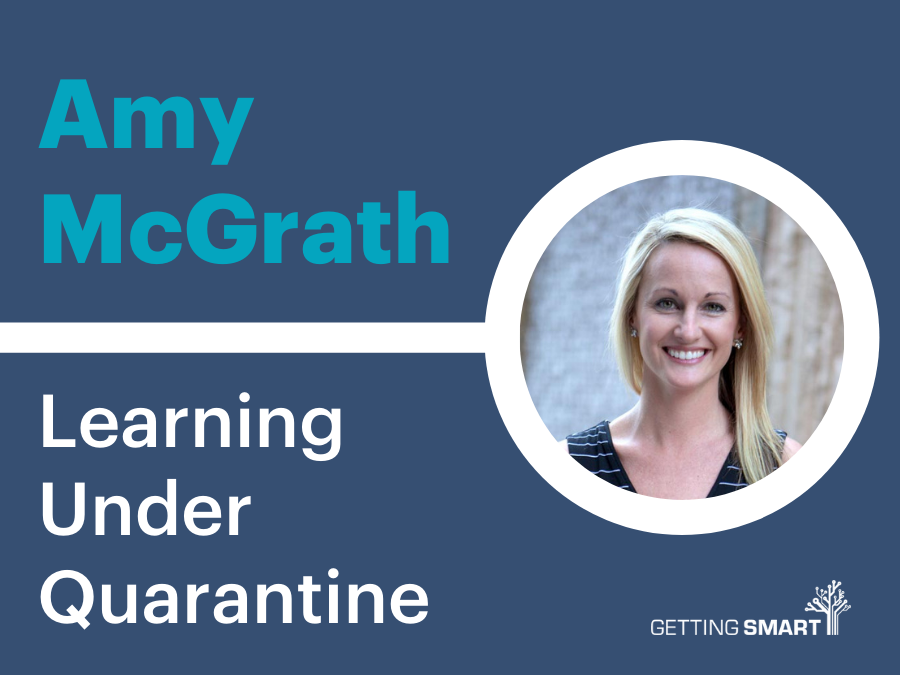
Amy McGrath on Learning Under Quarantine
Key Points
-
Students need access to high quality online options, no matter where they are or the state of the world.
-
Universities should be asking themselves what assets they can bring to their learners at whatever stage they are at in their learning journey.
This episode of the Getting Smart Podcast is sponsored by GettingSmart.com.
On this episode of the Getting Smart Podcast, Nate McClennen is joined by Amy McGrath, Deputy Vice President of Arizona State University. They discuss Learning Under Quarantine, a new model that is a fully adaptable, just-in-time learning support for students who have been temporarily sent home for any reason.
Amy has spent the vast majority of her career in education, working in education innovation and transformation as well as personalized learning. This exciting new initiative is a natural build on these professional passions.
Let’s listen in as they discuss student supports, online learning and what higher education can do for students of all ages.
“[We need to talk about] what does solid online, virtual, hybrid learning look like so that the future is not going to be the same, so that we can build something that’s more elastic, and flexible and resilient. There will undoubtedly be more crises that hit us and we all need to be prepared for our kids.”
Transcript
This transcript has not been edited for spelling accuracy.
Hey listeners, before we jump in today, we wanted to let you know about some exciting updates for Getting Smart followers. We recently launched a brand new website, which is faster, cleaner, easier to navigate, and helps us keep you in the loop with all things Getting Smart. It also has a new and improved search functionality, more accurate recommendations for what you
should read next, playlists, and much more. Check it out at GettingSmart.com. Alright, let’s get to the conversation. You’re listening to the Getting Smart podcast. I’m Nate McLennan, and today I’m talking with Amy McGrath, Deputy Vice President of
Arizona State University. Amy and I will be discussing Learning Under Quarantine, a new model that is fully adaptable just in time online learning support for students who have been temporarily sent home for any reason. Amy has spent the vast majority of her career in education, working in education innovation
and transformation as well as personalized learning. This exciting new initiative is a natural build on these professional passions. Here at Getting Smart, we’re always excited to talk to the team at Arizona State University and love our partnership with ASU Prep, including past support for ASU Prep Digital and currently helping with the launch of a few new bricks and mortar schools in Phoenix.
Amy, thanks so much for being here today. Thanks for having me, Nate. So let’s start with your journey. You’ve done a lot of things in your career, but how about a quick introduction, your professional journey and where you are right now?
Sure. So I am a teacher, and that’s how I started my career. And I just kept raising my hand to say yes to things. I said yes to technology when we were still in dial-up. I said yes to having my high school American history students try to code one of their very
first lessons that they had to present to their classmates. And so that kind of passion started early in my career, and that led me to the Florida Virtual School, which is where I transitioned out of the classroom and out of an administrative position in Orange County, Florida, into working at the Florida Virtual School, where I was a virtual teacher and mentor and principal and superintendent and worked on the leadership
team there. And again, just continued to raise my hand to say yes. And so I had an opportunity to do a few other fun, very difficult, lots of bruise and scars initiatives that taught me a lot, including trying to launch an international school in China.
And during that process, with several other very smart colleagues, I learned that there’s something really missing in this model building of kind of seamless education for students to be able to move on when ready. And a lot of it was, you know, I was seeing a lot of underserved students that were accelerated and they didn’t have access to college courses when they needed.
So somehow I found myself with the progressive and innovative vision of Arizona State University and have joined the team almost, it’s four and a half years now, to help ASU think about K-12 and to be able to, you know, as we at ASU are so passionate on learning and that entire sort of, we call it from pre-K through gray, what, you know, what assets can the university bring to students no matter where they are in their learning journey.
So that’s what I’m working on now. Yeah, it seems like the ASU is out in front in so many ways with big audacious goals about how do we impact communities? How do we partner with communities? So digitally and Rickson Mordor and on the ground as well.
So we’re obviously in this challenging pandemic. It’s impacted the world in so many ways. In your world of online learning with all your past experiences and now with ASU prep, digital and ASU in general, are we at an inflection point? Is this a big sea change for online learning or will we just fall back to where we were before?
What’s your thought on that? I sure hope not. I think for so many of you and others that have been in educational technology and in this space for so long, it’s exciting that my mom friends and all of the other people in my social circles kind of know what I do now because we all had to do that no matter
who we were or what our jobs were. So I do see COVID as a really disruptive force that has forced change. And I do think it’s going to help so many educational systems that have been stagnant for so long to potentially build new models. But I do have some reticence as I’m watching.
We’re still in the thick of it. So, you know, there’s really not this term post COVID where, you know, we’re kind of trying to navigate around right now. But I, you know, I am seeing even just from a policy perspective, some of the the ways that states are kind of stepping back because online learning when not done well can be
very damaging for students. And because so many districts were not prepared and we didn’t get the luxury of designing a lot of these models, it was very reactive. And so I can very much understand why there’s some reticence from policymakers, from superintendents to to potentially accelerate, you know, big levers around funding and policy
that could help really great models thrive. And so that’s why I think these conversations are so incredibly important for us to be able to talk about what does solid online virtual hybrid learning look like so that the future is not going to be the same and that we can actually build something that is more elastic and flexible and resilient because there’s undoubtedly going to be more, you know, crisis
that comes and hits us and we all need to be prepared for our kids. Exactly. We don’t want to have to have as a school leader or district leader, we don’t have to make want to make a choice that’s a choice for bad online learning. So you can see the reticence that’s happening and the challenge of I know New York City
public schools open today and there are no options for online learning for those students. And so so we need to be thinking in this ecosystem and you’re right out in front of saying what does it look like to be high quality? What does it look like to be personalized? Make sure that everybody has access to it.
So so given that you you at ASU prep have have all been really deeply thinking about the ecosystem of ASU prep. So can you give our listeners just a little bit of an understanding of the system you’re working within because it’s an interesting and complicated. Sure, it is.
And we embrace the complexities for sure. And so ASU, of course, is a post secondary institution and many most post secondary institutions are keenly focused on their degree seeking learners. But one of the great innovations at ASU is just the way the enterprise operates. And so ASU prep is ASU’s K-12 platform.
And I say platform very broadly because it is part of the vision for it to be deployed in it could be potentially a brick and mortar charter school. The it ASU prep could be in the form of a partnership with the Department of Education and Arizona. It could be in the form of a superintendent that needs some help in California.
And so really, it’s a platform that has almost a marketplace of assets. In our model, we have hundreds of really highly qualified teachers all across the country to be able to come and support learners using the underpinning platform of digital assets. So that’s kind of in concept and practice for the last 10 years. ASU has been chartering physical charter schools in the Phoenix area.
And so we have 10 physical brick and mortar hybrid and immersion schools in the Phoenix area that serve really different modalities, different socioeconomic profiles, urban rule. Very passionate about trying to prove that every single learner can and that every learner really is equipped that they just need the right mechanisms of support to be able to have the learning momentum that they that they need on their journey.
So we have 10 physical schools and then our 11th charter is our ASU prep digital. And so that is a full time academy that’s available to students across the state. As you can imagine, we had massive growth in 2020 when COVID hit. So we grew 700 percent there and as well as, of course, in the state, it’s free to students. But our tuition model, we call that ASU prep global is anything outside of the state so that we can have
full time students that are coming through our virtual diploma seeking K-12 school. Or we also work through collaborations with school districts and some very unique things in like thinking creatively with with Utah and how we can leverage the state online education program funds so that we can bring ASU assets to private schools. So there’s lots of different ways.
We are very solution oriented and very elastic. So most of our conversations are really what are the problems and how can we try to figure out together and collaboratively? The intended outcome is just an improve and increase academic achievement. And so we just have as many assets that we can go find.
I jokingly call myself Sherlock Holmes. If we have a problem, I think I can get somewhere in one of the academic units to find a solution and make it somehow relevant to the K-12 context. And and do the bricks and mortar interact with do they use the same online platform for their learning? How does that work in terms of integration?
Yeah, so ASU Prep Digital is more of this underpinning digital platform that has best of breed at some of our own intellectual property. Some that we would have found from publishers that we think is working really well. Some really cool adaptive tools that maybe a professional learning community of teachers have come together. And it goes through our security reviews, etc.
So we have these kind of approved assets that act as sort of what would we would consider curating playlists for our students. So it may look a little different from classroom in the classroom, but we have a platform that is the repository of digital content that gets deployed to each of our schools. Got it. So single platform, multiple modalities,
whether delivered to your virtual students or delivered to your on site students, but really crossing over and integrating across the board. Yep, exactly. You said it much more simply. Give me a sense of scale just in terms of numbers. How many are enrolled in your bricks and mortar and then how many are virtual?
What does that look like in terms of numbers right now? So across our 10 schools in the Phoenix area, we have about 3,000 kindergarten through 12th grade students and they can come in person for five days a week or they can come in hybrid. And that’s something we launched last year just in response to making sure that we were able to find
what model worked for working families, etc. So about 3,000 students there continuing to grow. As you know, Nate, because you’re part of some of the design work that we’re doing, well, we are continuing in the geographic sense around the state to find out where potentially we need to come in and support.
We’ve acquired schools and done turnaround efforts, etc. Over the next five years that will certainly grow. And then on the digital sense, we’ve got some pretty massive growth there as it relates to full-time students kindergarten through 12th grade. We have 4,000 learners and then in terms of partnership,
and this is more of the a la carte that might look like us working with a school district that just needs some licensing content, where you might be going in to do professional development and bring a learning management system and really power an entire AOI, which would be an Arizona online effort that the school wants to draw down on their funding, but actually have us help them
support powering that AOI. So there’s that is inside of the state as well as nationally, we’ve got 52,000 enrollments that we’re serving. And so again, that could be just one course or it could be four or five courses. So it’s different from school to school.
Right. So let’s pivot now to the world of quarantine, which is as we know is being updated daily. It’s variable across the country with some states requiring it, some states not requiring it, and those that are requiring it, they’re all different from one another. Right.
So it’s a confusing ecosystem. It’s confusing for parents, probably for teachers, for leaders. You have come up at Arizona State through the ASU Prep Digital, this model of learning under quarantine.
So talk to me a little bit about that. I’m super excited about how do we do this on demand work and meet the needs of students that have to step out of school for five days, 10 days, and then can reintegrate back in. How are you meeting that need and where did that idea come from and what does it look like? Yeah.
And it’s something we certainly at ASU Prep were very lucky to feel prepared. So when schools were shutting down in 2020 just quickly and abruptly, we felt prepared that there was school did not stop. The learning momentum continued because we were able to immediately have our students have access from wherever their devices were, wherever their Wi-Fi was.
And if they didn’t have that hardware or infrastructure, we were able to get it to them. So we did have a lot that we in that preparation, we became very passionate about wanting to make sure that we’re always very state focused. So how can we improve the access to that infrastructure around the state through a partnership with the Department of Education, with the governor’s office, through funders
and philanthropists? How can we be a catalyst in that? So it’s something we really focused on over the last six to eight months to design new models to test out around the state, but then also to bring more to the national stage. And so our students performed well, they showed up, they were there every single day.
Our attendance when they were zooming from home was pretty phenomenal because we cared so much about engagement. We had elementary kids that were in the kitchen, in the garden, and they were, they’re not just sitting for six, seven hours at zoom because I can barely handle doing that as an adult.
So they’re thoughtful in how we were building lesson plans and our teachers were phenomenal. They thrived. They taught one another. And so a lot of really interesting and valuable models came from that that we’re applying now. And one that you mentioned, Nate, is that learning under quarantine.
And so in this really volatile time where schools open, but maybe a kindergarten class has to close or trace contact and you have to send seven or eight students home, whatever the rules or the public health measures are, the one thing that’s constant is just the volatility. And so in our conversations with school districts, we’ve decided to come up with this model
called learning under quarantine and really focus heavily on math and ELA. Obviously literacy and math are where we’ve seen the exasperated learning loss. And so we’ve been working on the national standards kindergarten through 12th grade and creating by grade level power standards that, you know, should generally across the calendar, we can assume where, you know, in math, they’re going to be working on polynomials during this
time. And so we’ve been creating these power standards that we can hone in and get very specific and relevant to whatever classroom we’re working with in collaboration with the teacher. Once we actually get the chance to have the students come. And so those students that if a class is continuing in person, but maybe a percent of those students
have to go home for a 10 day quarantine, then we have this kind of library of power standards. And we have a bench of highly qualified, trained, ready teachers that are going to come alongside and be adjacent to that in classroom teacher. So one thing that we know certainly was incredibly difficult is when teachers had kids in the classroom and kids at home.
You can’t really do that super well. And so we’re trying to say, how can we come alongside and allow the teachers to do what they need to do, move around the classroom, have individual conversations and not be so worried about the students at home. And so to be able to help with that balance is when we came up with the learning under
quarantine model, we’ve seen great success so far. Okay. So I have a lot of questions around the model. So I think so. So I really appreciate the parallel or the partner teaching piece here because I think we’ve all realized that one, it’s hard, as you said, and the other pieces.
I think there’s distinctly different skill sets for someone who’s trying to deliver something online and work with students online, someone who’s in front of a group of students. And so I do think that there’s a level of expertise that’s required in both those things. And often teachers, it’s hard to wear both those hats. In this learning under quarantine model, are these schools already partnered or the classroom,
are they already partnered with ASU Prep Digital? Or if a school suddenly found themselves with a lot of quarantine issues, could they jump on spontaneously? How does the partnership work here? Yeah, that’s a great question. Many of them have happened organically. In fact, we designed this because we were learning from all of the problems that,
problems may not be fair from the challenges that schools were faced with keeping, as you said, teachers from not wanting to just give up. At this point, it’s so difficult to be a teacher just in the normal sense, but you throw in all of these other variables and it’s incredibly hard. So when ASU started a partnership with the Department of Education and the governor’s
office and Helios came together and essentially made professional development free to every K-12 school, public or charter school in the state, we started creating lots and lots of boot camp on what is it like to be an engaging teacher? How do you go back into the classroom? What do you do if you’ve honed your craft online and you like it better? So some of these kind of elephant in the rid questions.
In that process, we developed really deep relationships with schools in a different way. We weren’t there as a service provider or a vendor. We were there as a collaborator trying to figure out, okay, this next year is going to look really kind of crazy. What are your hardest things? You’re looking at your master schedule. So everyone looks a little bit different, but if we already have an established relationship and where we have a teacher kind of mentoring
and we’re kind of buddying with the in-classroom teacher, they look at what that that month looks like here, the standards that we want to make sure that we cover just in preparation for, you know, with how incredibly just rampant this is right now, kids are going to be coming in and out. And so that teacher in peer with the classroom teacher is able to sort of stay in pretty consistent dialogue with what standards need to be during that particular 10-day period
where those students would be quarantined. And it might be stackable. So as you noted, you might have a student that starts their 10-day and then six days later another student starts their 10-day quarantine. In other districts, we’ve seen it’s a 14-day quarantine. Some of them have seven-day quarantine. So it’s very, very different and we’re very prepared for then they were not, they’re not going to jump right in with the students who started their 10-day. They’re
going to have their own. So it’s high dose tutoring. It’s being present. It’s showing up. It’s being available. And so that’s when we knew we needed to just build a bench of both adjunct and full-time, highly qualified instructors that were able to do that in a really flexible manner. Right. It seems that this on-demand model also is really, has to be found and grounded in this idea of proficiency around your essential standards rather than at the level of course. I think Tom
and I have been talking a lot about this unbundling of moving away from course choice, which is important, but also down to this idea of standards choice. Like what standards are you working on? What does that learning experience look like? And when you have a bench of teachers ready to go, they are at that level of granularity so that they can work on specific skills and content for those particular students. Yep. I could not agree more. It’s, and it’s really important
even when we have a group of maybe five to 10 students that enter into this 10-day learning under quarantine model, they’re all coming from different points of readiness. So we do give them a quick adaptive diagnostic assessment to say, okay, this student’s actually here and is going to need this. And this is the style that the teacher needs to engage with them. And texting and calling, and if they’re going to meet four days a week and then they give them assignments. And so there’s
this, it’s this really wonderful way to give a little dose of what it doesn’t always have to be synchronous. A lot of high school kids, particularly, they don’t, they need a little bit with the teacher and then they want to go away and work and come back. It’s just about being there and being ready and being available. So modeling that as well for the classroom teacher, we’ve really seen some great results there for some of, you know, that great online teaching pedagogy to sort of merge into with
the classroom as well. It seems that ultimately, you’re starting to make traction towards this idea that how do we meet every student’s need at the time that they need it with the content and skills development in the way that makes sense to them, right? And it goes back to why is it that one-on-one tutoring makes sense to help accelerate people during the pandemic is because it helps accelerate people and during prior to the pandemic. It’s when you’re working one-on-one with someone,
then it becomes ultimately the personalized experience. Yeah, and our core beliefs around what the future of learning looks like, this is just a technical model. You know, this is, and that’s why, you know, I spoke earlier to COVID is a very strong force that’s that’s begging and forcing change. But what I think is the silver lining in all of this is that it’s, we can’t just systemize everything. It is going, there’s so many different variables that are coming at us,
coming at the teachers, coming at the learners, that we kind of have to have our bank of lesson plans looking ready to be different on a day-to-day basis. And so even though it’s uncomfortable, it’s incredibly hard. It’s highlighting that we even have to change how we train the teachers, which is something, you know, at our teachers college at ASU we’re doing as well is, you know, it’s going to be incredibly important that we, that every single learner is in every modality
as opposed to just the traditional potential path of training that we once thought was was useful. It seems that we are hopefully going to be out of the pandemic at some point in the next one to two years, knock on wood, I might have said that a year ago. However, what’s next for learning under quarantine because it might not be quarantine, but where do you see this as a stepping stone for? And if you’ve alluded to it a little bit around ultra personalized, how do we
make sure that every student gets the things that they need at the time that they need it? Do you see this as something that will perpetuate? Are you going to add more subject areas, more content areas, more skill areas? What’s the vision moving forward? Yeah, I do think that learning under quarantine is just one example of thinking beyond school walls to consider how learning can happen anywhere. And as long as we have the student in the center,
then a lot of different models are going to come from that. So I think we will continue to build out the depth of learning under quarantine in some odd human way. I hope that it’s not a forever because I hope that we don’t have to even use the word quarantine. But at the same time, it’s teaching us, it’s teaching our partners that you kind of have to be ready for anything. And that kind of goes into the vision piece of we’re never going to stop innovating. And that’s sort of in
the DNA of ASU. And so this has forced our imaginations to think differently of what personalized learning looks like in practice and ask kids a lot more. We’ve seen some of the most amazing assignments and kids are showing us how they’re learning in such different ways because they’re not just inside of a classroom. And so I know you’re asking specific to learning under quarantine, we’ll continue to build that out. And we would love for, we know we’re having conversations with
the state to see how can we more or less formalize this so that no school has to shut down a classroom, that there are just ready at home learning assets that are available for every single school. And so ASU is going to certainly be there to help collaborate and support in that effort. But it also we’re hoping that’ll just be one of a dozen different models that come as we sort of break down the idea that it has to happen in school walls. And it might even be that a student is struggling
and the teacher doesn’t have the capacity to address that they could jump into something like this, a student needs acceleration, but it could be that again that on time on demand, ready to match what that teacher is doing in the classroom. It makes me think Amy, yeah, it makes me think Amy a little bit about context and how are you thinking, you talked about being learner centered and students at the center and that the students are teaching you a lot about what they create. Are you seeing
local relevant contexts come out? So what’s important for the students coming out in what they’re demonstrating proficiency on? How does that look? Yeah, if I think I know where you’re going with this, a lot of the qualitative side of we’re getting to know our students in different ways. Even being on Zoom, you can see their backgrounds, you meet their animals, you see their families, you hear the noise, somebody’s their internet’s breaking down, you’re interacting
with kids in such a different way than sometimes you do in just a classroom model. And so I think it’s been, at least for our expert teachers, the need to spend a lot of time on emotional intelligence and learning agility has been very key. So the subjects, the academic and cognitive content is that is real. And we’re continuing to work and push our students forward so that they’re able to perform and to grow. But where there’s also been just exposed gaps is on how much time we
need to spend asking students how they are. And the depression, the, I mean, obviously, I’m sure you’ve talked about with many other guests, the social climate is very difficult too. So, you know, we’ve had a lot of professional development for our teachers on how to have constructive, difficult dialogue. Because we know if that is in front of the students, it’s going to be difficult for them to be able to learn. And so I think that’s another piece,
as an example of putting students at the center, because teachers get really excited about their lesson plans. Teachers get really excited about their content, especially six through 12. I’m a, I am a history teacher, and I cannot wait to teach this lesson. But coming in with a completely different perspective and more thinking through the lens of the student, how hard was their morning, did they eat? Can they actually even get on screen? Is their bandwidth bad? Those are some of those
questions that we’re forcing ourselves to be a little bit more selfless as teachers, as educators, so that we can bring the students in. And then we’ll see, I think, the fruits of that labor as well. That drawing out, drawing out from students and understanding what’s important to them. And I always thought when I taught, I’d always ask the question, do they care about this? And my part of my job is to convey the content that’s required of them and the skills that’s required of them,
in a way that makes them care about it. And I think that’s the holy grail of teaching in so many ways is to make that magic happen. And when you’re in a way that can meet the needs of them at the time that they need it in an environment that’s safe and comfortable for them, I think you have an added advantage. I was just going to add, I think it’s important, the community driven piece, I think, that, you know, with our kids at, you know, many kids are going to boys and girls clubs, to
libraries, to wherever they can to get some of the bandwidth or infrastructure challenges solved for them. And so another area that I think is really key is the peer to peer learning. And so online communities that gets very difficult to do. So helping teachers think creatively about internship opportunities or how can the students feel connected to someone on the, you know, in a different state in a different country and that global connection, I think is another great opportunity
for us because really believing that the future of learning is community driven as key as well. And how can they go out into the community, internship or apprenticeship and even designing solutions to any of the challenges that they see out there? And how do we help young people build agency? And if you’re thinking about that, as well as the content and skills that are required of them, then we are helping develop young people into the citizens that the world needs.
Amy, it has been fantastic talking to you today. If our listeners want to understand more, know more, learn more about what’s happening in your world, where can they do find that and what can they do in order to make that happen? Yeah, ASUprepDigital.org is a great place to more expansively find some of what’s going on at ASU Prep Digital. Of course, you know, ASU Prep and ASU, we’ve got so many initiatives going on. I’m always happy to talk. So Amy.mograph at ASU.edu and
would love to help really any creative educators that are trying to make changes and help students. So thank you so much for giving us the opportunity to talk about learning under quarantine today. Amy, thank you so much for joining us today as well. And if you are an innovator and you are looking for interesting partnerships, ASU is the place to go. We’re super excited to see what comes next for ASU Prep, ASU Prep Digital and ASU is an entire ecosystem.
Thanks everybody for listening today and we hope you’ll join us next time. Thanks.



0 Comments
Leave a Comment
Your email address will not be published. All fields are required.