


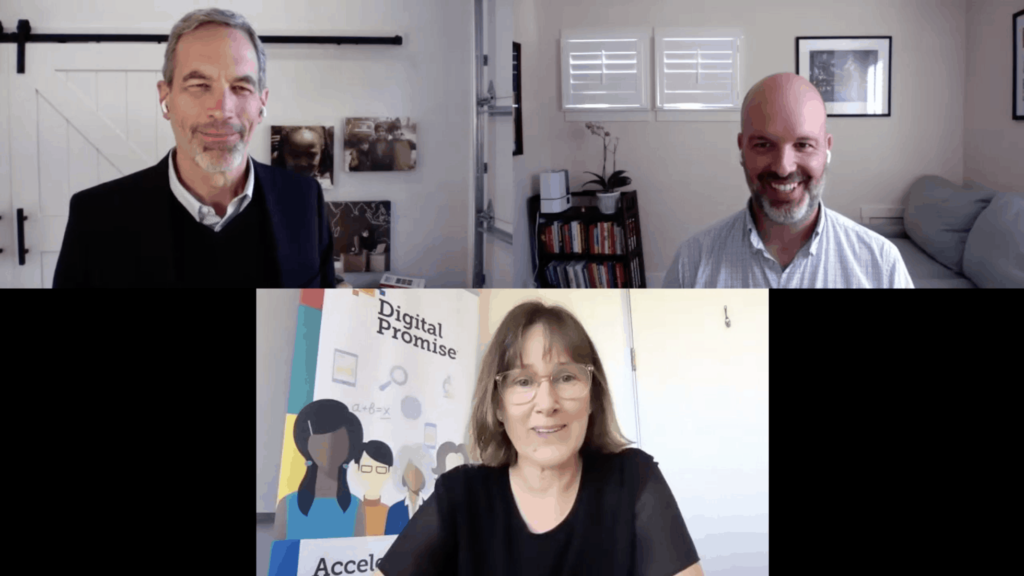
Karen Cator & Vic Vuchic on Whole Child Focused Edtech & Inclusive Innovation
- Every learner with a device (home internet access, students with their own device)
- Coaches for schools (Verizon schools)
- Integration/Support/Pedagogy
- Learning anytime, anywhere
- Whole child in learning environment design and product design
- Personalized Learning
- Learner experience
- Challenge-based learning
- Reflective muscle, agency
- Measurement: nascent challenges
Mentioned in This Episode:
- Digital Promise
- Karen Cator’s LinkedIn
- Vic Vuchic’s LinkedIn
- The Aspen Institute
- Verizon Innovative Learning Schools
- National Center for Research in Advanced Information and Digital Technologies
- League of Innovative Schools
- Dewayne J. McClary | Director of League of Innovative Schools at Digital Promise
- Center for Inclusive Innovation — Digital Promise
- Difference Making at the Heart of Learning: Students, Schools, and Communities Alive With Possibility, by Tom Vander Ark
- Invention Opportunity
- Tuva Labs
- Desmos
- Newsela
- Concord Consortium
- EdTech: Past and Future with Larry Berger.
Transcript
This transcript has not been edited for spelling accuracy.
You’re listening to the Getting Smart podcast where we unpack what is new and innovative in education. I’m your host Jessica and on this week’s episode, Tom talks with Karen Cater and Vic Lucic. Karen Cater began her career in Alaska as a teacher and as special assistant for telecommunications
for the governor of Alaska. This led to Apple where she directed their leadership and advocacy efforts in education. She then was appointed to lead the Office of EdTech in the Obama administration which culminated in her joining Digital Promise as CEO in 2013. Vic Lucic is the chief innovation officer at Digital Promise Global.
Before his time at Digital Promise Global, Vic consulted with a number of foundations and organizations on education technology, innovation, and philanthropy. Prior to consulting, Vic developed strategies and managed over $100 million in technology focused grants at the Hewlett Foundation to launch and grow the open educational resources movement and create and advance the deeper learning strategy.
Let’s listen in as Tom talks with these esteemed guests about EdTech and the invention opportunity. Karen Cater and Vic Lucic, welcome to the Getting Smart podcast. Thank you. Thanks for having us. It’s great to have you guys here.
I was doing a little bit of research, Karen, and was reminded that Digital Promise was authorized as part of the Higher Ed Act in 2008 and then launched, so signed into law by Bush and then launched by Obama in 2011. I think I was actually at the ceremony where Arne Duncan launched Digital Promise. Was that in 2011?
It was September 2011 and I think you probably were there. We invited all of the who’s who that we knew in education and innovation, research, entrepreneurship, and had an event at the White House. So yes, it was a big deal. We had the Board of Digital Promise and we had a variety of big conversations in addition
to the initial launch. It was great. Karen, at the time you were leading the Office of Education Technology, I just want to acknowledge that you’re part of a great lineage in that office. I think it started with Linda Roberts.
It included Susan Patrick, our friend John Bailey. It’s included Katrina Stevens and Rich Colotta, really great group of people before you and after you. So we appreciate your leadership in that role. Yes, I was at the Office of Ed Tech when we launched Digital Promise.
One of the things that we had to do was put together a board and the way that the statute was written was that the board would be appointed by the Secretary of Education, Arne Duncan at the time, from names provided by Congress. It was an interesting project that me and folks in my office had to figure that whole process out.
It was a little bit of a chicken and egg because the thing didn’t exist. So we’re asking people to be part of something and join a board for something that didn’t actually exist and it couldn’t exist until it had a board. It was a very interesting process. Long story short, it got launched.
Adam Frankel was an amazing first director of Digital Promise and he got it all launched. He had, I think, $500,000 in a fax machine and I think the Aspen Institute took him in, gave him an office. Right. We got it all launched.
I visited with Adam and Sarah Shapiro. I visited with any hired Sarah Shapiro to lead the work with the League of Innovative Schools, which was really the initiative that started that was the launch initiative for Digital Promise and that sustained it for the first couple of years. I’ve been thinking, Karen, that education is really different than other sectors of
the economy. When I think about health and biotech, for example, there’s a really thick link to basic science and there’s a layer of R&D that’s public and private funding and that most innovation in medicine and biotech emerges from basic science and R&D and then it influences not only tool development but practice in a really systematic way.
In education, we just don’t have that historic direct link to science and we’ve never really had a thick layer of R&D and as a result, seems like Digital Promise has had a really important role and unique role in that R&D space of helping to link science to practice. Was that part of the mission? The mission, it was initially launched and called the National Center for Research in
Advanced Information and Digital Technology. The initial idea was to create a very significant fund. The idea was actually to use money from spectrum auctions to put together a fund that would really support advanced R&D. The money didn’t actually materialize from the spectrum auctions but the concept has
sort of stayed alive. I would say we haven’t made a tremendous amount of progress in getting advanced R&D moving but we started by saying research is incredibly important and how do we make a much tighter linkage between research and what we do know from basic research on learning and practice and practice both in education practitioners and leaders and also entrepreneurs who are
building products, who are making things that people will be using. We set out to connect those things but I would say the three things that are missing in education R&D, money, so that’s the big one, so healthcare and defense and intelligence and energy and some of these other sectors have a tremendous amount of money. Tom Cullill used to say there’s more money in R&D around potato chips than there is around
education. I have never done that math myself but I trust him to know what he’s talking about. The second problem is time. The kinds of things that go to market are sort of fast moving, they’re start-ups, they need to pass their initial design and development quickly so they can start making money so
they can raise more money. So this whole time constraint really hinders the careful implementation and understanding of science. And then the third is incentives, right? There just have not been the incentives.
The demand side, the districts have not demanded products that are grounded in basic research on learning as much as they should. So we have tried to work on both sides. One, making sure people understand research, so should we launch the research map, which was this visualization and still is, a visualization of over 100,000 peer-reviewed research articles,
added videos, everyone from David Rose talking about autism and other scientists talking about different topics, and then also launch things like ask a researcher. So all of these ways that we really wanted people to understand the basic research on learning so that they could put it in their minds and implement it and include it in both their practice and their product cycles.
But more money is needed. The time constraints need to be figured out. We need pre-competitive R&D is really where we need to build up much more effort and then build in those incentives, make sure the demand side understands why they should be asking for research-based products and practices.
Let me bring in your chief information officer, Vic Wuczek. Vic Innovation Officer. I was doing some research, Vic, and this made me love you even more. I found out that you took a break while you were studying as an engineer to study jazz flute at Berkeley in Boston.
Is that right? That’s absolutely right. That’s absolutely right. That is very cool. Do you still play?
I actually don’t, sadly. I haven’t for a while, but I was torn between engineering and music. I was really studying engineering was challenging, let’s just say. I told my parents I need to figure this out, give me a year, and I went to Berkeley College of Music.
It was amazing, but then I realized, you know what? I think I’d like to do the engineering stuff. I came back. I still kept playing for a while up and down these coasts. It was definitely a fun and impactful time of my life.
That’s awesome. Do you have a favorite flout of these days? Anyone you would listen to? Yeah. I mean, I got started with Jeff Rital, Ian Anderson.
It was just an amazing interview online. Dan Rather, I think it was that interviewed him, which was super fascinating. He’s older now, but he’s still doing stuff. That got me started, but then I got into some of the jazz artists. I appreciate that.
Deep Diver to Jazz really gives you a different way to think about systems, about improvisation, about innovation. Love that. Finding out about that creative streak. I also want to give you and Mike Smith some props for those that don’t know that you and
Mike are sort of the godfathers of OER. You launched the Age of Open Education Resources in your career at the Hewlett Foundation. Really appreciate all your work there. Thank you. I would add Kathy Casterly to that too.
I hope I’ve noticed the three of us that really launched that. No, that’s great. Three of you really broke open a kind of a new era of open and charitable resources. I appreciate that and your role at Digital Promise with projects like learner variability. I wanted to talk about the subject of innovations in learning and the important role that Digital
Promise plays. I’m looking for some examples in your portfolio, but also opinions that you’ve developed about the future of learning. Maybe we can start with just a few headlines from both of you about the innovations in learning and development that you’re most excited about or that you think are potentially most important.
What’s on your shortlist, Karen? You’re going to kind of laugh at this. I remember back in 2011, 2012, when you and I, I think it was actually we saw each other in the airport and we decided to say, you know, let’s say by 2014, every student has a device and every classroom has internet access.
We thought if we say it, it will happen. Little did we know at the time it really took a pandemic to make that so. Isn’t that true? And I think with friends like Evan Marwell who started Superhighway, you know, a bunch of us sort of petted ourselves on the back by 2018, 2019 as we were getting closer to
one to one and most schools were wired. And I think we’ve learned now that we really didn’t pay enough attention to broadband access at home for learners and for teachers. Right? That’s been a tough lesson this year that there’s probably 20, maybe even 30 million Americans
that don’t have reliable access at home. That’s true. That was almost 10 years ago we had that hope. So I think that one of the things that I’m actually super excited about is I think, you know, post pandemic, we will, the thing that’s happened with the pandemic is not only this
focus on home internet access, which we haven’t solved, but we’re seeing some interesting solutions coming to the fore. But we also are seeing students with their own device and that is important. So then we can see more and more innovation around devices, whether it’s the, you know, whatever devices kids have, making sure that they have full access to the appropriate,
all the appropriate parts of the internet and also full access to productivity tools and creativity tools and cameras and, you know, we’ll enter into augmented reality and some of those kinds of things. So that is actually an innovation. You know what, it seems like it’s not an innovation, but it actually is an incredible
advancement that every student will have a device. So it’s now we’re past the why should we use technology and why should every kid have their own to, okay, we’re there. Now how do we make sure that the right tools are in their hands and that teachers know, you know, how to use it for which students?
And Karen, has your work with Verizon helped advance that work? Absolutely. So with the Verizon schools, so we have 264 schools now, we’ve just added about 10 high schools to the mix. The rest are all middle schools.
With that work, when again, when the pandemic hit, we had every student in those schools and every teacher in those schools had the device plus the data plan. So they could use the devices inside of school and outside of school. That was a start, but the other thing those schools had that stood them in so much ahead of the pack, they had a coach.
Every school had their own coach. And so teachers, when they were like struggling trying to figure out what do we do now? And teachers are amazingly creative and, you know, problem solvers with minimal resources. They had their coach that could come up alongside them and help them solve challenges for individual kids.
So the Verizon schools have definitely been an amazing place to learn and to capture, you know, practices that can be that can be shared across the country. Rick, what are your headlines? What are the innovations that you’re mostly excited about? Yeah, so I think a couple areas that I think overlap with a lot of what Karen said, you
know, first there is still basic blocking and tackling around devices and bandwidth, right? And that has to happen and COVID really shine a spotlight on that. So continuing that. And then as she talked about, you know, it’s funny, I remember a conversation Karen and
I had a few months ago where we were like, you know, in the previous decade, it was how do we get teachers to use technology? Right? That was, you know, we would lament, they’re not using it. Well, all this stuff.
Well, guess what? Now everybody’s using it, right? But now it’s that they have 150 apps being thrown at them. And how do you integrate this, right? And bring it together and make it coherent and know how to use this.
So I think this next almost decade is kind of integration and supporting and embedding and pedagogy and really thinking powerfully in that. A third area is just kind of learning everywhere and leveraging that. You know, I heard a stat that every day there’s over a billion hours of learning videos watched on YouTube, which is incredible.
And I see my kids learn my kids learned how to fish. He just caught a 25 pound salmon basically by watching YouTube. And like it’s unbelievable. And then the last one, which is really big and we’re doing a lot of work in this ties into the learner variability work is bringing the whole child into learning environment
design and technology design and how we think about kind of everything. And I’ll just give a really quick anecdote. We just launched a product certification around learner variability and we made it mandatory and we heard this from teachers. They wanted this mandatory that you had at least some social emotional learning supports
in your product. And we got questions from products that say, Hey, we’re math products. Why are you for forcing us to embed social emotional learning in this? We’re like, that’s exactly, you know, our point. Like you need to do it.
Everybody needs to think about this in an integrated fashion. And and that’s just as important. And I think that’s, you know, people are, you know, understanding and realizing importance of whole child. But how do we really integrate and bring it into everything we do and not just have as
a separate silo. And then I would just add on to that the, I love that. And the other piece of that is the personalization for individual students. And so what VIX team has done, and I know you’ve supported as well, Tom, is really thinking about how people are different one from the next.
And so we know now, and we’ve always known one size does not fit all and we can’t just blanket a classroom with the same kind of strategies. And so now getting many more strategies that can be focused on specific needs if a student’s dyslexic has this calculator, just has low, low, low working memory. I mean, all of these kinds of things learning much more from the learning sciences and then
being able to put them into strategies that people can actually try with with individual kids. I mean, that is another innovation. And we need to learn much, much more about this and, and begin to sort of systematize how we actually think about that and how we do it.
Karen earlier, you mentioned the League of Innovative Schools that was launched back in 2011. It now includes 114 districts. Is that right? Almost 3,900 schools, 3 million kids.
What’s the role the League of Innovative Schools plays in relationship to innovation? Yeah. So the schools are selected because they have looked at things that are emerging and new and they have tried things and gotten better at them. So they have some track record of trying new things.
So whether it is around maker learning or robotics or other kinds of STEM advancements, you know, coding or computational thinking, or whether it’s around literacy initiatives or, you know, whatever it is. We look broadly at innovation thinking, what are the things you’re trying and what is the evidence that there’s some sort of, some sort of impact.
And so that’s first of all how they’re selected. So we have 114 districts now that are part of this. And I would say what they, a couple hugely important things that they do. One is they convene with each other and share ideas, solve challenges together, inform challenges. So in case somebody else is working on that challenge, they can be more informed about
how it plays out in different places. So that’s kind of one really important part. Part two of that is air cover. When they try something new at home, they can say it’s not just us, all these other districts are doing this.
This is kind of a trend. And so they give each other air cover to try new things. So that’s a second important thing. The third that we’re kind of just getting started on, it’s been the promise of the League for a long time.
The League has a test bed, a place where new ideas can go to be trialed, products can be trialed and people can kind of sign up with their school or district to try things out and provide feedback. So I think that there are many, everybody knows kind of the benefits of a professional community, a professional learning network, how people support each other and help each
other through challenges. But this notion of the League as a test bed is something that’s just beginning to ramp up. Karen, I had Duane McClarry on a webinar with me a week ago. Duane is the director of the League of Innovative Schools.
Duane and I noted that in addition to being the 114 of America’s best school districts, they all, almost all share an interesting attribute and that’s stable and effective leadership. Really at the superintendent, cabinet and board level, which indicates that sticking around and building support for an agenda over a long period of time is really critical to letting innovation take root and then be brought to scale.
So I just wanted to note that leaders that stick around to do the work over time, I think it’s really one of the important lessons from your League. The other one that kind of goes along with that is we’ve really learned that it’s the combination of the leader and their own mindsets and their own view of innovation and trying new things and taking risks and that kind of thing as they manage their board and that
leadership of the district. And so one of the things we’ve had to figure out is if a superintendent leaves and they go to a new district, within a year, if they can get their new district on board kind of the same way, they tend to come back into the league and likewise, when a leader leaves a district, the district kind of goes into a holding pattern and if the new leader can
join in and kind of pick up with their district, they too can kind of rejoin. So it’s that combination of the district with a board that is with the leader, with the board that’s supportive and then the district leadership and on down into schools that make this valuable and powerful. We did also note that most of the leaders in those 114 districts are old white guys like
me, but you and your partner districts have been really making a push at more inclusive leadership and today you announced the Center for Inclusive Innovation. What’s the mission there? Yeah, so the vision is a world where black, brown and indigenous students can learn and grow and thrive.
So that’s the vision in something I think we all would agree to agree with. The mission is to resource the creative ingenuity of communities, communities of color that will create these education innovations that are designed from the start to enable black, brown, indigenous students to learn and to take advantage of these innovations. So the important thing is that people in these communities come into an innovative process
as co-experts. They lead in many cases, they definitely participate in the development of solutions and then obviously they are the ones who will benefit from them. Karen will include a link in the show notes because this is not only for people of color. There’s some amazing resources there on inclusive innovation and how every education leader in
America should be thinking about the way they invite educators and community members into their innovation process. So it’s an important center not just because it opens doors for people of color, but just because it’s a set of resources that we can all use to be much more thoughtful about engaging our communities and creating better schools for all kids.
Absolutely. Thank you. Thanks for watching that. It looks like a really terrific set of resources. Vic, I want to go back to the Learner Variability Project.
You over the last two years have developed this amazing web of research that now is searchable by case study or by symptom. When you have a learning difference that you’ve identified or a symptom that might lead to identification of a learning difference, you have this research web that really helps teachers connect with important resources.
I wonder as you think about the impact potential of the Learner Variability Project, where and how do you think it’s going to make the biggest difference? Yeah. Also, just to sort of broaden a little bit, it identifies the factors that we know learners vary on.
So it’s not just about deficits or traditional learning differences. It’s like, I may struggle with emotional regulation when I’m learning math. It’s like, I get anxiety. And so it just identifies for everybody how we all vary. And then it has those strategies, both instructional and product design, that have research to
support that. And so I think there’s kind of two or three areas that I’m really seeing impact play out. So first of all, you start with just this sort of mental model of Learner Variability. And we incorporate here the academic factors, the cognitive and executive function type factors, the social-emotional, and then even just background factors.
And so so often when we’re designing a product or even trying to help a child, if they’re struggling in phonics, we just focus on the literacy factors. And we just try to dive in on that. But this gives you a model in the lens that says, hey, you know what? Emotion actually matters when a kid’s trying to learn to read.
And we’ve seen this where a teacher or parent says, oh my god. I just remember my kid has anxiety. When we sit down to read, they start stuttering and get tense and anxious. And it helps broaden their lens to what may be going on kind of under just the surface of, yeah, they’re struggling with phonics right now.
So it brings that whole child lens in and opens everyone’s mind in when they’re designing products to think about that. And then the second thing is really making this actionable in those strategies that we give ways that people can implement strategies in their classroom or if they’re designing a product.
And so we’re seeing lots of products. And we’ve directly worked with over 30 products, major products impacted hundreds of features. And then what’s really exciting is there’s a couple of products that have used this framework as sort of the founding personalization framework for their products. So this is how they’re instrumenting to understand the learners that are going through their product
and their mapping to these factors. And they’re designing in these strategies intentionally based on that to have more learners succeed when they come in to use the product. And I’ll say the last piece is we’ve just launched some of these product certifications to help signal in the market.
Was this product intentional? Did they design based on research? And do they have some level of supports for learner variability? And do they think about that? Because we hear from districts and teachers, what they’re struggling with is the diversity
in their districts and schools. The learner population is so diverse. And in any classroom, that’s what teachers struggle with every day. And we even did a national survey. One of the top reasons they use education technology is to support that diversity.
So how do we make it so that people are doing that based on research and with this full diversity of learner lens? And so that’s, you know, there’s some of the areas we’re seeing a big impact. I appreciate that. I noticed on the website today you had a great quote from our colleague, Dr. Pamela Cancer,
where she acknowledged that it’s not just the learning differences, it’s the way learners interact with the context. And so your site really does a great job of both helping teachers identify context variables and learning differences in the way that those two interact in a really smart way. I want to jump into sort of a lightning round and just give each of you a quick chance to
respond to a couple of different dimensions of innovation and give you a chance to mention something that you see going on or why you think that is an important dimension of innovation. So just headlines against a couple of these opportunities. So when you think of the category of learner experience, what are the innovations that you’re most excited about?
Karen, I’ll start with you. Yeah, I’m still interested in those kinds of innovations that are powerful learning experiences. So things that allow students to build their reflective muscle, their inquiry muscle and develop agency. One of the things we’ve seen with COVID is that students, if they don’t have any self-motivation,
if they aren’t like self-starters and don’t have sense of agency around their learning, they’re not, it’s very difficult to get them to do anything. So I think those kinds of, those experiences that are relevant to authentic get kids excited, get kids involved are the things I’m excited about. Karen, in the show notes, I’ll link to your microsite on challenge-based learning.
We love that topic. We just published a book on place-based learning and it’s all about community-connected project-based learning. Your challenge-based learning site is very similar. So I imagine that’s a topic that we both share an interest in.
Yeah, challenge-based learning is very specifically what we’re excited about, right? Getting students engaged in a challenge that is in their community and their school and their neighborhood and their family and be developing the methodologies for solving those. So it’s a process, it’s inquiry, it’s understanding how to find the experts and put ideas together. Love that idea.
And actually, one other thing about challenge-based learning that’s very, very important is the end of it is not just present a solution, it’s take action. Try it, see what happens, reflect that. I love that. Vic, learner experience, what’s the Alex innovation you’re most enthusiastic about?
It’s actually kind of, I would say, the infrastructure to kind of make that happen. So the tools that are out there and that are coming out that are so amazing to allow kids just do a completely different level of learning. And I’ll just give a couple of examples, and especially taking advantage of the real world and all of the information and data we have on that, you can sit at a computer now and
bring in, you know, there’s things like Tuva Labs and Desmos and Newzella, which brings in outside journalism. Noah has these amazing kind of mapping tools based on Noah data. My daughter just did a big essentially challenge around mapping the biggest surf spot in the world in Portugal.
And used the Noah database, modeled it in person herself, and then went and looked at the real data and is comparing that. She’s in seventh grade. And this is all free, a free tool. You know, to be able to do this and they’re, you know, with Zoom, they’re having an astro
scientist, geologist, you know, pipe in to talk about all this stuff. And so these tools are getting better. I think the trick, the challenge what’s holding back is getting the market to demand this. Right? That’s, we all want this and it’s there, but it’s not, we’re still stuck in like, how
am I going to get from this standard to that standard and improve my test score? And that’s where I’m going to put my budget towards, right? So how do we unlock the demand side on this? So this is where the money is flowing and then creating a whole ground swell of tools to make this possible at a really large scale.
And especially for kids who are underserved and don’t have these experiences otherwise, you know, going from the sort of elite schools where these things can happen to all, to everybody, to making sure this is the way that all people are learning. And Vic, I think of the advanced modeling tools that are available now, Concord Consortium has some great ones.
I think of even the fact that you can now get PyTorch and TensorFlow open machine learning tools on mobile devices or on laptops for high school kids to really engage in very sophisticated investigations and problem solving in their community. For us as adults, that requires a new mindset of being willing with young people to walk into complicated problems with new schools and say, I don’t know how to use that, but
how might we do that together? So I’d love both your examples. Let me, I want to bundle a couple of things together and just measurement and credentialing, sort of how we measure and communicate developing capabilities. What are you excited about there, Karen?
Well, I’m excited. I’m, yeah, I would bundle a few things together here. One is excited about this whole area of, you know, learning and employment records, something that can really capture who I am as a person through my career, what this, through my education career and then on into my career.
So it’s something that I would own myself. It is me as a learner. It’s my profile. I understand much more about myself as a learner. I know where I’m going.
So it requires these sort of progressions to be designed and integrated into this notion of a profile. And so then you have this, what then layers in very importantly are new kinds of assessments and ways of knowing whether you are progressing and capturing that data and that evidence that shows that.
So then you are kind of thinking about your profiles. You’re also thinking about your, your learning progressions and how you’re advancing on into the workforce. And then credentialing, you can begin to award, you know, micro-credentials or different kinds of credentials that will, that will demonstrate to somebody that you share it with, that you
actually have competence in one skill or, or some sort of knowledge. Yeah, that’s really exciting. I think there’s three or four super important innovations there. One is the idea of a portable learning record. Yes.
And then there’s some improved measurement strategies so that you’re combining formative assessment to track both growth and proficiency in important skills, not just in math and reading, but across success skills. Three, you’re credentialing that. So you’re combining a set of assessments into a recognized credential that’s portable with
that record and recognized by a large audience. And then you talked about the link to talent development so that it, it enables professional growth within your career. You might even unlock new, new compensation opportunities. It’s good.
And I’ll just, I’ll just give a shout out to your leadership on micro-credentials. You’re the, the leading provider of micro-credentials and we’re seeing more and more districts adopt your strategy of micro-credentials as their, as their primary talent development strategy. So that’s really a combination of the innovations that you describe. Yes.
Vic, in those categories, what would you shout out? Yeah. So actually I’ll highlight some of the challenges, which I think provide opportunities for innovation across those because I agree. I mean, obviously Karen and I work a lot together so we agree a lot of these things.
We talk about these things. I know. So first, learning measurement. That is a perpetual challenge. And it is something that also for people innovating, they have to realize that this field is much
more nascent than say in medicine, right? Or in other sciences. And you know, I used to always give the story when I was at the Hewlett Foundation, you know, they funded, you know, climate change research, population development and education. And it kind of dawned on me.
We were trying to do strategic philanthropy, outcomes focused, grant making. And you know, I said, if you take the top 100 climate change scientists and ask them, what’s one measure that like represents the health of climate change? You probably get about five to eight different answers and they’d all say that they’re reasonably good measures, right?
Whereas if I asked the top 100 experts in learning, what’s one measure that represents the state of learning? I’m probably going to get about 90 different answers. And most of them are going to tell that the other ones are not right and not accurate. And so it’s much harder and we need to move forward.
It is hard to measure learning, but that’s where we need a lot of innovation to really kind of empower the system. The next thing I’ll jump on that, that build on that is actually one of the things that it brings in equity challenges as we bring in AI and large scale technologies. And this is where the randomized control trial, this is one of my latest things that I’ve
been really kind of concerned about, but thinking about how to improve. And it dawned on me, you know, we worked with a product where it had an AI component to it. It was a product to learners and it was from a university, well researched, and they rolled it out to about 80,000 kids.
And then later they found out that actually it was telling all the English language learners that they were wrong when they were actually right. And first of all, that’s actually not just a neutral experience. That’s damaging. That’s hurting the child.
And you take just rough percentages, 80,000, well that’s probably about 6,000 kids, 7,000 kids that have that experience. But here’s the kicker. If I ran a randomized control trial, which is considered the gold standard of evidence, guess what?
That product actually probably would have a positive effect size on aggregate. Right? It’s probably the kids doing well, could jump really high, the kids in the middle of the curve still doing pretty well. And this is just, you know, 7, 8% of kids.
And so it would be washed out and it would have an aggregate net, you know, positive effect size and we would say, hey, this is great. We have efficacy that works. It’s only if you look at those subpopulations, which often are underserved populations intentionally that we can tease apart.
And you imagine, you know, I’m a former funder, I put in money and say scale us to millions of kids and it’s systematically hurting these English language learners, right? In this case, but you could substitute kids with learning differences, with mental health challenges, executive function, any sort of dimension that this could happen to and at a really large scale.
And so really, how do we understand variance that we ask when we see effect sizes? Is it highly variable, you know, whether learners succeed or not in this product and doing subpopulation analysis as much as we can in these is really, really important. And then the last piece I’ll touch on getting to sort of then, when we get good with this, you can do the competency based learning and the one big area is we have competencies
and pathways and credentialing and things where I don’t see enough is if a learner is not getting the competency, then what? Right? And what I hear, you know, people saying, oh, they’re going through this progression, the kid didn’t get this competency.
Now what do I do, right? And that’s where helping understand learning variability, bringing in science, you know, understanding different ways that you can support that. And how do we bundle that elegantly to kind of keep them moving forward? And I think that’s a really important area.
And that’s the promise of AI and how, and how we can get better recommendation engines, which is still a big promise. It’s not in a solid area. And I think, you know, you guys have done such a great job of leading on innovation for equity.
And this is a case where you, when you do competency based learning, you have to combine it with weighted funding and make sure that you provisioning extra time and support for learners that needed. And you guys have done a great job leading on equity, innovation for equity. So I appreciate that.
And just getting started there. That’s important. Anything on learning formats that you’re interested in, new school models that you’re excited about? I mean, I think one of the things I think is also really exciting is how we leverage the
internet to get, it’s kind of this learning at scale, right? So schools, I think everybody knows now, I mean, we hear kids and teachers and everybody like can’t wait to get back to what used to be how we thought about school. And that really has to do with the relationships. People are excited to see their teachers in person, see their peers in person.
I mean, it’s, so that’s important. But the learning at scale, how we leverage expertise in mathematics, for example, to create a whole national cadre of tutors that people could access regardless of where they are, build in relationships so they can get to know their tutor, even though the tutor may be across the country or another place.
But finding out, it’s getting someone who looks like me, understands me, can get to know me, and I can count on to help me for 10 minutes or for 45 minutes a day. I mean, they’re different formats. But so I think that’s one thing that we’re very excited about is this notion of learning at scale.
It kind of started with MOOCs, but kind of moving on from there, how do we get to this much more scalable model for supporting learners where they are and with what they need. Mike, are you a big fan of micro schools and nano schools and pods and all that? What do you think about new learning formats? I don’t know if I am from that perspective, and there are huge equity challenges with
that that I do fear. We’re too far from that right now to be able to say, hey, this should go out. But I do think, I mean, harping on that, how do you bring in the outside world into the learning experiences and schools that do that well? You know what?
Kids should be able to go to YouTube and use tools and all these things rather than sitting inside and just doing worksheets and traditional modalities of learning. And so I think that’s still the schools that do that well or the experiences that do that well, that inspire learning outside of school, which is when you really get things going. And I think to Karen’s point, providing expertise at scale for many kids, and then embedding
also the relationship piece. I think the big thing we haven’t unlocked, I know, you know, Christensen Institute talks about this a lot is social capital, you know, is still one of the biggest determinants of success. And what are innovations that can really build that for kids that don’t have that and families
that don’t have that? And how do you can do that at mass scale if you can figure out how to basically design it once, you know, the technology is there. It’s just figuring out how to do this and what the right models are. As may transcend, they may stay, but again, equity is a huge challenge there.
Small groups and we’ve always known small groups, you know, interaction, working together on things, having much more individualized supports and working with peers. Those are all good things. So how that plays out on in the future is going to be important. So I could do this for another hour with you guys because you’re the expert on innovation.
I totally appreciate your time and your insights today. But Karen, the main thing I wanted to do is just say thank you for the eight years of leadership, not just that digital promise, but really the last 20 years, your leadership on innovations and learning in America. It’s made a huge difference.
Schools are better in this country because of the work that you’ve done at digital promise. You stood up a great organization, recruited an amazing team, built some high impact programs. And I’m among an army of people that really appreciate your leadership over the last eight years. Thank you.
Thank you. I very much appreciate that. Thank you. Vic, what would you say as your beloved Lascaux back to Apple? I think just keep doing what you’re doing.
You’re inspiring. You create space for great things to happen. And you help get resources for people to do great things. And doing that on a huge stage as big as that is there’s tremendous potential and it’s going to be so exciting to see what happens.
Thank you. So with a lot of appreciation for both of you guys, thanks for joining us. And Karen, thanks to you and best wishes in your next chapter. Thank you very much. A big thanks to Karen and Vic for joining us this week.
We appreciate their essential leadership in ed tech and equity and wish the best for Karen in her next chapter. For more information on ed tech, check out episode 242, past and future with Larry Berger. This podcast is also part of our exploration of the invention opportunity to help and inform deliver new agreements, new practices and new tools.
Getting smart and edgy innovation are exploring invention opportunities and learning. And you can follow along with our journey at gettingsmart.com slash invention opportunity. We’ll be sure to put a link in the show notes and on the blog. That’s it for today listeners. Thanks for tuning in for the Getting Smart podcast.
This is Jessica signing off.



0 Comments
Leave a Comment
Your email address will not be published. All fields are required.