


Podcast: Emily Liebtag and Nate McClennen on the Power of Place
-
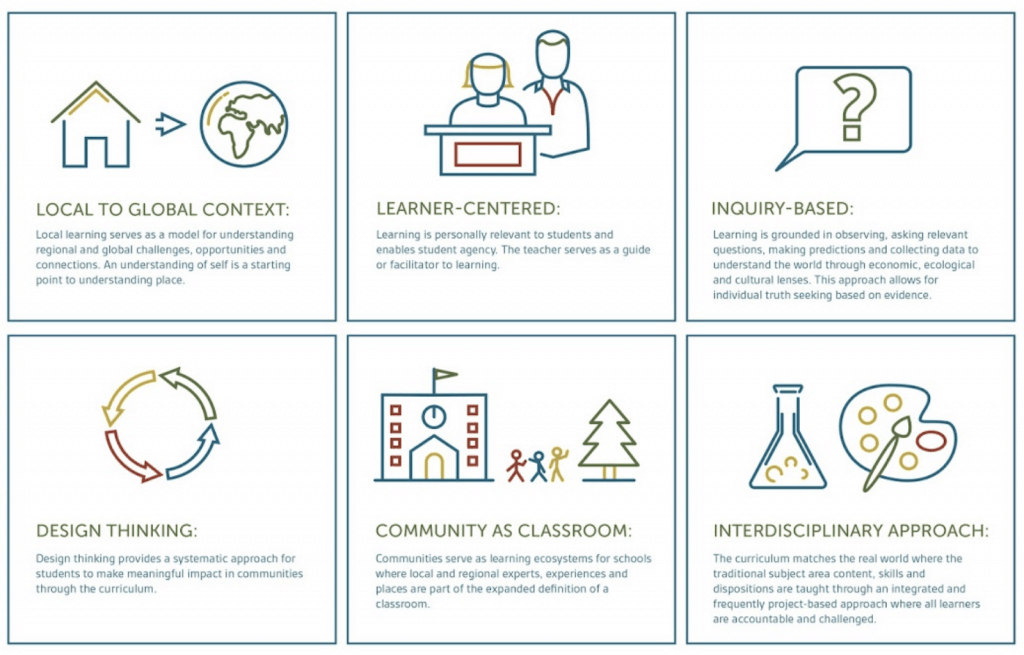
- Learner-centered: everyone experiences place differently; everyone deserves the right to build an identity rooted in place; everyone can make a difference.
- Local to global: starting local allows students to build on prior knowledge and connect to global issues.
- Inquiry-based: understanding what is in the world; staying curious and making observations.
- Design thinking: a creative problem-solving approach that allows young people to become solutionaries
- Community as classroom: every place offers something to teach; every place is part of an ecosystem; learning wherever it happens should count;
- Interdisciplinary: using project-based learning, skills and dispositions are learning through real world learning not in isolation.
Key Takeaways: [1:42] Emily shares one of her favorite place-based education moments from the last several weeks. [4:04] Nate also shares a recent favorite place-based education moment that comes to mind for him. [6:06] Tom shares his enthusiasm about Crosstown High centered in Crosstown Concourse in Memphis, Texas. [7:38] When did Emily learn about Crosstown High and the benefits it brings to students. [11:06] Emily shares the origin story of The Power of Place as well as her favorite part about working on it. [12:40] Nate speaks about his career at Teton Science Schools and how he became involved in writing The Power of Place with Emily and Tom. [13:42] Tom speaks about his experience joining the Teton Science Schools’ Advisory Board. [14:18] Nate shares his definition of place-based education. [16:15] Nate speaks about the power of place. [17:25] Emily shares why place-based education is becoming increasingly important in the global conversation. [18:51] Tom speaks about how the shift to digital and the strong focus on standards have made learning more sterile. [20:58] Nate highlights how the themes of agency, equity, and community, connect The Power of Place together. [22:24] Emily continues the conversation around the themes that connect the book and how all learners experience place in a different, unique way. [23:25] Tom shares a recent experience of his at Latitude High and the different ‘place’ can make. [24:18] Nate shares a conversation between him and Tom about the importance of how connecting to place brings everyone together. [25:22] Nate explains what local-to-global means. [27:18] Tom and Nate explain what inquiry-based relates to. [29:08] Emily speaks about why design thinking is critically important when it comes to place. [31:35] What place-based education requires. [32:54] Nate highlights important aspects of place-based education and community as a classroom. [34:34] Tom speaks about Crosstown High’s 901 Project which is a great example of using community as a classroom. [35:48] Emily gives her thoughts on interdisciplinary learning. [38:42] Nate speaks about what readers will get out of their new book, The Power of Place. [39:55] Emily provides her final thoughts on [40:52] Nates gives an update on his recent project: place network. [42:06] Where to find Nate online. [42:31] Where to find Emily online. [42:46] Tom closes out the podcast and gives his thanks to Emily and Nate for joining.
Mentioned in This Episode: The Power of Place: Authentic Learning Through Place-Based Education, by Tom Vander Ark, Dr. Emily Liebtag, and Nate McClennen Emily Liebtag Boundless (GoBoundless.org) Nate McClennen Teton Science Schools (TetonScience.org) Crosstown Concourse Crosstown High High Tech High Latitude High School Quote by Wendall Berry: “…our sense of wholeness is not just the sense of completeness in ourselves but also is the sense of belonging to others and to our place; it is an unconscious awareness of community…” Crosstown High – Project 901 Nate McClennen on Twitter: @NMcClenn Emily Liebtag on Twitter: @EmilyLiebtag
For more, see:
- check out our place-based education series.
- The Power of Place: Authentic Learning Through Place-Based Education
Stay in-the-know with innovations in learning by signing up for the weekly Smart Update.
Transcript
This transcript has not been edited for spelling accuracy.
You’re listening to the Getting Smart podcast, where we unpack what is new and innovative in education. I’m your host, Jessica, and today we’re listening in on a conversation with Tom Van Der Arc, Dr. Emily Liebtag, and Nate MacLennan as they discuss their newly published book, The Power of Place, Authentic Learning through Place-Based Education.
Emily Liebtag is the recently appointed CEO of Boundless, an organization dedicated to highlighting innovations in education. Nate MacLennan is vice president for education and innovation at Teton Science Schools, where he focuses his time on how to scale the impact of place-based education through technology, innovation, design learning, rural education, and school networks.
And Tom Van Der Arc is the CEO of Getting Smart, and, well, if you listen to this podcast, you definitely know Tom. Let’s listen into this conversation about writing, place-based education, and the new book. Emily Liebtag and Nate MacLennan, welcome to the Getting Smart podcast.
Yeah, happy to be here, Tom. Hi, Emily. Hello. Thanks for having me on. You guys have both done several podcasts, and we’re super, super glad to have you back.
We’re celebrating the launch of the book we wrote together called The Power of Place. I thought we could dive in just by sharing maybe one of your best place-based experiences of the last couple of weeks. Emily, what comes to mind? Yeah, so actually this morning, I had an epiphany and then a learning experience.
There’s a local drug store that I go to just down the road, and come to find out it was the place 60 years ago to the date, to February 28th, 1960, where nine young men sat and had a sit-in because they were fighting for their own rights. And it was one of the starts and the sparks of the civil rights movement here in the South. I reside in North Carolina.
And when I went to the drug store this morning, there was a bunch of commotion, and they’re dedicating a plaque to these nine men. And I thought, I’ve come to this place weekly for the past, I don’t know, 10 years, and I had no idea the significance of where I was standing and of that drug store and of that place.
So I spent time talking to community members who are honoring these nine men and just learning a bit more about what had come before, the history of that place, and then how they’re going to commemorate and memorialize those men going forward. And it was just this in-the-moment, in-place, in-time experience where I learned a lot more about not only my community, but something had happened there.
And I wasn’t even looking for a place-based experience, and there you go. Yeah, it’s so interesting. There’s a lot of serendipity involved in that, right? Absolutely. And had I not known that, I would be walking along, continuing on and never knowing.
And now it sparked my curiosity. And since then, coming back this morning and prior to recording with you today, I’ve been digging and learning and researching where the young men are today and what they’re doing and have this whole new appreciation for a place just a mile down the way. Yeah, it’s funny how something like that can interrupt your habit and then become a spark
for learning and then make that place will now be special in a whole new way for the rest of your life, right? Absolutely. And thinking about when I pass by that place next, if there’s someone around me, how might I engage them in learning about that place?
And if I were working with young people who are regularly on Franklin Street, which is where this place is, how might I engage them in learning about the significance of that drugstore and of the people that came before? Yeah, I love that. Nate, what comes to mind for you?
Well, mine also is this morning, which is great, and it wasn’t an epiphany, but it was this realization is that so I drive to work generally at the same time every morning on the same route every morning. And this morning, I had to put my sunglasses on for the first time because it’s getting lighter and the sun, I realized was coming through a notch in the mountains because I
live up in the northern Rockies. And it just gave me perspective of just how we observe the world and a simple thing like putting on sunglasses can then spark this whole idea of, wow, the earth is continuing to make its trip around the sun. And that’s then moving the sun in perspective further north in my viewing, which then allows
it to sit in that notch in the mountains, which makes me put my sunglasses on. And I think about all the learning experiences that can happen from that. And it makes me think about, okay, well, I know three months from now that sun’s going to be even further along the ridge of the mountains. So again, just like Emily’s talking about, and hers was more in a social cultural context,
and mine’s more ecological, but just the sparks when we take a look and have the lens of place to everything we do, everything becomes a possible learning experience. And a possible place of order. Yeah, that’s cool. A couple of days ago, I noted on my running app that I was able to leave my headlamp at
home and catch a picture of sunrise for the first time early in the morning. I also, when I’m here in the Seattle area, I always check the Tide app in the morning and find that that creates this interesting connection with the moon cycles. So it’s fun to watch your regular morning routine connect with the motion of the earth, right? Right, right.
Yeah. It gives perspective and hits on one of our principles right around local to global. Really understanding local to touch global and universal. Yeah, I love that. Before we started recording, I mentioned that I spent the weekend in Memphis at
Crosstown Concourse. And it’s like Hightech High in San Diego, I think one of the most interesting urban redevelopment projects in America. And like the Hightech High Liberty Station example, it has a high school, right, at the heart of it.
It’s a million square foot redeveloped distribution center and it has health facilities and companies, a YMCA, art galleries, theaters, restaurants. It’s just this spectacular urban village. And some of the students even live upstairs in the apartments in this urban village. And it’s just one of the most interesting place-based learning opportunities that I’ve
ever seen where a high school is deeply embedded in a spectacular place. I think all of us believe that every high school has some really wonderful place-based opportunities, but at Crosstown High, they are right outside the door or one floor up. And so it was just very exciting to see such a cool example of place-based learning over the weekend. Emily, you had heard about that school?
Yes, I had. And I learned that not only is the place significant itself, but how it was designed and how it incorporated what students really wanted to see in that place was essential in the redesign. I just think more and more, as you described at Crosstown, students don’t live within four walls anymore. They live with no walls, right? They’re living through device globally connected.
And so they want to see their learning environments be more open-walled and more place-based. So yeah, I was really thrilled to hear the story behind getting to what that space looks like. It is a great example of developing with community and not doing something to community. In most places, a big building like that would have been bought by a developer, and then they would have done some arm twisting and put in a bunch of condos.
But what happened there was an arts organization got involved early on and really co-developed with community. And as a result, you ended up with this magical place that had community and health and art at the core, not as an add-on. The magical thing is that that created such a virtuous cycle that there’s now venture-vaxx robotics companies moving into the building right next to the high schools. So just a very cool example of developing with community and not
doing to community. It’s really the difference between gentrification and sort of co-construction. So cool project. And the benefits that bring students. We’ve seen this at Purdue Polytech that’s located currently one space in a mall where they’re learning from other people and business leaders in the space, as well as I’m thinking of Center One and Alba Marl, where there’s a marketing firm right next to where the school is located. And so students are doing
internships every day back and forth with the marketing firm that’s co-located with where the school is. And I think there’s unintended and unexpected benefits, of course challenges as well, but really some interesting things can come from those opportunities when place is no longer just an enclosed school building. Right. I also think about Roscoe unified down in Texas where they it’s a super rural place, but they’ve actually opened up places in their school for businesses
to start, which then have a commitment like around VETTAC and DroneTAC and AgTAC, all these kind of pieces. And so those businesses are now in the school, but also partnered with the school to provide resources for the community. I think we all believe we’re going to see a lot more of that in the future. IDEA and Tacoma is another example of a school with an incubator. I think we’re going to see more schools in incubators and more schools with incubators as it becomes apparent to folks
that we’re all entrepreneurs today and that kids need a chance to work with entrepreneurs to become entrepreneurs. So love that idea. I’m curious, Emily, if you remember the what the origin story of this book, where did the idea come from and maybe what was your favorite part of working on it? I think for me and you both might answer otherwise, but it was moments where we were in communities that were beginning to do deep work
and thinking about what they wanted their grads to know and be able to do. And all of those countless conversations we’ve had with communities, they really didn’t start with what the standards were or what the dispositions were. They all started with where did these young people live? Who do they want to become and what can our community offer them to get them there? And it was a conversation about place. And I think it maybe looked at you, Tom, and we had this, oh my goodness,
it’s so much more about what mentors, support systems, opportunities are in a community. And then how can we bring learning into that rather than the reverse? And I think that conversation really then made us connect with Nate, who obviously has been doing this work across the nation and in the Tetons for years and years, and really just started to think differently about the purpose of learning rather than leading with just what the standards are we want them to cover.
But how is place central and pivotal to young people and their time throughout K-12? Nate, how long have you been at Teton Science School? Over 20 years now, so it’s been a long time and in a variety of different roles. And I think I’d answer that question. I think we approached it a little bit differently, is because, as Emily alluded to, as we’ve been doing place-based education, it’s
core to our mission for over 50 years here at Teton Science Schools. But what we recognize is that there was not a place where you could go that it was easy to access to say, what is place-based education? What does this look like in schools? And so when you two approached me and said, let’s write this book, it was really an opportunity to say, how can we allow and give access to more schools, more teachers, more school leaders, more communities, the ability to launch place-based
initiatives and really put place in the learner at the center of the student experience? So I think that was one of my main motivations to getting this book out there. You know, I had the chance to join your advisory board in 2016 and was immediately hooked by the place. Obviously, being in Jackson is a magical place, but it’s really the confluence of a set of extraordinary educators that have been thinking deeply about this for
generations. And I think I knew immediately that I, in several ways, had to help tell the story that you’ve been trying to get out. Nate, why don’t we back up and just have you share your definition of place-based education? Right. So we try to keep it really simple. And place-based education is about integrating learning and community. And we use the word and rather than with because I think the community, it can go both ways. And so we look for three sort
of shorter-term outcomes of increasing learner outcomes, increasing student engagement, our learner engagement, and also teacher engagement. We find that when we work with teachers in this set, this way that everyone’s more excited to do the work of learning, which is great. And then the third outcome that we see is around community impact. And we’ll talk more about that later, I’m sure, as we go through the sort of details of the book. But when we look at increased learner
outcomes, increased engagement and increased impact, those are those short-term pieces as we connect learning and community. We also talk about looking at the lens of community through what we call the place triangle, which is around how do we see different aspects of a community from the ecological, the economic, the social and cultural elements, and then how do we look at that across time from the past, present, and into the future. So those are some of the ways that we define and
talk about place here at Teton Science Schools. Yeah, I really appreciate all of those. The focus on engagement and contribution. I love the triangular lens. As we’ve talked for many times, a lot of people will sort of limit this to outdoor education or environmental education, but you really have a robust view that it’s not just the ecology, it’s the economy, it’s the sociology and culture, and this sort of vector of history of how all three of those are changing
over time. Hi, I’m Nate McLennan, co-author of the new book, The Power of Place. Something unexpected happens when you explore a community for the first time. Your worldview shifts with each question, each interaction, and each inquiry. You understand the place more deeply, and yet the deeper you go, the more you realize you have to learn, and the deeper you go, the more you see the opportunities to make a positive impact. This is the power of place. My most important learning has come from
place in the outdoors, jobs, conversations, and explorations, all teaching me skills and knowledge that were just as important as what I learned in school. I see that I can make an impact, I see that I can always learn, and I see that my actions create ripple effects across communities and ecosystems. This is what our young people need to learn, that they matter and their place matters. They can make change happen in place, and every learner has the right to make a difference.
You’re invited to explore or continue your own play space journey with us through our new book, The Power of Place. The Power of Place is available for order at the link in the show notes or by visiting www.gettingsmart.com slash power of place. Emily, why do you think this idea is so important now? It does feel like it’s both timely and rising in the national and even global conversation.
Why do you think that is? Absolutely. Let’s be real, we’re facing some really interesting times, and I think we’re facing some really interesting challenges in schools, namely students who aren’t finding purpose, aren’t finding value, and are disengaged quite frankly. For good reason, we’re not providing them experiences that get them what they need and get them connected to meaning and to who they are. I think now more than ever, we need to provide students with
experience that are connected to community. They have real world meaning and application, and that they really feel like they can make a difference and do something, not just about climate, not just about politics, but just about what they care about and who they want to become in the world. Learning through place is absolutely a way to do that, to let them have agency of their world and of their lives. That’s why I think more than ever now, places
has been pivotal, but also it’s emerging as just imperative. We’ve made this historical shift from print to digital just about every school over the last 10 years, one-to-one in some fashion. There’s a bunch of benefits to that, more personalized learning, but in some respects, I’m afraid that the shift to digital and the focus on standards have made learning for more kids a lot more sterile and probably more boring. In some respects,
I think many of us have come to the conclusion that we probably made school more boring, less engaging for kids, and that putting place back into the center of learning where it belongs is maybe re-centering our focus. Is that right? Yeah. I think of our friend Julia Freeland Fisher, who has really made clear that it’s who you know and that that social capital and working not in isolation, but in community and with others, is really what’s going to help get young folks ahead,
especially from an equity standpoint. If we’re doing work solo and just within four walls, we’re not giving students access to that. Place, I think, opens up those networks, those opportunities, and get to know your neighbor. They might be your best mentor or advisor for years to come. Who knows? Yeah. Julia is a great example because the Christensen Institute, along with folks like Getting Smart, we’re leading advocates for blended and personalized learning
for somebody like Julia to step back and say, you know what, blended learning is great, but it’s also who you know that matters a lot. I think the three of us would add to that. It’s the place that you know that matters a lot. I wonder, it makes me think, Emily, you mentioned agency and equity and makes me think of the three, we use three themes to run throughout the entire book, agency and equity and community as these long-term distal outcomes for place-based education.
So the agency about how do we give students all the skills and knowledge and also the belief that they can make change happen and then the equity that everybody has the right to make a difference in the world, not just those certain few that have access and then tying into community saying, young people can help make our community stronger and when they become adults, they will be well versed in this ability to make an impact and make contribution happen. So those themes of agency,
equity and community are really a thread that connects the entire book together as we are writing and both of you are just alluding to that. I don’t know where those came from, but those are beautiful themes and you guys did a wonderful job using them as a kind of a thread to tie the book together. Much of the book is organized around design principles that Teton Science School identified some years ago, so I’d love to just take a quick spin through the design principles.
They start with learner-centered. Emily, what does learner-centered have to do with place-based education? I actually want to just pause and piggyback off of what Nate just said because it’s central to this design principle, learner-centered. Nate, you just said everyone deserves the right to make a difference, right? And so if we’re thinking about place and how it’s learner-centered, it’s exactly that, that every young person has something within them
that school and learning experience should help unleash and then provide them the opportunities to do something with that or to explore that. And that’s what I think about when I think of how learner-centered environments in place are connected, that the way one young person experiences a place and what they want to contribute or they want to do and work on might be different than another person or another young learner and that what we design and facilitate for students should be
allowing them to explore and discover not only themselves, but what it is they want to give and do in that place. Yeah, that’s a beautiful sentiment that we do all experience place in a different way. It reminds me, yesterday I was at Latitude High in Oakland and I was speaking with one of the advisors and they’ve had a really tough journey as a school because they’re still trying to get into their building, but for the time being they’re in this spectacular college setting on the
top of a mountain in Oakland and she said, Tom, some days I just will take one of my advisees and we’ll go for a walk to the crest of a hill and look out at the vista and just sort of reconnect with who we are and where we are and place can have a magical way to allow us to do that. Tom, it reminds me of you’ve added, you always talk about complexity and uncertainty is that we’re training young people to manage
complexity and uncertainty into their futures and you added the other day when we had a conversation this idea of mutuality is that place brings people together and you just gave a great example of that and how do we help students and young people see that the success and the future of our world and the people and everything that lives within it will depend on mutuality rather than individualism. Yeah, I love that idea. It’s interesting how a walk in the woods or just a walk around the block can
insert the power of place into what could be a difficult or troubling circumstance. It’s just this interesting mitigating sort of undeniable feature that can be really powerful in any kind of a setting. Nate, you guys often talk about local to global. What does that mean? Right, so the second principle we really think about how do we understand local first to connect to
global and the most discreet example that I often give when I work with teachers in schools is in elementary school often students learn about the rainforest at a pretty young age which is fine and they may engage in it but they really have no knowledge of the trees and the flora outside their own classroom building. Many of them don’t and so what we do is flip-flop that is that it’s fine to learn about the rainforest but understanding the local flora first and fauna
first will help students build on their prior knowledge which we know is a core tenet of learning sciences so if we want to make things sticky and we want them to understand at a young age about different ecosystems around the world they should understand their local ecosystem first or they should understand what how business works in their town before understanding how business works at a national scale and or government and there’s countless examples.
So I think about a school in Alabama that we work with a university charter school and one of the projects they’re working on down there was around agriculture and the topics they had to cover were agriculture around the world and they started with what is the local agriculture in that region? What are people growing in their gardens? What are the crops that are grown before extending and comparing to what happens around the world and that’s just it’s just a stickier way to learn and
it really is. Yeah it is but it is cool how this can work both directions. Yeah. You can hear about something on the television and then a teacher can connect it to something right outside the door to their classroom. Right we’ve even started to replace the word two with a two-sided arrow going in both directions because we have these conversations is that there’s also because of media there’s all sorts of sparks that happen in students heads and how can they connect those
global events to what’s happening in their own backyard like you are alluding to. Yeah and the next one’s inquiry based and I love that one. This really means starting with questions instead of answers. Nate you earlier talked about complexity and uncertainty and that’s really going to be a big part of every young person’s life so how to give them the confidence to walk into complexity and know that the solution is to start by asking questions
to begin to understand what kind of an issue they’re dealing with and then to do some empathy research to understand how people also being affected by that are living in challenge so how to start with inquiry. What else would you add to that Nate about your approach? Right I often think about it I couch it in the terms of really understanding what is in the world and so it goes back to your first prompt for us around what was your place-based experience sometime in the last
few weeks and what we need to do is take this innate skill that all babies are born with which is observation and questioning and continue to perpetuate and promote that as they go through their schooling and adult lives. We need people to be great observers from different perspectives and ask great questions so I would just add the observation piece. I talk a lot about walking around with our eyes wide open rather than with our eyes closed. Yeah I love that and just the way
you inculturate the three lenses of economy, ecology and culture so that you talked about putting your sunglasses on today that they’re thinking about the lenses that they’re using to look at the world so I love that. Emily the next one is design thinking and you and I have had the chance to visit the best design thinking schools in the world over the last five years why is that a big deal? I think it’s a huge deal when it comes to place because if we think about traditional
sit and get learning that assumes that the world is today as it was yesterday and as it will be tomorrow that’s just not the case. In this conversation things have drastically changed things are rapidly escalating accelerating at a rate with which none of us can predict and none of us like as a human species quite frankly can’t handle just yet. So to me and that applies to place right the world is just changing so design thinking is essential in that the world is not as it’s going
to be today as it will be tomorrow and that we need young people who see the world in an iterative way and that they can be solutionaries or that they can be a part of recreating and creating a world anew rather than repetition of the old. That’s why design thinking to me is is just so such a good way to approach teaching and learning when it comes to place because what we’re creating has to be an iterative process. Yeah I love that so I love the
solutionaries term and just getting some reps in right of knowing that you can walk into a complex situation and produce value for a constituency that man that’s agency building. Yeah and just exercising that muscle and going through the process of leading with a cause or and with empathy and then figuring out a way to build create or generate something new. I think of our friend or honored friend Wendell Berry who says in a piece our sense of wholeness is not
just the sense of completeness in ourselves but also in the sense of belonging to others and to our place. It is an unconscious awareness of community and to me that deems not sit and get that deems we need young people who are creating using design thinking and coming up with solutions that don’t only benefit themselves but benefit their place in community. Yeah it’s a beautiful quote we’ll include that in the in the notes. Emily I love the idea that it starts with that sense of
community so let’s if we take equity seriously then place-based has to begin with attachment and a sense of belongingness. That means creating safe places places where basic needs are met and then from that place creating these steps as solutionaries where everyone experiences success making a difference for their community. Agreed. Right right and I would just say from a design thinking perspective
and it ties nicely in the community as classroom is with equity is that really understanding that everyone has a unique view of place and when we think about the place triangle and historical perspectives present in future we also think about equity and the different lenses that any individual has one person might see incredible outcomes and positivity in their community another might have the the diametrically opposite reaction and so when we go into design thinking
we have to think about that as an equity lens saying and that goes back to the interviewing for empathy etc when we’re defining our challenges in the beginning of the process. From the community’s classroom this ties pieces together and we’ve been alluding to a lot of them and I think the the the most important pieces from community as a classroom are around this idea of learning ecosystems is that everything is an opportunity for learning and I think in our
our modern system of schooling we’ve often said learning happens in school and then there’s all these other things that occur in a young person’s life but they don’t count and so I think a lot about learning ecosystems and how do we expand the definition of schools and learning so that when a student is out in the community doing something and learning in a particular way or learning a particular thing it can count towards whatever they’re thinking about and play space really
helps provide tools for that. The second is this idea of scale is that when we think about place-based education it’s not necessarily students always have to go out off campus out into the community but it could be thinking about place as a classroom place as a school place as the town or city or region etc so whatever is accessible to that school can be defined as place it’s really where they can inquire and make a difference using design thinking and then the last piece is this
idea that community can come into schools and in schools have schools have done a good job at this of bringing in visitors and them giving presentations I think where we’ve not done a good job in schools is saying how do these one-shot deals of great invited guests coming in how do they tie distinctly into place-based projects how do they become assets and resources and experts to make projects more whole and more inclusive in the community so that’s how I think about
community as a classroom. Yeah I love that Nate I was at Cross Town High on Friday and they have a project called 901 which is the local Memphis zip code in it the project started with a bus trip into three Memphis neighborhoods where kids had the opportunity to learn about neighborhoods with the the lenses that you described that economy ecology and culture and then each student had the chance to pick a topic that they wanted to go deep on to do some research on and and then write up
some recommendations and so it was a beautiful example of using the community as the classroom creating agency and voice and choice for young people to to do some deep dives but in a project that was really packed with research and writing standards the teachers also brought collaboration standards into those projects so just a very thoughtful learner experience design using the principle of community as classroom
Emily do you want to close this out with just some thoughts on interdisciplinary learning? Sure I think when we consider place nothing is happening in isolation so I’ll take the example that I shared this morning when I was downtown near the drug store there were historical underpinnings of what I was experiencing there was a writing project that could have sprung from my experience there were environmental factors and thinking about the architecture and how that’s
changed over time and just nothing really is happening in isolation it never really has we tried to siphon things off into subjects and more and more we’re returning to this idea that things are interdisciplinary as is place we see more and more schools working in projects across subject areas because of just the natural the natural way with which things are interconnected and again that is absolutely the case when it comes to place and so we invite people and you’ll
experience this in the book to consider when you look at a place to not just see it as single subjects that I’m experiencing a place to learn environmental science no there’s so many different things that you can bring in to a project or an experience with place and you’d be remiss if you didn’t because there’s so much to be learned and see when you reveal for students or rather students reveal for themselves that interconnectedness they then begin and Nate I’m sure you could attest
to this begin to see the interconnectedness within each other and within communities and within past projects and work it’s a funny term because as you said projects aren’t disciplinary in nature it’s just a weird construct that we’ve created in in education so life happens in school is organized in discipline so how to break down those walls so kids can really experience challenges and opportunities in a real and authentic way or sure if you lead with say you do lead with a science
project through place and exploring the biology of something right and then you need to work in different mass skills or an English assignment the students that are compelled by the nature of the project or the driving question of the project that’s tied to science are going to be so much more inclined to learn that mass skill or apply that mass skill if there’s a real reason for them to do so so I just think it’s also to our benefit to find those ways with which things come together
rather than silo silo them and see how they break apart. Nate what what will people get out of this book? I think the book is is really geared for any practitioner or anybody involved in education and even parents and probably young people that are having some agency in their school to say what could school look like and how could it look different to really engage in our community so they’ll get a little bit of the background theory but we were pretty light on theory and
really heavy on exemplars and actual tangible things that teachers can do right now so I think anybody in this book could find something that’s relevant for them in their classroom in their whatever their learning experience that they’re working on and run with it within a couple days so it’s meant to be super accessible to really start place-based education from the ground up. Yeah and you guys both packed the book with so many examples that range from you know whole school
models like Teton Science to the teacher that just opens their door and looks out and takes advantage of what’s outside the classroom so from small to large everybody can make use of of place. Emily other thoughts on why this book or what’s next in place? I think for anyone who’s trying to readjust their schema and figure out what’s next for them as an educator place is not is a great is a great place to start it’s not a new theory it’s a coming
together of what we know is tried and true and really works and creates meaning for young people as Nate referred to the the founding reasons for why they got started in this work and so I think any educator who just knows they need to get back to really meaningful learning experiences will find value in this book and see that there’s things they’re already doing that really relate to place and that it’s not a new set of theories to learn or a new set of new set of constructs
rather it’s bringing together what we know just really is impactful for communities and for young people. That’s great and Nate one of the things that you’re working on is building out this place network give us a quick update on that. Yeah so place network is based off of the model we have here in our own pre-K through 12 school in Wyoming in Idaho and we’ve really found a network of partner schools that want to adopt and implement a school redesign using this model this place
based education model so we’ve wrapped the six principles with with four tools of project based learning competency based assessment personalized learning and an SEL social emotional learning component and we’re currently partnering with 13 schools across the country we’ll grow to 16 next year and then 20 plus the year after that focused specifically on rural and higher poverty areas although working with some partners in various geographies based on fit so we’re excited and
we’re seeing some really interesting learning around the network of how people are making this place based education model come alive in their communities and how those students are making impact in their communities so exciting to see possibilities and our goal is to grow to 100 150 schools over the next 10 years that’s really exciting Nate where can people find you online yeah www.tetonscience.org if you go to that webpage and look at school network you’ll find all
sorts of information about science schools and the network itself how about on twitter where can they find you at n mclenn n m c c l e n n great emily where can people find you online at emily leap tag li e b is in boy t ag it means day of love in german if you wanted to know and at go boundless.org hey this is such a treat uh writing this book with you guys it was a beautiful journey uh i think back to that uh spectacular september writing retreat that we had at the
at the murie ranch uh remember that Nate oh yeah the murie ranch is one of the very special places on earth it’s up in grand teton national park run by teton science schools and that was a great place to get writing done and to talk big picture about how the world can be changed by young people yeah what a wonderful experience thanks uh for letting me go on the journey with you guys and thanks for being on the getting smart podcast today thanks tom thank you tom have a great day
a big thanks to emily and nate for taking time to talk with us for this week’s episode we’re so excited about the launch of the power of place you can pick up a copy at the link in the show notes or by visiting gettingsmart.com slash power of place and if you’re starting to plan your summer pd we’d love to help we’re ready to lead workshops conversations book clubs and all sorts of great opportunities to help your team understand and build impact around the power of
place and for more on all things innovations and learning be sure to check out our blog gettingsmart.com lastly don’t forget to hit subscribe so you don’t miss out on any future episodes and so every wednesday morning our latest interview is ready for you to press play that’s it for today listeners for the getting smart podcast this is jessica signing off


0 Comments
Leave a Comment
Your email address will not be published. All fields are required.