

Catching Up: Meta’s Billion-Dollar Payout, AI Search Bias, and Fixing Student Voice
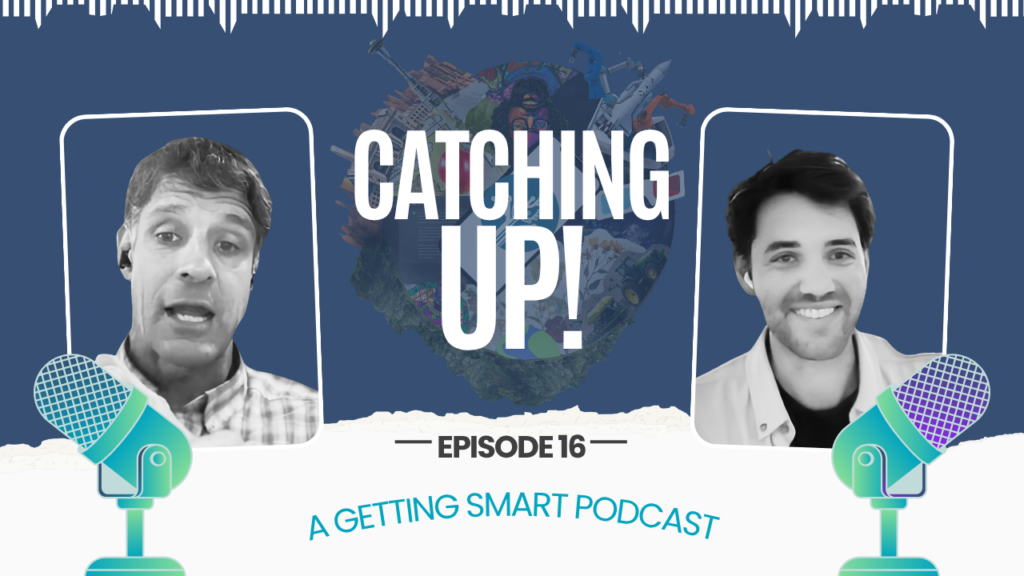
In this episode of Catching Up, Nate McClennen and Mason Pashia dig into what happens after a $2.5 billion settlement lands, and whether “fund real life” is a better answer than another wave of mental health apps. They also unpack a study showing that AI models recommend wildly different schools depending on which one you ask, and why that matters more than it sounds. The conversation turns to a growing tension in AI and education: efficiency versus efficacy, and why the real opportunity isn’t faster lesson planning, but AI tools built around what learning science already knows works, spaced practice, real-time feedback, and targeted instruction. Nate also walks through a simple framework for how school systems actually learn, separating implementation, innovation, and continuous improvement, and why conflating them causes districts to get stuck. Mason brings a deep dive on the shift from tokenistic student surveys to genuine intergenerational co-design, featuring real examples like a student-drafted AI policy bill passed 82 to 16 and the Kentucky Student Voice Team’s constitutional lawsuit against their state. The episode closes on a lighter note, with a living room full of guitars and a pottery shop in Illinois that runs entirely on the honor system, two small, human reminders of what real connection looks like.
Introduction
Nate: Mason, good to see you today. Excited to catch up.
Mason: Likewise, Nate. Good to see you.
Nate: What are you sharing today? We’ve got a long list of things in our doc, so what are the highlights for our listeners?
Mason: There’s a lot. I’m going to talk a little bit about privacy and raise an eyebrow or two. We’re going to think a little bit about when you search for schools in an AI model, what do you find. We talk about the shift from tokenism to authentic intergenerational co-design, and, this sounds like the beginning of a bad joke, but we talk a little bit about what happens when you put a bunch of guitars in a room.
How about you, Nate? What are you sharing today?
Nate: Outside of the music, which they have to stay for, we’re going to talk a little bit about Meta’s social media fund that’s now been created because they lost a lawsuit about young people using social media. A little bit about AI efficacy over efficiency, and how we think about AI as an efficacy tool rather than an efficiency tool. And then our deep dive is going to be around learning systems, and again, at SPARC, we’re really thinking about how systems clearly define how they’re learning as an entire system. And then we’re going to end, just to balance out your story of guitars lying around, with a story about pottery in Illinois.
Nate: So stay tuned, everybody. This is going to be a great one, and we look forward to hearing your feedback.
Catching Up: Weddings, Road Trips, and Tom Vander Ark Sightings
Nate: You officiated a wedding this weekend? You’ve been busy with wedding officiation season, huh?
Mason: I know, officiated too. I think it’s a non-lucrative business model for myself, but it is an honor to share those moments with people that you love and know well. This one woman came up afterwards and said, “You’re like a mix between John Mulaney and a priest, and Slim in a suit.”
And I was like, “Awesome. Thank you. That’s all I need to hear.”
Nate: That’s a big compliment. We had the other one in person out in Seattle, which was great, to have a picnic lunch by the ocean with everybody. So that was a fun day of thinking and brainstorming, and we even had a Tom Vander Ark sighting, which was even better.
Mason: Tom Vander Ark and the porpoises, they both came by. Yes, super fun.
Nate: I just drove across country to do some family stuff here on the East Coast, and we had a good reminder about how big the United States is, and how much agriculture exists from Wyoming through at least partway through Wisconsin. It feels like there are fields upon fields. We went the northern route up on I-90, and there is a lot of food being produced in this country.
Mason: Yeah, that’s a conversation for another podcast. I have a lot of thoughts, but that is a very unique band of the country for sure.
Nate: Yes, yes. All right, let’s talk about education.
Meta’s Social Media Settlement: “Fund Real Life”
Nate: I’ll start us off. So we have this huge settlement from social media, from Meta having to pay out billions, and it was all over the news. There are all sorts of interesting things about it. I heard some great interviews with kids: “Hey, we’re just going to go around it. It’s not a big deal.” But the bottom line is Meta has to pay a bunch of states a lot of money, and so the big question is, what do we do with it?
There was a great article by a woman named Elizabeth Gaines, and her tagline was, “Fund real life.” A number of the arguments have been, “fund mental health,” et cetera, but I love this tagline of “fund real life.” She states that means use this money to invest in after-school programs where students discover new passions, and community organizatioprivacy. To do this, Meta has to figure out that people are between the ages of 13 and 17, and the way they’re doing that right now is building AI to determine if kids are lying about their age, basically making inferences based off facial recognition and context and things they’re saying.
If we lived in a perfect world, maybe that would be fine, but we don’t, and Meta has built most of its money through advertising and targeted marketing and all this stuff. So there’s a part of me that’s wondering about the how of this whole thing, how are you going to figure out they’re 13 to 17? And if this isn’t working and people continue to put pressure on you, where does that line get drawn?
One other piece on this, Taylor Lorenz, a great internet critic and writer, wrote this really interesting piece documenting the shift of the internet from anonymity to not being anonymous. Best practice used to be, if you make a Reddit account, have no identifying information in your username, or a video game gamer tag, all this stuff where people have been able to be anonymous forever behind a kind of gateway of a username. But this is a mark in the other direction, where it’s, “No, to play, you have to verify who you are.”
Maybe fine in a perfect world, but I’m hesitant to be giving out a bunch of personal identifiers from young people to platforms. So in general, I’m pro this legislation. If it works perfectly, hooray, and I’m also a little bit dubious.
Nate: It goes back to what does self-sovereignty look like. How do young people, students, and really adults own their own data and control their own data? If they have to verify via, entering your birthday, who’s to say someone’s not lying about that? And if there is a verification process, you’re no longer anonymous, but then how do you maintain control over your data, which is something our generation really has not been able to do. There are digital personas for every human being out there that people are making money off of, and we’re not making money off of.
So it’ll be interesting. I hope that some money goes to schools in the form of grants, for after-school programs, community-centered efforts, health and wellness. It would also be interesting to get a larger record of what the long-term impact is. I know the data has not been strong in Australia in terms of trying to do a ban on this kind of thing for students under a certain age, so I’ll be very curious if the United States can do it any differently.
Mason: I agree.
AI, MBAs, and the Shift from Efficiency to Efficacy
Nate: Let me throw one more out here at you, a couple more AI things, and these are short. PricewaterhouseCoopers did a survey of 1,000 US financial services executives, the leaders, and found that 86% were valuing AI skills over MBAs.
Mason: Hmm.
Nate: It’s really interesting, because an MBA can cost a couple hundred thousand dollars and takes a couple years to do, usually two. And we’re now seeing the emergence in higher ed of, I think MIT is offering a five-day boot camp on AI and executive leadership, which may be more valuable in the long run than an entire MBA for two years, just because of the rate of change.
That makes me think about how the advance of a technology informs what industry wants, which then should inform what outcomes are needed in K-12. We talk about profiles of a graduate, or profiles of a learner, that’s one piece from the outcome side.
The other piece that was interesting to me from the teaching and learning side, we call that the learning model in our Wayfinder, is a really good white paper by Whiteboard Advisors titled “From Efficiency to Efficacy.” Their argument was, while everybody’s focusing on increasing efficiency with AI tools in the education sector, planning faster, planning better, assessing, what they argued is that we really want to focus AI tools on things that have proven to be best practices in teaching and learning, based on learning sciences.
These things include: how do we give timely, high-quality feedback? Do we do spaced practice, interval-type work where you learn something and come back to it a couple weeks later rather than learning it all at once? How do we do targeted instruction and tutoring, which ties into Bloom’s 2 Sigma problem, when people are tutored one-on-one, their outcomes are better than in a 30-person class. How do we do productive struggle and zone of proximal development, differentiated instruction, metacognitive work, access and communication? Their argument was, when we do this right, AI actually will increase efficacy rather than just efficiency.
Imagine a math class of high schoolers in algebra, 30 of them, and the teacher says, “Everybody, here’s a formula, draw the parabola.” At this point the teacher has to walk around and make a judgment call on who knows it, who doesn’t. But if they were on an iPad, and there are AI-driven software platforms doing this, suddenly the teacher could get real-time information: these students understand it, these students need this. The human in the room gets real-time actionable feedback, which is a real holy grail for teachers. That increases efficacy as opposed to efficiency.
The other example was, if you’re a student with an IEP that helps support your learning, teachers are often overwhelmed by IEPs because they’re very large, prescriptive documents they have to customize around. Imagine if there was an AI tool that could quickly, in real time, adjust the assignment you’re giving students on IEPs by cross-referencing those IEPs.
Mason: That’s super interesting. I think The 74 put out something today about the shortcomings of AI tutors so far, that they’re not delivering on their full realized potential. Their big thing was these have actually been trained pretty well in science of literacy, learning sciences, but they just don’t keep kids coming back to them.
I think that’s baked into things like productive struggle and all this stuff, but the engagement piece is going to be hard. That’s just one of the big challenges when you’re shifting from a more human delivery to machine delivery technology. There’s a hybrid middle ground I think we’re pretty bullish on, which has human in the loop and keeps both people around. But I do think that’s going to be a really important skill, even beyond agency, just self-directed, determined, showing up. I don’t know if it goes in efficacy or efficiency, it may be a third tier, like will, or something like that.
None of this work in Whiteboard’s paper was around what is the quality, the relevance, the engagement level of the learning experience. This was purely on, if you’re learning something, this is what will make learning better, and these are things we’ve known, spaced practice has been around for a hundred years. What’s not here, what you’re alluding to, is what does engagement look like, what does agency look like, what does learner-centeredness look like in an AI age? Certainly with human in the loop, probably with some of these things built in, but just doing these things and hoping students will follow is probably not going to work either.
Mason: Yeah, I totally agree.
It’s like the difference between learning sciences, which focuses on, in a particular constrained environment, how do people learn best, learning sciences doesn’t necessarily talk about the larger environment, in the context of what engages students, et cetera. At least in this particular article.
Mason: Do you think those should be separate study areas?
Nate: No, I think it should all be part of it. We need to know how the brain works, and the brain works on certain very specific pieces, if we get feedback much faster, we’re going to learn faster. Feedback could be in an engaging experience, or it could be a 10-question multiple choice quiz that I immediately got feedback on. The quality of what someone is learning may be much different. If I’m doing real-world work, and the person I’m working with gives me feedback like, “You need to work with that customer in a better way,” that’s a different experience than a multiple-choice quiz. Both are using feedback.
I’m trying to discern the difference. I think it’s part of learning sciences, we do things we’re engaged in, where we find relevance, have agency, and there’s purpose. That’s part of how our brain works. So I’ll put them all into learning sciences, but this particular case was really specifically focused on Hattie’s best practices and efficacy.
Mason: Yeah, I think that’s really interesting. I think this is where we can continue to learn from media. We’ve talked before about teachers learning from YouTube-style facilitators and influencers, but propaganda and things like that are somewhere in between the two. It knows how to package a message so someone can carry it with them, learning and delivery, and it also has the hook, the storytelling, the entertainment and attention-grabbing part. So there’s something worth unpacking there, how do we broaden learning sciences to also talk about engagement and relevance, which I think matters.
No, I think it totally matters. Let’s think about, you’ve brought this up before, why isn’t YouTube sort of the actual end game of school in some ways? This idea that you can learn anything you want. But the difference is, in school, if I’m the teacher and you’re the student, I’m giving you things. On YouTube, you’re the student, and you go choose things. If there’s a four-hour podcast on pruning plants because you’re really interested in pruning plants, you’re going to love that. But most kids, if you make them listen to a four-hour podcast on pruning plants, they’re going to be like, “Who cares?”
Mason: Totally.
It goes back to what you said before, agency matters, choice matters within a constrained set of outcomes that are the requirements. But that learning experience itself, do we learn as humans, and how do we create experiences where the best-case scenario for learning can happen.
Mason: Yep, I agree with that.
AI Models and the Fragmentation of School Search
Mason: Speaking of choice, I can’t remember if I’ve shared this before, and if so, I’ll drop this section. But there’s a report from a company called Tembo that looked at, if you were to look up school choices near you, this was specifically a study of private schools, how do the different AI models recommend different schooling options based on their training data.
This is really about how do you find options. The study found that out of the top 20 results for each model and each location, 80% of the results were different. So if you use ChatGPT, Gemini, and Grok, you’re getting 80% different responses in each one if you say, “Best private school near me.”
They looked into it a little more. If you’re using Microsoft Copilot, it pulls a lot from local directories, so a lot more geographical tags of nearby places, and it weights a few websites heavier than others. If you’re using Google AI Overview, it’s pulling primarily from YouTube and other social directories. If you’re pulling from Grok, you’re getting a lot from social media places like Facebook, Instagram, Reddit, and YouTube. And ChatGPT, which a lot of people saw in the early days of AI, its training base is over 10% Reddit results, so you’re getting a ton of individual, like, “Oh, I had a good experience at this school” type posts.
So it’s actually not really rated or ranked along this larger pool of consensus. I just think that’s really interesting, as these become the things people habitually pick one over the other, the results between them are going to be different, and I think in some ways this is a boon. You could technically pull up all four and cross-reference and see what’s similar between all of them, and maybe that’s a good way of doing research. But it also changes what it means to be discoverable and discovered. What does that bring to mind for you?
Nate: Yeah, I think there’s a larger point here. When you look at research on large language models, the major players, they have tendencies towards certain things. Even though they’re presumably trained on the same amount of data, the same large body of what humans have written down, recorded, both video and audio, they’re not all the same. It’s similar to when you and I, in a Google search prior to AI, if I search something and you search something, we get a different set of answers, even for the exact same search.
This is now more challenging because I think people are seeing AI as much more of an authoritative source. Instead of, “Here, I’m going to go choose the answer that I want,” it’s actually just telling me an answer, and it sounds very sure. I think this goes back to AI literacy in young people, that all K-12 students should be well-versed in, whatever tool they’re using has some bias implicitly built into it.
Nate: This is now more challenging because I think people are seeing AI as much more of an authoritative source. Instead of, “Here, I’m going to go choose the answer that I want,” it’s actually just telling me an answer, and it sounds very sure. I think this goes back to AI literacy in young people, that all K-12 students should be well-versed in, whatever tool they’re using has some bias implicitly built into it.
The large language model is going to give you an answer that sounds very certain, it may be different than another large language model that gives that same answer, and that one will be just as certain. So this is all about human perception and awareness, that it sounds very authoritative, but there’s always bias in it.
Mason: And I think it means you’re only as good as your prompt. In a perfect world, a person who puts in, “What’s the best private school near me for a seventh grader?” is going to get really different results than if you ask, “What’s a private school near me that does project-based learning, engaged in community, competency-based?” The more we can equip the people searching with the tools to narrow, the better the results are going to be. It’s still going to generally have all the information, it’ll just weight it differently. If you’re not precise, it won’t be able to be precise. So I think this is just a continued demand-side issue.
Nate: You’re arguing for a need for language here. If you say “best school,” that’s fairly arbitrary in terms of what people define as best. But if you say, “I want a school that does X, Y, and Z,” that’s going to be better, yet people need to know what X, Y, and Z are, and I don’t think that vocabulary is actually widespread in the general population. People don’t know what those words are.
Mason: I agree.
Nate: All right, cool, good intro segment.
Deep Dive: How Do Systems Learn? Implementation, Innovation, and Continuous Improvement
Nate: As always, we go deeper than short takes. We have two deep dives today: one around this innovation-implementation piece I’ve been writing about, and then you’re going to talk a little about tokenism and intergenerational stuff, and how you get student voice out there more, which I know you’re really passionate about.
I’ll start us off. We have a blog coming out that Rebeck and I wrote. We’ve been thinking a lot, as we work with systems in Virginia, Michigan, Kansas City, and now some in New York and Nevada, about how systems learn. What does it take for a system to learn, and what are the tools and mechanisms?
In education, we have a couple terms that get thrown around a lot, and we’re trying to make sense of this so there’s a clear focus on how an organization or system, a school district or a school, learns. Let’s start from what we think of as a strategic organization. We think a strategic organization is directional, that means it has strategic direction, has finances matched to that direction, and clear metrics for success. Number two is relational, how does leadership happen, how do humans interact with one another, which ties back into the values and norms established in a community’s vision.
The third one, which I want to dive into today, is that strategic organizations are operational, how organizations strategically learn and get better. There are three different terms I’ll define, then I’ll give an example.
The first is implementation, which is well known in the sector. There are organizations focused on implementation science, how do you take something that has a known solution, I’ll use the science of reading, or a curriculum you want to implement, that has a lot of research and efficacy data behind it. You’re not trying to find a new solution, you’re trying to implement a known solution. We use very basic steps: notice the challenge, define the actual thing you want, align the solution to it, practice that solution, then reflect. You’re not creating anything, you’re implementing something.
The second piece, counter to implementation, is what we’re loosely calling innovation, research and development, where the solution isn’t known as much. I’ll fold competency-based education in here, because the implementation of competency-based learning doesn’t have as massive a research base behind it as, say, the science of reading, it’s harder to evaluate, harder to run randomized control trials on. There’s some research, and it’s actually positive, but not nearly as robust.
So the idea of implementing, you have a portrait of a graduate, a set of competencies, what is competency-based education, there’s a lot of terms out there, that’s going to be much more on the innovation side. You’re going to do a lot of experimenting and testing. We use a basic cycle: notice a challenge, build a solution, test it with students, share with others, because we think sharing is important, then reflect and go again, until you get to something with enough efficacy that you move into the implementation phase.
So you have innovation when the solution’s unknown, implementation when it’s known, and then continuous improvement, which has been used ubiquitously across industry and sectors like education, this is plan-do-study-act, how do we make things better. Continuous improvement sits in both innovation, you create something, try it, it doesn’t work, you do a PDSA cycle and rapidly iterate, or in implementation, science of reading didn’t work exactly the way you wanted, you do a PDSA cycle, which you could also call inquiry cycles or action research.
Our simplification, which people deeply involved in this at the university level might push back on, is that we’ve got to simplify this. In terms of our strategic organization, we need to be very operational about how we define this. We think there’s learning to be done through innovation, learning to be done through implementation, and continuous improvement that cycles through both. We’re testing this language out, we’ve refined it over the last couple years, and feel pretty good that this is the most concise description we can use to help a district or school answer, “How do you learn as an organization?” Which to us is a really big, fundamental question. I’ll pause there, what questions or thoughts do you have?
Mason: I think it’s a really nice, simple distillation of pretty complex stuff. How do you know if something is unknown? Are these things you realize kind of in real time, and you’re like, “Oh, we’re at the notice phase”? Or are you thinking more about, the research base is thin, that may indicate unknown? Give me some signals for how you know you’re in an innovation cycle.
Nate: I think both of those things could be true. One is the research base is thin, and that doesn’t mean it’s negative, it just means it’s more emergent. I’ll use personalized learning, which is a really broad term, the research base for personalized learning isn’t as deep as something specific like the science of reading, because it’s just really broad.
The second part of that answer is that even during an implementation, I’ll use science of reading again, the challenge is that it’s the same thing for all kids. There’s a real challenge with standard implementations, “You as a teacher must implement it this way to get the results shown in this randomized control trial.” That doesn’t account for context, geography, student background, student interests, et cetera. At that point, you might realize, “I don’t actually know enough to say this implementation is working right, I’ve got to try a few things because I don’t know if it’s going to work with my particular group of students.” So you run some design sprints, test it, do it a little differently, and see if that helps. By doing that, you drop the fidelity level of the exact improvements implementation science would call for, “Uh-oh, we lose fidelity that way.” And you do, but you might better reach those students because you have better design sprints around context.
Nate: The second part of that answer is that even during an implementation, I’ll use science of reading again, the challenge is that it’s the same thing for all kids. There’s a real challenge with standard implementations, “You as a teacher must implement it this way to get the results shown in this randomized control trial.” That doesn’t account for context, geography, student background, student interests, et cetera. At that point, you might realize, “I don’t actually know enough to say this implementation is working right, I’ve got to try a few things because I don’t know if it’s going to work with my particular group of students.” So you run some design sprints, test it, do it a little differently, and see if that helps. By doing that, you drop the fidelity level of the exact improvements implementation science would call for, “Uh-oh, we lose fidelity that way.” And you do, but you might better reach those students because you have better design sprints around context.
Mason: That makes sense. I like that. Just for the storytelling section, part of what we’re trying to do right now is uncover people who aren’t being talked about, organizations, schools. What are some signals or beacons that an organization is learning? Externally, how can you identify when a system is actually on a learning journey? Whether that’s education or otherwise, it seems like we have centuries of organizations that have learned, how do we observe that?
Nate: That’s a really good question. I’d ask very specific guiding questions to different stakeholders. For educators, those in the classroom, I’d ask, “What are the things you’re trying now to help better reach your students?” If they answer, “Well, I’m just following the directions from the district level, we’re implementing a new curriculum,” that means, well, at least they’re thinking about implementation. Often great teachers will say, “We have this curriculum, and I’ve got a group of students I’m not reaching well, and I’m going to reshape one of these units to make it more engaging, I don’t know how it’s going to turn out.” That phrase, “I’m not sure how it’s going to turn out, but,” means there’s much more of an innovation space happening. Innovation will have much more agency at the teacher level, implementation will have more fidelity but less agency, that’s the reverse.
For a principal or superintendent, I’d ask, “How does your organization learn?” It’s a really curious question we’re starting to test with those we work with, and seeing what the answers are. Every principal and superintendent will have an answer, but I’m curious if the answers fall into these three categories, implementation, innovation, and continuous improvement, or if there’s some other bigger factor we’re missing, or that they’re describing in a totally different process.
Nate: For a principal or superintendent, I’d ask, “How does your organization learn?” It’s a really curious question we’re starting to test with those we work with, and seeing what the answers are. Every principal and superintendent will have an answer, but I’m curious if the answers fall into these three categories, implementation, innovation, and continuous improvement, or if there’s some other bigger factor we’re missing, or that they’re describing in a totally different process.
Mason: No, I think that’s a useful summary. There’s also maybe something in there we should think about more, how do you create a “look-fors” guide for a system that’s learning? I feel like that could be an interesting back-map.
My last question on this topic, I think the blog lays out really clearly why this matters, in terms of, implementation is great, but it can perpetuate a compliance-based system, so many known knowns that it never really escapes the ceiling that’s in place. How do you even know what your options are? I assume the Wayfinder is one, our theory for how you might do that, but how would you describe it for someone whose time it is to do something, what do we do, how do they even get there?
Nate: There’s this great media channel called Getting Smart, and I’d just really suggest they go on Getting Smart.
Mason: Soft plug.
Nate: I think there’s a couple things. One, this is the known-unknown matrix, I think it’s called the Rumsfeld matrix, when you’re in the “we don’t know what we don’t know” quadrant, it’s really difficult to break out of that. From a storytelling lens, we, collectively the organizations that talk about this and work with organizations undergoing these transformations, need to continue to produce stories of transformation, how do you move from current status to future status, that gives others an idea of what future status looks like. We have a tool built around creating case studies people can react to in short order, to actually imagine what the future is.
The second thing is really thinking about site tours, and how you make those more ubiquitous. It’s a little harder in rural areas than urban. In urban areas, I think every teacher and aspiring leader and leader should go visit other schools, especially innovative schools, not to duplicate or replicate exactly, but to broaden the knowns, that artificial ceiling of our knowns, because that ceiling’s pretty thick in education, in my opinion.
Nate: The second thing is really thinking about site tours, and how you make those more ubiquitous. It’s a little harder in rural areas than urban. In urban areas, I think every teacher and aspiring leader and leader should go visit other schools, especially innovative schools, not to duplicate or replicate exactly, but to broaden the knowns, that artificial ceiling of our knowns, because that ceiling’s pretty thick in education, in my opinion.
Mason: The artificial ceiling of our knowns, that’s a book title waiting to happen for someone.
Nate: No one will really understand what the book’s about, but.
Mason: That’s a lot of book titles, that is totally good. Well, super fascinating. I highly recommend folks check out the blog and let us know what they think of this language, if it’s sticky, if it makes something complicated more simple. We’d love to hear from you.
Deep Dive: From Tokenism to Intergenerational Co-Design
Nate: All right, let’s talk about tokenism and intergenerational stuff. I know you’re on a bandwagon about this.
Mason: Yeah, I’m on a bit of a journey the last few weeks, talking to a bunch of organizations that have been really deep in student voice work for a long time. Right now we’re seeing this big shift toward “student voice matters,” and people are taking surveys and including youth voice in a bunch of conferences and everything. As we’ve talked about before, a lot of the time that just looks extractive, tokenism, the students don’t get to see the survey they participated in at the end, they’re just sort of blindly throwing around their voice. They don’t get to see the impacts. They don’t own their data, kind of returning back to what we were talking about at the beginning.
Nate: Yeah.
Mason: It’s kind of messy. In the last four weeks in particular, I’ve been in a couple spaces where people are all using the word “intergenerational,” whereas a year ago they were not, that was kind of a nascent term. I think this is related to the third-space conversation, there’s just not as many spaces where you have young people, middle-aged people, old people all in the same room, even if they’re not working on the same project, just cohabitating. But it’d be really cool if they were working on the same project.
I’ve been thinking a lot about this, and I’m going to throw a bunch of random things at you and think about this together, because what I’m struggling with is, does intergenerational matter, is it actually a unique thing, or are we really just talking about bridging power dynamics in group settings? Fundamentally I think that’s what’s different when you invite young people into the room, they’re not used to having power, they don’t know how to use it, and we rarely cede it to them.
Yesterday I was talking with a woman named Eunice from the organization CoGenerate, who’s been doing intergenerational work for a really long time. She says Hollywood is actually really leading this charge, because almost all their movies are cast really intergenerationally, which I think is fascinating, because the incentive is they make more money if they appeal to every audience.
If you look at The Odyssey getting Matt Damon, Anne Hathaway, Zendaya, and Tom Holland, you’re going to get the Euphoria crowd, the Good Will Hunting crowd, the Martian crowd, you by proxy sell a lot of tickets. You get the Spider-Man crowd, the Billy Elliot crowd from his early ballet Broadway days. As I’m talking about these things, I just want to put that bug in your ear, what’s the equivalent for design? If you’re trying to actually intergenerationally design, what’s the equivalent of “it makes us more money”?
Nate: Yeah.
Mason: There’s a couple efforts I want to present to you and talk about, because I think they represent really different, and in my opinion positive, versions of student voice, but with varying amounts of tokenism involved. I saw this article, I think Rebecca on our team shared it this week, about 100 high school students from all 50 states gathering in Boston in a US Senate chamber replica to vote on AI and figure out what to do with it in schools.
They ended up writing an act called the Students First Act. It passed overwhelmingly, 82 to 16. This bill is not official law, but it’s essentially now being distributed to 10,000 leaders through AASA as a real-world policy for districts to see what gets adopted. This policy had a bunch of really interesting results. They banned AI on all graded tests, forbid it in direct writing assignments, but allowed for it in editing, brainstorming, and studying. Teachers are required to publish written AI rules every semester. For parents, the bill is basically, “You should encourage ethical habits, but you cannot really control how I engage with AI at school,” which I thought was really interesting. The students wanted say over how they use AI in their learning. There was also a bunch about mental health, and when and how to use AI in that context.
This one’s interesting because it’s a simulation, the students are participating in an isolated incident, all student-led, but the result is kind of like a survey, an agentic survey. It’s a bill where students led their voice, they created something, but now the leaders at AASA can choose to incorporate or do whatever with it.
In January of 2025, a group of Kentucky students filed a lawsuit against the Commonwealth of Kentucky, asserting the state has failed to fulfill its constitutional obligation to provide students with an adequate and equitable public education. This is fully student-led, still underway in the state of Kentucky. Kentucky Student Voice Team describes themselves as youth-led and intergenerationally sustained, which I love, you can meet with some adults who keep the admin stuff going, but the students are the ones showing up, lobbying, drafting legislation, enacting.
The third one is an organization called the Responsible Technology Youth Power Fund. This was kickstarted by the Omidyar Group, a philanthropic initiative where young people decide what to do with money to advise on responsible technology in the world. The fund has been going for three years now, has raised $7 million to support charities, with award amounts ranging from $25,000 to $150,000. They’re basically just seeding money to initiatives in the real world. They have an intergenerational board, but the students run it all, they fundraise, they distribute the money, and the board just kind of helps out on the sides.
These are three, I think, really unique versions of going from more of a survey mentality to an action mentality. I’m curious about your reaction to all this intergenerational conversation, and then I want to talk about co-design a little after that.
Nate: Yeah, as you know, I’m a big advocate for student voice. They’re the recipients of the work of education, and they often know what’s not working for them. My caveat is that in a lot of student spaces, there’s this unknown-unknown problem, or actually it’s a known, they know there’s a challenge, they don’t know what the solution is. I think there’s a need, and we go back, broken record, to the demand side, students also need good language to say, “Mastery-based learning or proficiency-based learning is a much better way for me to learn, and I actually know the learning sciences behind it, I know it’s going to be good for me because of the way my brain works, and letter grades really are a false narrative about how I’m doing.”
When we move from tokenism into this intergenerational concept, I think the role of adults may be to create experiences where students can see a wide variety of schools, learning experiences, places where things work, or at least experiments where things work, and simultaneously engage. Maybe that’s your co-design process, one group or the other doesn’t necessarily work for me personally, I think it has to be this partnership, this intergenerational partnership, where the knowns of what adults may know about education, at least if they’ve solved their unknown-unknown issue, are also partnered with the students who are the recipients, and say, “I have this gut feeling that I’m disengaged in my high school, nothing engages me, but I don’t know the alternative, so I’m just going to stick with it.” So my gut reaction is there’s this partnership that’s really important here, rather than just students or just adults.
Mason: Yeah, I totally agree. I think we’ve seen this with stuff like the climate crisis, where students are like, “You can’t just make this our problem, don’t just be like, you’ll solve it.” It has to be everyone working on the same thing. So if that’s true, and intergenerational is just one possible vector for bridging difference in co-design, what are some examples of co-design you’ve seen done well? That bridges power structures. It can be intergenerational or not, but I really think if you get a bunch of teachers, superintendents, and principals in a room, you’re going to have the same issue, a perceived power dynamic. Co-design is kind of clumsy at first, people are looking for a leader in the room, and that means a lot of voices are not heard or expressed. I’m just curious if you’ve seen examples, and if you have any ideas about how to do this well.
Nate: Yeah, I think some very specific examples, I’ll share three. One is that student representation on school governance is a really powerful thing, because by law it’s designed to be representational, those that are on there, if they truly have a vote. That’s pretty well-established in the sector, not all school boards have students, but there are many examples of where that happens, and it turns out there’s an association for it, which is why we’re going to do a podcast around this.
I think the second thing where we’ve seen this be effective is, we do a bunch of strategy work with schools creating strategic plans or strategic directions, and we universally advocate for young people to be on those strategy committees, which are representative of all constituents and stakeholders, parents, board members, teachers, students, school leaders, and general community members. That’s been really effective when you get young people who are articulate and can say, “Here’s the data, and this is what I’m experiencing in real time in the school.” That’s another place where they’re co-designing around a strategic plan. The challenge sometimes is, if those students aren’t used to having their voices heard, they’re sometimes reticent to speak up, so those norms have to be established early on.
The third thing we see and advocate for is when students are on school design teams. In the work we do with systems, thinking about an initiative, rethinking what a student experience looks like, we advocate for design teams, and those design teams should be multi-stakeholder as well, students on those design teams can be really helpful, if they’re given the power and tools and agency to say, “Here’s what we think, and here’s the evidence we’re bringing.”
Nate: The third thing we see and advocate for is when students are on school design teams. In the work we do with systems, thinking about an initiative, rethinking what a student experience looks like, we advocate for design teams, and those design teams should be multi-stakeholder as well, students on those design teams can be really helpful, if they’re given the power and tools and agency to say, “Here’s what we think, and here’s the evidence we’re bringing.”
Mason: Yeah, and I think honestly there’s probably just general facilitation techniques people can use. Part of the reason I’m bringing this up probably too many times in the last year is I think we’re rounding this corner as a sector right now, we’ve done a lot of surveys, we maybe have a student leadership team, there’s maybe a student on the school board, we have some of these pieces in place, but actually shifting to authentic inclusion is hard, and that’s going to be really tough. I think the hardest part, and this is what the Kentucky Student Voice Team has taught me in a few conversations, and I’m hoping to do a podcast with them too, is that you will hit so many more obstacles before you have a win.
How do you basically do this in a way that a district doesn’t just try it and give up when it’s hard and the students don’t share their voice, or they think, “Oh, the students don’t really have any ideas about this”? I think there’s some really basic stuff you can do, like have the superintendent be the note-taker, actually do things that dethrone the power dynamic in the room and invert it. How do you maybe have the students standing and everyone else sitting down? There’s a bunch of physical things you could try to make this start to feel different. I actually don’t know, and I’d love to hear from listeners, what are some techniques you can use to make this feel authentic and actually inclusionary, because we’re fighting against 150 years of history that says otherwise.
Nate: Yeah, it feels like there’s this idea that for learners to really be empowered, they need to have the language, what they’re talking about.
Mason: Agree.
Nate: Those in that AI policy group, they were diving deep into AI, they had a deep understanding of it, and wrote something articulate, we’ll put it in the show notes because it’s fun to read.
Mason: Mm-hmm.
Nate: They need to have the knowledge about what’s possible in education, teaching, and learning, and they need to move from what we currently have, student advisory, advising, into agency. At the same time, we also need to help both young people and the different generations value each other well.
I’ve seen one experience where a particular student was given a lot of voice, and they then lectured the teachers about how bad they were. So it can go the other way as well, and the adults have to be in the co-design process too. These are all tools about how do we work well together, which a lot of humans actually don’t have. Young people need it, teachers need it, everybody needs it, humans need to learn how to work better together. This goes back to facilitation, like you were saying, what are the values, what are the norms, what are our standard practices, to make this the best co-design process. So I’m really looking forward to it. I think we have some big projects we’re scheming around that could play a really big national role in making this happen, and we’re fishing around a little to find the right partners on that.
Mason: Yep, I agree, big deal. Thanks for humoring me for continued deep dives on that subject.
Nate: Yeah, that’s good.
Cool Schools: Grand Rapids’ Micro-School Programs
Nate: All right, let’s wrap up here, we’ve been going for a while today, this is awesome. I’m trying to bring back this idea of schools that are cool that are out there. We had a great podcast with Mike Posthumus out of Fielding International the other day about school design, actual physical design and how learning design relates to that. He told us about, he went to school in Grand Rapids, Michigan, and they have some really interesting micro-school programs, I just want to list a couple that we’ll put in the show notes.
As a sixth grader, he applied to a school called Blandford, and Blandford is a nature center that the district owns, and for his entire sixth-grade year he was embedded in this Blandford Nature Center with a bunch of other sixth graders from around the district. They also offer a Zoo School embedded in the zoo, a Center for Economecology, I love that word, about environmental and sustainable education, also for sixth graders, and then an Environmental Science Academy for grades 6 through 12, and the Grand Rapids Museum School, which many people have heard about, also grades 6 through 12.
I really like this idea of sixth-grade micro-academies where people could apply, and you’re mixing with other middle school students as the start and launch of your school, where you’re embedded in something that’s not necessarily a school building. Just a shout-out to Grand Rapids School District, doing some really interesting models of how you create these theme-based schools for different cohorts of students.
So that was fun to learn about, for sure.
Mason: Super cool. Way to go, Grand Rapids.
Nate: Yep, good work there.
Human Expression: Guitars in the Living Room and a Pottery Honor System
Nate: All right, let’s finish with human expression. What do you have for me today? I’ll finish this off after that.
As you alluded to, I officiated a couple weddings recently. One of them was a family wedding, so we had a lot of family in town staying at a big Airbnb. I brought all the guitars I own to the house and just laid them around on things. I knew it was a pretty musical family, a bunch of people play, but it was just so fun to be lounging in open spaces, and people would just, in the middle of conversation, pick up a guitar and noodle, and the person next to them would pick it up and kind of play over what they’re playing.
The conversation never stopped, it never became a performance, it was just a really beautiful, emergent thing to do with your hands. And I was just thinking, the alternative to this is you pick up a phone, or you do something else with your hands, or you just never make this thing you’re making right now. It was really a testament to the power of having instruments nearby, even if people are amateurs. It’s just a physical thing, a way to engage with the world and express yourself, and I don’t think enough people get access to just grabbing an instrument every once in a while. Guitars are great because they’re so portable, but it could be anything.
Nate: I love it. I brought my guitar cross-country in the car just for that very reason.
Mason: Perfect.
Nate: I wanted to share that when I drove cross-country, we stopped at my wife’s aunt’s house, and my wife’s aunt is a potter in Illinois, she’s been a potter all her life. She lives in a house, and in the garage next door is her pottery shop, and she leaves the garage door open all day long, seven days a week. It’s like eggs for sale on the side of the road, except it’s all pottery from her and a bunch of other potter friends. They just put pottery out there, there’s a price on it, and a little IOU system, if you don’t have enough money, you can take an envelope with a stamp on it, and if you have money, you drop the cash in the cash bucket and take the piece of pottery you like.
I said, “Do you ever have any issues with people just taking pottery?” And she said, “Nope, never had an issue, done this for years and years and years.” I think your example and my example are about this good-news work of humans just cooperating and doing good things together, that we don’t hear enough of because media loves to sell the negative things. These moments of human expression, I think, are really, really important, that you can sell pottery and not have to man the store and worry about people taking it, and you can put instruments around and people just pick them up and create music together. I think those are two powerful examples to finish off with human expression, before we get to our final song.
Mason: Before we get to our human expression, which probably featured no real instruments laying around.
Nate: Yeah, absolutely, no pottery, no instruments, purely AI generated. But this is a good one today, so why don’t you cue us up and tell me what you think.
What’s that Song?
Mason: Outstanding, outstanding. Is that line, “the map follows you”?
Nate: Yeah, I think that’s pretty.
That’s pretty profound. Wow.
Nate: Yeah, I thought the lyrics on this one were actually pretty good this time around. They’re always cheesy, but they had some good, profound things in there, I thought.
Yeah, not bad at all. Definitely something like country bluegrass, it’s got the bluegrass shuffle.
I just put in “bluegrass,” I didn’t put anything more than that, and I think I gave it a date range or something like that. I’m really interested, as you know, in flatpicking, and whenever you hear this, in this case, AI good flatpicking, I’m like, “Oh, I want to be like that AI flatpicker.”
Mason: Yeah, he’s good. It’s also striking to me how country music has been maybe the most altered by Auto-Tune in the last few years, and that voice easily could have been on the radio, it sounds exactly like a country singer, in a way that a lot of the other ones feel more machine. Country music has really already been machined.
It has been. It’s this convergent sound of “this is country music,” especially as it’s become more widespread and more people are following it.
Mason: Totally.
Nate: Anyway, great to catch up today, this was an awesome one. Good to see you, good to riff about education, and look forward to the next one.
Mason: Always great to see you, Nate.
Links
- If Social Media Companies Owe Billions, Let’s Fund What Kids Need
- Taylor Lorenz in the Guardian
- PricewaterhouseCoopers LLP
- https://whiteboardadvisors.docsend.com/view/aka3amitbucqs8f7
- Kentucky Student Voice Team (KSVT)
- Youth Power Fund

Mason Pashia





0 Comments
Leave a Comment
Your email address will not be published. All fields are required.