

Overview
LearnKit is a proposed framework and infrastructure designed to give learners greater control over the information that describes what they know, what they can do, and how they learn. Today, learning data is fragmented across institutions, applications, credentials, employers, and other systems, making it difficult for individuals to access and use their own information. LearnKit envisions a trusted and interoperable ecosystem in which academic records, skills and competencies, goals, interests, learning experiences, and other relevant data over time can be brought together with insights.
This project explores the technical, policy, governance, and market conditions required to make that vision possible. It examines approaches to interoperability, identity, consent, privacy, and data stewardship. The paper also considers how AI agents could use learner-authorized data to provide more personalized guidance, identify opportunities, recommend learning pathways, and help individuals communicate their capabilities across education and work. Ultimately, LearnKit proposes a shift from institution-centered data systems toward learner-centered infrastructure that can support lifelong learning, mobility, and opportunity while maintaining strong safeguards for privacy, security, and trust.
The strategic thinking in the Track 1, Track 2, and Governance and the LearnKit Alliance sections of this paper, along with the AI agent examples and ecosystem map above, is drawn from LearnKit: An Infrastructure for Learner Agency, developed for the Gates Foundation from fall 2025 to early 2026 and authored by Karen Cator, Valerie Greenhill, and Sharon Leu. That brief also included a full investment plan, budget estimates, and staffing recommendations across its three tracks, which are not reproduced in this public-facing paper and are available upon request.
Karen Cator is a former President and CEO of Digital Promise and former Director of the Office of Educational Technology at the U.S. Department of Education. Valerie Greenhill is the President of the Southern Regional Education Board and co-founder of EdLeader21. Sharon Leu is Executive Director of California’s Career Passport initiative and previously led the Verifiable Credentials Project at JFFLabs.
This paper also draws on Learner Agency, Motivation, and the Use of Personal Learning Data: A Rapid Literature Scan, associated research produced by Grecia Gaviria, PhD and Viki Young, PhD of Digital Promise’s Center for Learner Pathway Innovations, available upon request. The Signals from the Future scenarios were written by Mason Pashia of Getting Smart, developed alongside this work to make the infrastructure’s stakes concrete for a general audience.
All images have been provided by Gobekli.
At-A-Glance Summary
Learners move. Their data often does not. Records disappear when institutional accounts close. Credits fail to transfer. Skills demonstrated in one context go unrecognized in another. The people who pay the highest price are those navigating the most complex transitions with the least institutional support: special education families moving across state lines, first-generation students proving competencies that transcripts can’t capture, workers reskilling across systems that don’t talk to each other.
This isn’t a data problem. The data exists. What’s missing is a governed market that supports learners as they own, carry, manage, and act on their own learning data, across every system they encounter, for the duration of their lives. LearnKit is a concept for that infrastructure, and this paper lays out the strategic thinking behind it.
What LearnKit Is
LearnKit is a learner-centered data infrastructure designed to give individuals access to, control over, and the ability to act on their own learning data across K-12, postsecondary education, and the workforce. The opportunity is timely. AI agents that can track learning progress, advocate for a learner’s needs, match them to opportunity, and navigate complex systems on their behalf could make a genuinely powerful impact on people’s lives. But an agent is only as trustworthy as the data layer underneath it. Without infrastructure the learner owns and governs, AI systems default to serving the institutions and platforms that run them, not the learners they’re supposed to help.
Getting this right requires a control layer: technical architecture and governance infrastructure that ensures AI systems serve learners by default.
Three Tracks, One Convergence
Three mutually reinforcing tracks of work are needed to make LearnKit real. The first validates genuine learner demand before infrastructure bets are made, proving that specific people with specific pain would trust and adopt a new system, and advancing understanding of how that system should work. The second builds the technical control layer that makes learner agency architecturally possible. The third designs the governance structure that keeps it accountable over time. The tracks run in parallel and converge in the legal constitution of the LearnKit Alliance: a governed market for learner-centered infrastructure and applications.
What’s Ahead in This Paper
Track 1: Validating Learner Demand grounds the case in real people navigating real transitions, and lays out what it would actually take to earn a learner’s trust.
Track 2: The Control Layer describes the spectrum of models for who holds control over learner data, the technical components a control layer requires, and what’s newly at stake once AI agents start building memory of a learner over time.
Governance and the LearnKit Alliance covers what a governing body would need to do, the candidate structures for doing it, and how the three tracks converge into a functioning, accountable market.
Signals from the Future imagines three learners, at three different life stages, living inside a world where infrastructure like this already exists.
Two appendices close out the paper: a look at what a system of AI agents built on this infrastructure could actually do, and a map of the ecosystem already being built toward this future, plus a note on sources and authorship.
Track 1: Validating Learner Demand
Demand starts with felt pain. LearnKit succeeds by answering: what problem does this solve that real people feel acutely enough to change their behavior?
The Human Cost of Fragmented Data
Maria is a military mom navigating special education advocacy. Her 12-year-old son’s IEP disappears every time the family moves to a new duty station. In North Carolina, he had services that worked. In Arizona, the school starts from scratch: new evaluations, new explanations, weeks of lost time. “He pays the price every time,” she says. Special education families across the country repeat this experience at every transition.
Taylor is a high school senior in dual enrollment, earning A’s in college-level math at a community college. When she transfers to a state university, those credits are rejected as “non-standard.” She pays out of pocket to retake a course she already passed. Dual enrollment credits routinely lose their value in transfer. Students prove themselves twice, and pay twice.
These are not edge cases. They are the daily reality of a system where learning data is trapped in institutional silos rather than traveling with the learner. LearnKit’s promise is that Maria’s son’s IEP moves seamlessly when the family does, and that Taylor’s demonstrated mastery is verifiable across systems. Making that promise real requires understanding something more specific: not just that the pain exists, but what it would take for Maria and Taylor to trust and use a new system.
Why Demand Validation Is Critical
The education technology landscape is littered with interoperability solutions that institutions would not adopt and are unusable to learners. Data only moves when powerful actors require it, and the most powerful actors are the users themselves. Learner control matters ethically and legally, but it does not create motivation on its own. What drives adoption is whether the system solves a problem people feel acutely, today, in their actual lives.
Consider wearable health technology. Nobody adopts an Oura ring because it integrates with Apple HealthKit. They adopt it because it tells them something actionable about their own body that they could not know before. Interoperability is invisible infrastructure addressing a real need. The equivalent question for LearnKit is: what is the struggling moment so acute that a learner or family would adopt a learning data wallet and change their current behavior to do it?
Preliminary qualitative research with nine learners across five states and institutions identified several struggling moments acute enough to motivate behavior change. These findings should be considered directionally accurate, with the caveat that the sample is small and requires further validation.
- Data loss at transitions was universal in this early sample. Institutional accounts get deleted after graduation, portals go dark, work saved on school computers becomes permanently inaccessible. As one learner put it: “Each time you switch schools, I would lose all the assignments. I wish I had access to those assignments that represent my thinking and my work from that time.”
- Records that fail to capture real learning surfaced repeatedly. Multiple learners described wanting to show what they can do, work samples, demonstrated competencies, portfolios, especially for jobs where GPA tells employers almost nothing. A nursing student with three years of clinical experience found her work didn’t count because it wasn’t “school sanctioned.” A first-generation student noted that his transcript “just shows maybe I cap out at a C-plus. Nothing shows I had to start from zero to get there.”
- Trust conditions are specific and fragile. Learners in the sample weren’t uniformly skeptical, but their openness had clear conditions: explicit, opt-in, revocable sharing; transparency about who sees data and why; and a clear distinction between a system that works for them versus one that collects data about them. Several expressed concern about opaque AI usage in hiring and screening.
People are notoriously inaccurate at describing new solutions they would use, and they do not adopt new products because of features. They use new solutions when the current approach to that problem has broken down, or when the switching cost is lower than the pain of staying put. Applied to LearnKit, understanding what users need requires researching questions like: what is the learner trying to accomplish at this moment? What are they doing today instead, even if it’s a workaround like carrying paper records or manually emailing transcripts? What would make them trust a new system enough to use it? What are the switching costs, not just financial, but in effort, anxiety, and privacy and accuracy concerns?
Trust as a Prerequisite for Adoption
Learners cannot be assumed to trust a new data system, even one designed for their benefit. Several interview participants noted that education cannot yet emulate Apple HealthKit’s “invisibility,” where data flows seamlessly in the background. Given heightened concern about AI and data misuse, learners and families need to see control, not just have it. Visible, legible agency over their own data is what makes initial adoption psychologically possible.
The preliminary learner interviews reinforced this pattern. Learners drew a clear distinction between a system that works for them versus one that collects information about them. As one put it, regarding AI screening tools: “I think there’s this really big space of not really using it responsibly or in a way that is fair.” That distinction needs to be visible in the product design, not buried in settings.
A family that has watched their child’s records disappear across school systems is unlikely to change their behavior without a clear and immediate sense of who has access, what they can do with it, and how to revoke it. Critically, this extends to how AI interacts with learner data. The system design needs to make clear that any AI operating on a learner’s behalf is bound to act in their interest, not the institution’s.
Priority Learner Cohorts
Certain users need to be prioritized for demand validation: those with high urgency, where the pain is acute enough to motivate behavior change; a clear use case, so the value proposition is testable; and equity alignment, so the work serves those most underserved by current systems. These cohorts are best defined as real people navigating specific moments, not as abstract categories.
- Special education families navigating school transitions. Parents managing IEPs across school transitions face repeated pain: every new school means re-evaluation, re-explanation, and lost time.
- Transfer students proving their credits should count. Students in dual enrollment, and those moving between community colleges and four-year institutions, lose credits, retake courses, and face opaque transfer processes.
- Military-connected families maintaining educational continuity. Families relocating every two to three years on average lose educational continuity and face varying state standards at each move.
- Career changers demonstrating skills from multiple sources. Workers pursuing reskilling need to prove skills gathered across multiple, disconnected sources.
- First-generation students navigating unfamiliar systems. Navigating complex postsecondary pathways with limited family guidance, these students need tools that help them understand options and demonstrate competencies. Infrastructure that assumes learner navigation skills will otherwise serve those already advantaged.
- Learners seeking to document real-world competencies. Learners gaining competencies through nontraditional, out-of-school, apprenticeship, and work-based learning experiences need portable records that reflect competencies beyond grades, ones employers and institutions actually recognize.
This track exists to prove genuine demand and sharpen understanding of what’s needed, before larger infrastructure bets are made. That work doesn’t run separately from the technical build. Agent prototyping runs alongside demand validation, not after it, stress-testing what the control layer needs to support and demonstrating what becomes possible once the infrastructure exists.
Track 2: The Control Layer
An AI agent is only as trustworthy as the data layer underneath it.
The demand case is clear: the pain is real, the cohorts are specific, and the trust conditions are knowable. But proving demand is not the same as being able to answer it. Learners like Maria and Taylor aren’t waiting for a better interoperability standard. They’re waiting for a system that lets them carry their data, control who sees it, and trust that the tools operating on their behalf are working for them, not for the institutions or platforms those tools happen to run on. Meeting that expectation requires infrastructure that doesn’t yet exist in any coherent, interoperable form.
There is also a more specific dependency. AI agents are the mechanism by which LearnKit’s promise becomes concrete for individual learners: navigating a transfer credit dispute, flagging an IEP mismatch, surfacing a scholarship a first-generation student didn’t know to look for. But an agent is only as useful and trustworthy as the data layer underneath it. Without a control layer that the learner owns and governs, an AI agent acting on learner data isn’t working for the learner. It’s working for whoever controls the infrastructure.
The Spectrum of Learner Control
Not all learner data systems offer the same degree of control. In practice, control exists on a spectrum, and where a system sits on that spectrum determines what learners can do with their own data. Research into non-centralized data architectures identifies seven distinct models, ordered by the degree to which a learner can directly aggregate, authorize, and reuse their data across contexts. At one end, learners operate their own data environments entirely. At the other, state infrastructure guarantees access to official records but offers little flexibility. In between sit hybrid, stewarded, federated, and platform-mediated arrangements, each offering a different answer to the question of who holds control.
| Model | Who Holds Control | Key Question Answered |
|---|---|---|
| 1. Learner-Operated Data Environments | Learner | Can I carry and reuse my data independently? |
| 2. Learner-Mediated Collection and Presentation | Learner, via portable credentials | Can I prove what I’ve done, selectively and verifiably? |
| 3. Hybrid Institutional-Learner Architectures | Shared / joint custody | Can I share and reuse my data with institutional support? |
| 4. Stewarded Collective Architectures | Steward on behalf of learners | Will my data be used responsibly at scale? |
| 5. Federated Institutional Networks | Institutions, via shared standards | Can my data move with me between institutions? |
| 6. Platform-Mediated Ecosystems | Platform | Can a platform help me find an opportunity? |
| 7. Public Digital Infrastructure | State or public authority | Can I access my official records as a citizen? |
Most real-world systems sit in the middle of this spectrum, models three through six, where institutions, platforms, or stewards hold meaningful power over learner data. Learners participate, authorize, and sometimes benefit, but they don’t control. This is the default architecture of American education and workforce systems today.
The arrival of AI changes the stakes of this distribution significantly. Agents operating on learner data can be genuinely transformative: helping learners make sense of fragmented records, surface opportunity, and present their capabilities in richer ways than transcripts allow. But the same agents, operating on data controlled by institutions or platforms, become instruments of institutional interest rather than learner advocacy. Models one and two are the only models where genuine learner agency is architecturally possible. They are also the hardest to sustain at scale, because they require infrastructure that doesn’t currently exist.
What the Infrastructure Requires
The control layer sits between learner data and the systems that want to use it, keeping the learner in the authorizing position throughout. It has two distinct parts, and conflating them is where implementations characteristically fail.
The technical layer requires six components. None is exotic; each has precedents in adjacent domains, from financial data portability to health records interoperability. What’s missing is their assembly into a coherent stack designed around learner agency rather than institutional convenience.
- Consent Engine. Granular, revocable authorization for specific data shares to specific systems for specific purposes. Not a one-time terms-of-service agreement, but an ongoing permission system.
- Context Engine. Enforces selective visibility. A learner may authorize one system to see accommodation data while explicitly excluding another. This makes that granularity technically enforceable, not just a stated preference.
- Legal Context Layer. Maps jurisdiction-aware protections onto data sharing decisions in real time. A learner in one state has different legal protections than a learner in another; this component makes those protections operable rather than leaving compliance to institutional goodwill. It’s the least developed component technically and requires genuine development work.
- Data Exchange Standard. The interoperability protocol that allows data to move between systems in a consistent, machine-readable form. Without a shared standard, consent is meaningful in theory but unenforceable in practice.
- Non-Derivative Licensing. Binds receiving systems to the terms under which data was shared: you may use this to evaluate my application, you may not use it to train a model or share it with a third party. This prevents a single authorized transaction from becoming indefinite data extraction.
- Governance Module. Connects the technical layer to the rules layer: who sets parameters, under what authority, and what happens when something goes wrong. This is the seam between technical and governance layers, and where most current implementations are weakest.
The governance layer is the harder, more consequential question. The technical layer is designable. Governance answers what the technical layer cannot: who has authority to set the rules these components operate under, who holds fiduciary accountability when those rules are violated, what legal form that accountability takes, and what incentive structure ensures the governing body remains answerable to learners rather than to institutions and platforms with far greater resources and political leverage. These are not engineering problems. They are political economy problems, and every prior attempt to build learner-centered data portability has eventually migrated toward the interests of the most powerful actors in the ecosystem, not because of bad intent, but because governance was absent, underspecified, or housed inside entities with conflicting interests.
Agentic Memory: What It Is and What It Puts at Risk
An AI agent that works in a learner’s genuine interest over time requires more than a credential wallet. A wallet holds discrete, issued artifacts: transcripts, badges, certificates. These are snapshots that include what an institution chose to record, in the format it chose, at the moment it chose to issue it.
Agentic memory is something different. It is the persistent, portable record that accumulates across a learner’s interactions with an agent over time, not just what was issued, but what was demonstrated, expressed, inferred, and learned.
This is what allows an agent to be genuinely longitudinal: to know that the learner who earned a C in statistics two years ago has since demonstrated strong quantitative reasoning in three other contexts, and to act on that fuller picture rather than the transcript entry alone. It’s the architecture that makes a lifelong learning agent possible. It’s also what makes the control layer not just useful, but essential.
Memory risk. Because agentic memory is partially generated, built from inference and interaction rather than issued by an authority, it’s richer, more intimate, and harder to govern than a credential. It’s not just a record of what you did. It’s a representation of how you think, what you want, where you’re uncertain, and what you’re becoming. If that memory lives outside learner control, inside a platform, an institution, or an AI provider, it becomes the most comprehensive behavioral profile ever assembled about a person, generated continuously and largely invisibly.
Identity risk. Agentic memory only works because it’s bound to a specific learner. If the identity layer is controlled by a third party, the system inverts precisely: someone else controls the authoritative narrative of who you are. Platform-mediated ecosystems already exercise this kind of narrative control through algorithmic profiles and match scores that learners cannot see, contest, or carry. Agentic memory without learner-controlled identity infrastructure is that same dynamic at significantly greater scale and intimacy.
Both risks fall hardest on learners with the least power to push back. This is not incidental to the equity case for the control layer. It is central to it. The technical layer can be built. The identity and memory risks it must manage are knowable and designable. What cannot be assumed is that the entity responsible for governing that layer will remain answerable to learners over time, under pressure from actors with far greater resources and political leverage. That is the question the next section addresses.
Governance and the LearnKit Alliance
The governance layer is the open question, and the more consequential one.
What Governance Needs to Do
A governance layer for learner-centered data infrastructure has to do four things simultaneously.
- Set and enforce rules. The governance body must have actual authority, not just the ability to publish standards or issue recommendations, but to set binding rules and enforce them against participating entities. Without enforcement authority, governance is a marketing term.
- Hold fiduciary accountability. The governing entity must be legally obligated to act in the learner’s interest even when that conflicts with the interests of more powerful participants. Fiduciary accountability to learners, not to institutions or platforms.
- Define terms of joint custody. Learner data is not created by learners alone. Institutions generate records. Apps generate progression data. Employers generate assessments. AI agents generate inferences. The governance layer must define who can access what, for what purpose, under what conditions, without simply deferring to institutional power by default.
- Stay answerable over time. Governance bodies have a characteristic failure mode: slow capture by actors with the most sustained engagement and resources. This structure needs explicit mechanisms, term limits, learner representation, independent audits, sunset clauses, that make capture structurally harder rather than relying on the goodwill of current leadership.
Candidate Governance Models
Data trust or cooperative. A legally constituted entity with fiduciary obligation to learners, governed by a board with meaningful learner representation, operating under a clear statutory mandate. The challenge is capitalization: data trusts require sustained funding that doesn’t compromise their independence.
Standards body with enforcement authority. Modeled on the W3C: open standards development, technical credibility, but with binding membership requirements and real enforcement mechanisms. The control layer must be compatible with existing education infrastructure; 1EdTech’s LTI, OneRoster, and CLR specifications are the plumbing the field already runs on. But compatibility is not governance authority. What the W3C could not do was enforce standards against actors with sufficient market power to ignore them. The governance structure for learner data needs to answer the question the W3C never fully resolved: what happens when a participant violates the rules?
Public digital infrastructure mandate. A state or multi-state mandate defining learner data portability as a public utility. The advantage is democratic accountability and durability. The risk is public-sector timelines and the unevenness of state-level political conditions.
New independent nonprofit with a for-profit services arm. A purpose-built entity combining governance authority with a sustainable revenue model. Flexible by design. The risk is that without careful structural constraints, the for-profit arm eventually sets the terms for the nonprofit.
None of these models is sufficient alone. The most credible path is a hybrid: public infrastructure mandate providing the legal floor, a data trust or cooperative providing fiduciary accountability, and a standards body providing technical interoperability. A Learner Rights Charter, developed to codify minimum learner data protections as a condition of LearnKit Alliance membership, is the most concrete current mechanism for translating governance principles into enforceable commitments.
The AI Complication
Governance of agentic memory adds complexity that existing education data governance frameworks aren’t designed to handle. A credential wallet holds static artifacts; governance for that is relatively tractable. Agentic memory is dynamic, partially generated, and continuously accumulating. The governance layer must address not just who can access what, but who can infer what, from what, for what purpose, and how those inferences can be contested, corrected, or deleted.
Who owns an inference? Can a learner delete a pattern an agent has identified in their behavior? What happens to agentic memory when a learner switches providers? These are not edge cases. They are the central governance questions of the agentic era. They will be answered, either intentionally, through deliberate governance investment, or by default, through the accumulation of platform terms of service that learners cannot meaningfully contest.
Convergence: The LearnKit Alliance
The three tracks, demand, the control layer, and governance, are dependent on each other but not sequential. Waiting for one to close before opening the next would add years to a timeline the field cannot afford. Instead, they run in parallel and converge at a single point: the legal constitution of the LearnKit Alliance. The governance charter is finalized and legally reviewed. Anchor states and institutions make binding commitments. A Learner Rights Charter, its provisions shaped by what demand validation found, becomes the condition of membership. The control layer is live in Alliance infrastructure. And an initial cohort of AI providers is operating under Alliance terms.
The Alliance is where enforcement authority becomes real. Not from a standards body publishing recommendations, but from states and institutions committing to legal obligations, and vendors needing Alliance participation to access those markets. Participation becomes a market requirement, not a gesture of goodwill. In short, the system rewards good actors by making participation valuable, rather than relying on enforcement alone.
Two functions have to stay independent, with separate leadership, accountability, and decision-making authority, to keep the system both innovative and trustworthy. The Alliance sets the rules and governs the system, ensuring it serves learners: defining technical standards and certification requirements, approving developers who meet those standards, providing access to participating institutions and learners, maintaining the control layer, and overseeing accountability and trust. A separate Venture Catalyst function drives growth on the supply side, identifying, funding, and supporting the AI developers and app builders who build to the Alliance’s learner-centered standards, connecting them to real users, and curating a pipeline of applications that make the ecosystem valuable. A useful model here is In-Q-Tel, the nonprofit venture arm that invests in startups relevant to a defined mission and customer base without directly operating them, keeping investment decisions separate from oversight while still expanding the ecosystem.
Summary
LearnKit sits at the intersection of learner mobility, postsecondary attainment, workforce opportunity, and responsible AI. It aims to shift the field from institution-controlled data to learner-mediated portability, consent, and control, while setting guardrails for AI before extractive norms take hold.
This is a field-shaping opportunity. Beyond any single use case, LearnKit represents the chance to build long-missing infrastructure and enable a governed market that serves the public. At its core, LearnKit addresses a structural failure: learners lack agency because their records are fragmented, institution-bound, and increasingly mediated by AI systems they don’t control. As mobility across education and work grows, so do the consequences, especially for those least well served.
The solution requires more than interoperability. It requires a learner-centered control layer, technical and governance infrastructure that enables individuals to manage and authorize their own data over time, grounded in real demand from learners and families. By advancing its three tracks in parallel, LearnKit creates the conditions for a governed, learner-centered market. The result is not just better portability, but a foundation for trustworthy AI, stronger continuity across systems, and more equitable access to opportunity.
Ultimately, LearnKit is a chance to redefine the operating standard: placing learners, not institutions or platforms, in control of their own futures.
Signals from the Future
Three fictional learners, three stages of life, one continuous record.
The previous sections describe what a control layer, a governance structure, and a system of AI agents would need to look like. They don’t describe what it would actually feel like to live inside one. So we wrote three short, fictional scenarios, developed by Getting Smart alongside this work, to make the stakes concrete. Each one follows a different learner at a different life stage, each pressure-tests a different function the infrastructure would need to support, and each closes with real signals already emerging in the field today that make the scenario plausible rather than speculative.
These are not product specifications. They’re a way of asking, concretely, whether a given design choice, a consent flow, a governance rule, an agent’s behavior, would have helped Leo, Jamie, or Elena, or gotten in their way.
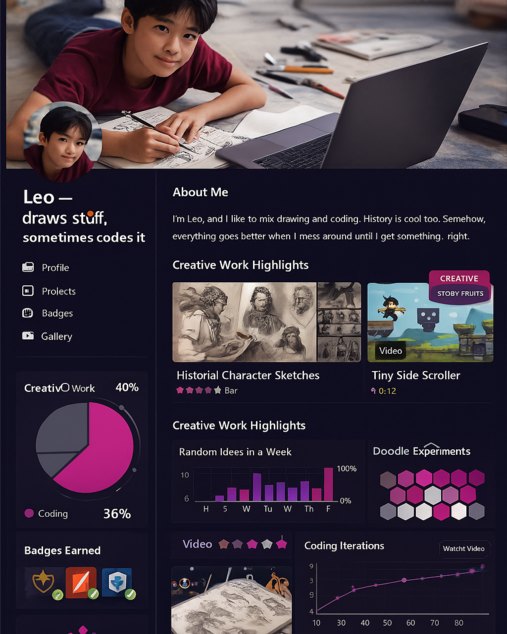
Leo: Defined and Motivated
Middle school. Core function: identity formation, reflection, and motivation, the earliest layer of a learner’s agentic memory.
Leo is 12 and likes coding, sketching, and history, but his teachers tell him he needs to “focus on one thing.” He feels guilty for jumping between hobbies and gets told he’s lazy because he can’t stick to a schedule. Leo would benefit from a digital record of his skills and experiences, but he’s also exactly the kind of student who would never voluntarily populate one. Not because he’s unmotivated, but because it doesn’t make sense to him yet. It’s hard to understand the lifelong utility of documenting a learning journey when you’re 12. To reach Leo, a tool has to be immersive, motivating, and help him find out who he is and what he’s good at, before it asks him to think about a resume.
When Leo turns 10 and gets access to his record for the first time, he doesn’t take a survey. He plays a mini-game where he has to choose how to solve a problem, and the app assigns him an archetype: “The Storm Chaser,” a learner who thrives in chaos and whose superpower is connecting things that don’t belong together. That reframe matters. It turns what his teachers call a weakness into a named strength.
From there, the record works by noticing, not interrogating, exactly the kind of Learning Coach agent described in the appendix that follows. When Leo sketches during math class instead of working, the system doesn’t scold him; it asks what triggered the flow state, and he learns to tell the difference between avoidance and inspiration. When he bombs a test, the system logs it as a setback and asks him where the breach was, and Leo realizes through his own reflection that the problem wasn’t that he’s dumb, it was test anxiety. When he uses geometry to make an art project look better, the system notices the overlap between two unrelated tags and rewards the synthesis. None of this is building Leo a credential for a job in 2032. It’s building him a mirror he can use to see himself clearly today, one only he and his family control.
Signals from the Future
- Learner Employment Records (LERs): portable, learner-owned records of growth and skills are already being piloted across states and platforms, including statewide efforts in places like North Dakota and Arkansas.
- Unbundled and credentialed systems: initiatives around the country are modeling citywide learning ecosystems with credentialed learning across sites.
- LearnCard’s Lifelong Learning Passport: an open-source digital wallet that connects to any system, designed for IDs, skills, and learning and employment records.
- SuperBetter: a gamified experience built to help people stay strong, motivated, and optimistic in the face of difficult challenges.

Jamie: Connected to Opportunity
Young adult. Core function: talent navigation, verification, and selective disclosure, the consent engine and non-derivative licensing made visible.
Jamie is 19 and has spent the last year studying cybersecurity and network resilience, then traveling to figure out whether that focus still fits. It does. To get a foothold, she needs a high-stakes internship, so she activates her Talent Navigator, an AI-powered tool that knows her entire skill architecture, built from years of her own inputs. It doesn’t just match keywords; it looks for culture and competency fit, at how she communicates and how she responds to failure. It flags a promising, local role at a cybersecurity firm, but with a catch: she’s only an 80% match, the kind of gap that would have gotten her filtered out by a keyword-matching system entirely.
Instead, her record does a gap analysis. It identifies the one credential she’s missing, points her to a four-week micro-course that closes it, and marks her public profile “In-Progress: Mastery Pending,” so the employer sees a self-directed learner anticipating a market shift instead of a rejected application. When she applies, no PDF resume gets generated. She goes to her own record and chooses exactly what to share: verified project work, a reflection on overcoming adversity in a team setting, even a travel journal that says something about who she is as a person. She sets the link to expire in 30 days, a revocable, purpose-bound share, not a one-time terms-of-service handoff. She stays the owner of her own story the entire way through the process, including in the interview itself, where instead of describing a time she handled pressure from memory, she pulls up a time-stamped, anonymized record of a real incident and lets the evidence speak.
Signals from the Future
- The Knowledge Society: a program that gives students rapid exposure to mindsets, emerging technologies, and global challenges, then asks them to build a solution to a purpose-driven problem.
- LivedX: a platform that lets students input their experiences and uses AI to process demonstrated durable skills into skills certificates that are exchangeable for college credit.
- SchoolJoy’s Nimo: an AI-powered simulation tool that uses voice conversations to assess performance, offer feedback, and make competency-based assessments against a predefined rubric.

Elena: Always Learning
Lifelong learner. Core function: interoperability, upskilling, and durable skills transfer, what a data exchange standard is actually for.
Elena is 45 and returning to work after her kids reached a more independent age. She’s told she’s been out of the workforce at a bad time, having missed several critical technological shifts, and her last resume is a monument to roles that no longer exist. But she’s had a personal record for a decade, quietly accumulating documentation of things that never made it onto a resume: her volunteer work coordinating a local food bank, her poetry, the party-planning and logistics she’s handled for her neighborhood for years. When she asks her record to look for roles where her skills make her a strong candidate, it doesn’t start from zero. It shows her the overlap between her lived experience and a real local opening, a Director of Logistics and Coordination role, and tells her she’s already a 70% match.
Elena enrolls in a few targeted courses through a state-sponsored lifelong learning fund, on her own schedule, and the moment she demonstrates mastery, the credential is issued directly to her record, moving with her the way Taylor’s dual enrollment credits should have. When it’s time to apply, her public profile blends the professional and the personal: a video walkthrough with testimonials from a community event she planned, an impact report from the food bank. Just as important, her record doesn’t only track output. It notices when she’s been working hard and nudges her toward rest instead of another course, treating balance itself as a competency worth logging rather than a gap on a timeline.
Signals from the Future
- The WGU Achievement Wallet from Western Governors University: a platform for skills identification, occupational alignment, career exploration, and credential management, tested with current students, employers, and non-completers.
- National reskilling investments: Singapore’s monthly allowance for mid-career training, France’s Compte Personnel de Formation training-credit accounts, Sweden’s Transition Study Support, and South Korea’s National Tomorrow Learning Card voucher system all point to lifelong learning infrastructure becoming a public commitment, not just a private one.
Why These Three Stories
Leo, Jamie, and Elena were chosen deliberately to stress-test LearnKit at its hardest points. Leo tests whether a record can matter to someone with no professional stakes yet, someone for whom “build your resume” is not a motivating pitch. Jamie tests whether a record can carry real weight in a high-consequence moment without becoming another surveillance tool a young adult has to negotiate. Elena tests whether a record built in childhood still means anything decades later, across a life that doesn’t move in a straight line. If the infrastructure only works for one of them, it isn’t done yet.
Appendix: A System of AI Agents
The future isn’t one AI agent. It’s a system of agents, where each has a clear role, the learner is in control, and data flows across contexts only with privacy and transparency built in.
Following are examples of possible learner-centered AI agents that could be developed as part of the LearnKit Alliance. For each of these examples, no single source of data is sufficient; each agent depends on stitching together institutional records, learner-provided data, and third-party signals via interoperable, permissioned access, compliant with the control layer described in the previous section. That layer would draw on a shared data infrastructure: a learner-controlled identity and wallet store built on standards like W3C Verifiable Credentials, interoperability through 1EdTech’s LTI, OneRoster, and xAPI, labor market feeds like O*NET and Bureau of Labor Statistics data, and learning content signals from providers like Khan Academy.
Every agent follows a simple contract: ask for the least data needed, be explicit about purpose, return value to the learner, allow revocation.
- The Learning Coach. Helps students understand how they learn, track progress, and stay motivated, building agency and self-awareness, not just performance. “You tend to master concepts faster when you mix practice and explanation, want to try that here?” Runs on coursework and assessment data, assignment-level feedback, learning app telemetry, and a learner’s own self-reports and reflections.
- The Pathway Navigator. Connects learning to real-world pathways, education, careers, and opportunities, making learning feel relevant and directional, especially for students who lack access to advising. “If you’re interested in climate work, here are three paths: policy, engineering, community organizing.” Runs on a learner’s profile and academic history, program and course catalogs, and labor market and pathway data.
- The Opportunity Scout. Continuously finds and filters opportunities like internships, scholarships, programs, and competitions, closing an information gap that’s a major driver of inequity. “This summer program matches your interest in biology, requires no prior lab experience, and is within 10 miles.” Runs on opportunity listings, eligibility criteria, deadlines, and a learner’s own profile, filtering out noise and scams along the way.
- The Skills Translator. Turns experiences, classes, projects, jobs, into clearly articulated skills, helping learners see their own value and communicate it. “Your history project demonstrates argumentation, research synthesis, and data interpretation.” Runs on a learner’s artifacts, rubrics and proficiency standards, teacher feedback, and existing credentials, building dynamic portfolios and profiles aligned to frameworks employers actually use.
- The Tutor and Explainer. Provides adaptive, personalized academic help, supporting equity of access to support, especially outside school hours. Explains concepts multiple ways, adjusts difficulty in real time, and identifies misconceptions and targets them directly. Runs on the current task, a learner’s prior mastery estimates, error patterns, and curriculum alignment.
- The Data Guardian. Manages what data is shared, with whom, and for what purpose, maintaining trust and learner ownership, critical for adoption of everything else on this list. “This scholarship requires access to your GPA and activities. Approve?” Shows audit trails of who accessed data and why, and recommends safer sharing options, running on the identity and wallet layer, app connectors, and policy engines.
- The Mentor Connector. Connects learners to real people, mentors, peers, advisors, preventing AI from replacing what matters most: human connection and social capital. “You might benefit from talking to someone in UX design, here are three mentors.” Prepares learners for conversations and helps them follow up, running on learner interests and goals, mentor profiles, and trust and safety signals.
- The Reality Checker. Checks bias and balance by challenging recommendations and preventing narrowing, protecting against algorithmic tunnel vision across the rest of the system. “You’ve been recommended STEM pathways frequently, do you want to explore creative fields too?” Runs on recommendation logs from all other agents, outcome data, and fairness benchmarks, flagging bias and encouraging exploration.
Appendix: The Ecosystem, Sources, and Acknowledgements
A map of the field already building toward this future, and a note on where this paper’s thinking comes from.
The LearnKit Ecosystem
LearnKit isn’t starting from zero. Pieces of this infrastructure, and the organizations that would need to align around it, already exist across the field. This is a representative map, not an exhaustive one.
Demand side. Learners, families, and cohort networks including special education advocacy groups like COPAA and The Arc, military family organizations like MCEC and Blue Star Families, first-generation student networks, and workforce intermediaries like JFF. Employers and employment systems including LinkedIn, major job platforms, and the US Chamber Foundation’s T3 Network. Behavior and engagement platforms like Duolingo, Roblox, and YouTube offer useful analogs for what habit-forming, learner-first design can look like.
Supply side, generated data. Learning platforms and ed-tech including Khan Academy and the Google Classroom ecosystem. Institutions that formally own data today: K-12 states and districts, community college networks, universities, and the National Student Clearinghouse. Informal and experience data from community programs, apprenticeships, and creator platforms.
Research and design. Organizations doing applied research and product design in this space include Education Design Lab, Digital Promise, and JFF, alongside measurement and insight organizations like Gallup and Strada Education Foundation.
Infrastructure and standards. 1EdTech (CLR, Open Badges), the W3C (Verifiable Credentials, decentralized identifiers), and HR Open Standards form the interoperability backbone. Wallet and credential systems already in the field include the Learning Economy Foundation’s LearnCard, the MIT Digital Credentials Wallet, and the ASU Trusted Learner Network.
Policy and governance. Privacy and data rights organizations like the Future of Privacy Forum, EPIC, and the Berkman Klein Center; higher ed and credential policy bodies like AACRAO and ACE; and workforce policy organizations working alongside them. The Multistate Longitudinal Data Exchange, a Gates-funded initiative housed at WICHE, is a working precedent that multi-state education data governance is operationally feasible, and it’s worth building on rather than starting from scratch.
