
For Learners
How do I build confidence and articulate value and capability?
The l/earners are the core users.



The ultimate beneficiary of this system is the learner. Evidence shows that students with valuable real-world and work-based learning experiences have greater confidence and often find more opportunities after (and before) graduation. The Center for Advanced Professional Studies (CAPS) Network, which immerses students in professional, problem-solving environments, found that learners “expressed high increases in overall confidence, resilience, self-knowledge and collaboration through the professional experiences they participated in.”
Research conducted at the University of North Texas on the impact of credentialing experiences found that the very process of receiving these credentials “increases their self-efficacy. It increases their resilience”. This psychological benefit had tangible academic outcomes, including “GPA increases” and a “stronger likelihood of people returning to their degrees because they were getting these things and starting to see the real-life applicability.”
This is the first step in a powerful causal chain:
- A learner participates in a high-quality, designed experience (Design Layer).
- That experience is validated using a structured framework, like the progression of experience above (Evaluation Layer).
- The learner evaluates themselves and the experience through the language of the framework to articulate their own growth (Storytelling Layer).
This intentional process of validation and articulation is what builds confidence and self-efficacy. We are not just credentialing skills; we are empowering learners to recognize, own, and communicate their own value. And, perhaps most importantly, we’re teaching them how to do it again and again. After learning the language and increasing skill visibility, learners are better able to self-evaluate their own experiences as they navigate through a multitude of learning environments and experiences.
Validating Lived Experience
Valuable learning experiences happen to all of us, all the time, but it is difficult to capture them and understand how transferable skills are developing in the process. Unfortunately, traditional transcripts often neglect skills and lived experience, relegating them to a line item under “Extracurriculars” or some other periphery. Consider “Maria,” who started a non-profit to teach coding.
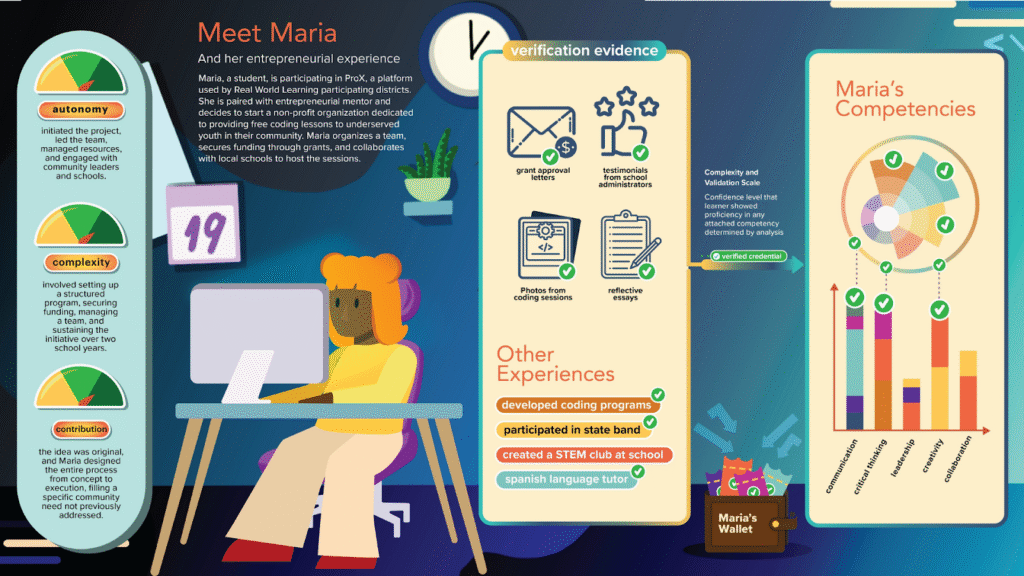
| Anchor | Maria’s Experience Evaluation | Verification Evidence |
|---|---|---|
| Autonomy | Level 3 (Apply): “Some agency. Initiated the project, helped manage resources, engaged with community leaders…” | • Grant approval letters • Testimonials from school administrators |
| Contribution | Level 3 (Apply): “Was the sole contributor to the project. Led the team, managed resources, engaged with community leaders…” | • GitHub coding examples from the work • Testimonials from school administrators |
| Complexity | Level 3 (Apply): “Complex. Involved setting up a structured program, securing funding, managing a team, and sustaining the initiative over two school years.” | • Reflective essays written by Maria • Photos and videos from coding sessions |
By analyzing the submitted evidence against the anchors, AI tools can provide a high confidence rating in competencies like leadership, problem-solving, and community engagement across different contexts and domains. This will give a better picture of how transferable Maria’s skills are in different contexts, as well as showing how much they have developed and grown across different experiences.
While Maria is demonstrating a Level 3 on the above anchors, she is approaching SFIA’s Level 4 (Enable). There is no age or time-bound ceiling; rather, certain experience types lend themselves more naturally to different levels.
This validated record is now stored in Maria’s digital wallet and has real currency for communicating capability. For higher education admissions, universities interested in students with proven leadership and community service skills highly regard her application. For employment, companies looking for young leaders with experience in managing projects and teams might reach out to her for intern roles. Her lived experience is no longer an invisible anecdote; it is a validated, high-value asset.
The Storytelling Layer: Owning the Narrative
Everyone has had the experience of asking a young person, “What did you learn today?” or “How was your day?” at the dinner table, only to hear *crickets* or the ever enlightening “fine.” What would it take to turn these responses into a data-rich recap of growth and learning?
Without the time to reflect, the scaffold to hang your experiences upon, and insight into which part of your story they want to hear, it’s no wonder that this question is often left rhetorical. For informal moments like this, or more formal moments like a job interview, learners need to learn how to prompt themselves all along the learning journey, reflecting over and over again upon growth, what they care about, where they’ve failed, and what they’re good at.
Similarly, educators and all school staff members (families too) need to become facilitators of story, key places of reprieve along each individual learning journey for reflection and digging deeper. We all need to become journalists, unpeeling the onion of learning one layer at a time.
Using this framework, a learner doesn’t just say “I had an internship.” Rather, they might say, “They pretty much let me run things on my own after the first week. I handled all the daily stuff, like scheduling and customer questions. I only had to ask my boss for help when something really weird or new came up.” With the anchor being visible to all parties, this helps map the learner’s experience to real and transferable criteria.
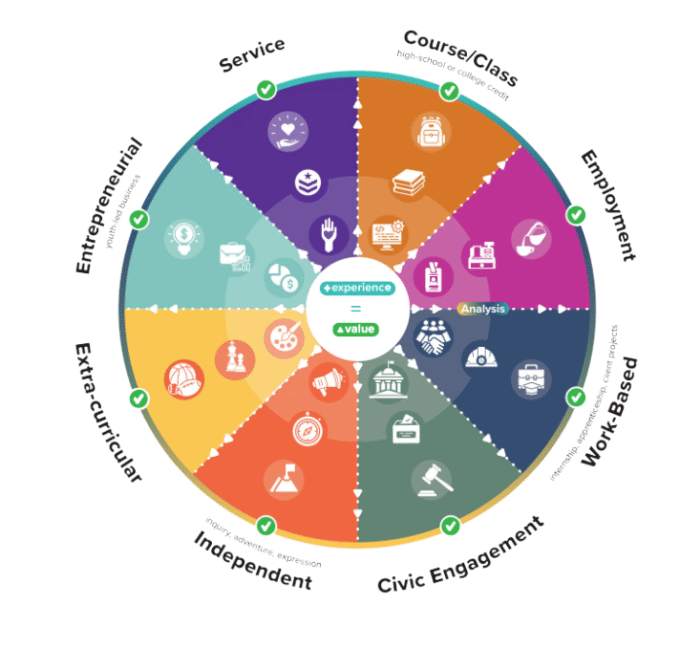
A key part of this work is the validation of experiences beyond just those in the workplace, this increases the recognition of a wide variety of life and experience, thereby increasing access to high-powered learning experiences. Check out this publication to see how states are expanding access to real world learning experiences and to better understand how the proposed framework might apply to a wide range of experience types.
